
Official statement
Other statements from this video 4 ▾
- □ Why does user and competitive analysis really make or break your SEO strategy?
- □ Should you really adapt your content to match the exact vocabulary of your target audience?
- □ Does Google really require you to remove 'fluffy content' from your pages to rank higher?
- □ Does complex SEO really matter to rank on Google, or is simplicity enough?
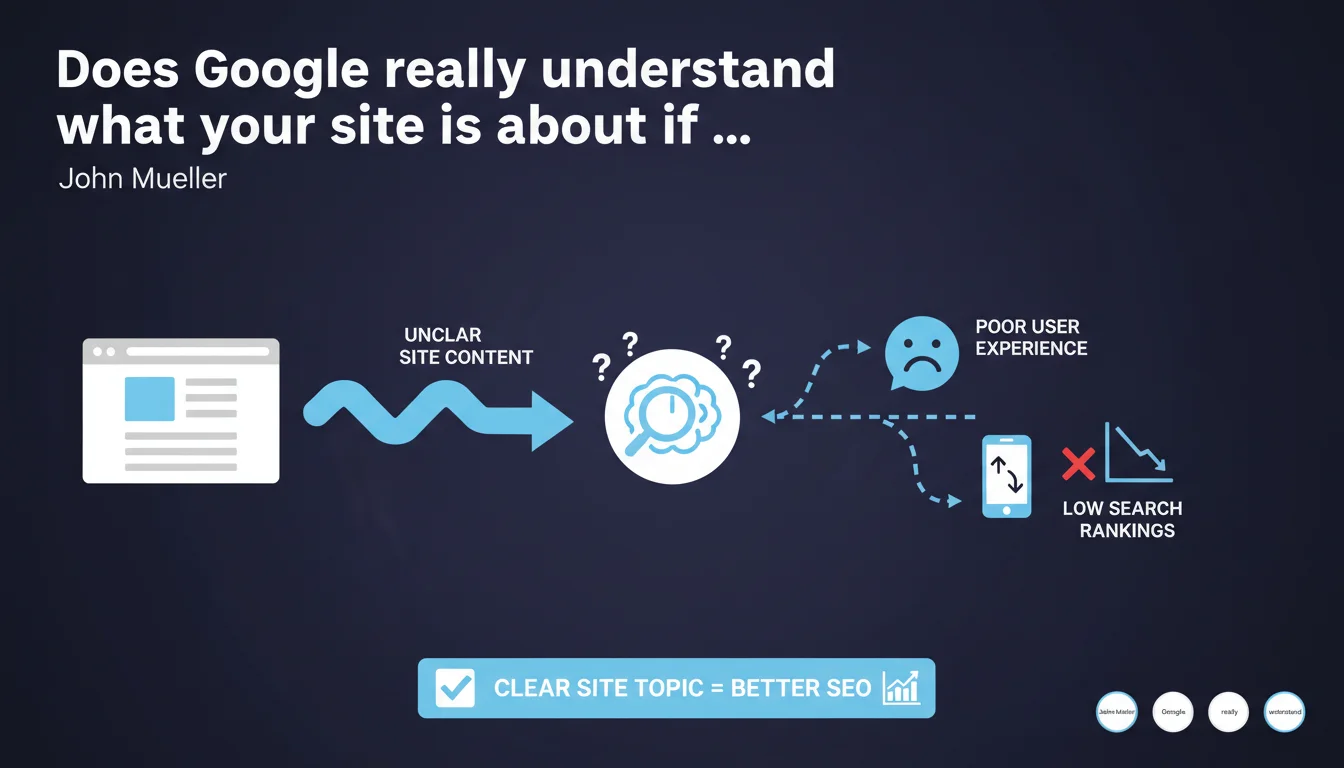
Mueller reminds us that too many sites remain vague about their main topic, which confuses Google and harms user experience. The algorithm can't guess what you want to rank for — you need to spell it out with consistent and explicit signals.
What you need to understand
John Mueller points out a problem we still see daily on corporate or e-commerce sites: the lack of thematic clarity. The search engine needs to quickly identify your main topic to position you correctly.
It's a statement that may seem basic, but it reveals a reality: Google doesn't like to interpret. If your signals are contradictory or diluted, you lose visibility.
Why do so many sites remain unclear about their topic?
Several reasons explain this lack of clarity. Many corporate sites try to cast a wide net for fear of losing traffic. Result: "jack-of-all-trades" pages with no clear angle.
Others suffer from poor information architecture — internal linking doesn't guide the engine, title/meta tags change tone from page to page, the H1 doesn't match the actual content. Google ends up facing an incoherent puzzle.
What does "making a topic obvious" mean in practical terms?
This involves semantic coherence throughout your entire site. Your titles, anchor texts, HTML structure, and text content should all point to the same theme.
Mueller is talking here about both architecture and copywriting. A clear site has stable vocabulary, well-defined thematic silos, and doesn't mix five topics on the homepage.
- Semantic coherence between title, H1, meta description, and content
- Silo architecture to isolate each main theme
- Strategic internal linking that reinforces pillar pages
- Stable vocabulary and homogeneous lexical field across pages in the same silo
- Avoid dilution by tackling too many topics simultaneously on the same page
SEO Expert opinion
Is this statement consistent with real-world observations?
Absolutely. We see it in audits: sites that clarify their thematic positioning gain visibility without touching link building. Refocusing a vague homepage around a specific topic often improves CTR and rankings.
However, Mueller remains vague on one point: he doesn't say at what level of granularity Google expects this clarity. Is it at the site level? The page level? The paragraph level? The answer varies by context, and it's frustrating that he doesn't clarify. [To verify]
In what cases doesn't this rule fully apply?
Generalist sites (media, marketplaces) can't afford a single topic. There, hermetically sealed silo structure does the job — each category should be treated as a mini-thematic site.
For transactional sites (pure-play e-commerce), clarity relies less on "topic" than on commercial intent. A shoe shop doesn't need to philosophize about shoemaking — it just needs to make it obvious that it sells shoes. Important nuance.
What nuances should we add to this advice?
Mueller talks about "poor user experience," but let's be honest — a site can be UX-friendly and still unclear to Google. The two don't always overlap. A minimalist homepage with two CTAs can please users but provide no exploitable semantic signals to the crawler.
The other nuance: making a topic obvious doesn't mean stuffing keywords. Clarity comes through structure, context, linking — not raw lexical density. Some will misinterpret this advice and revert to old-school keyword stuffing.
Practical impact and recommendations
What should you do concretely to clarify your topic?
Start with a semantic coherence audit. Take your 20 strategic pages and compare titles, H1s, meta descriptions. If you can't immediately identify the main topic by reading these elements, neither can Google.
Next, verify your internal linking. Link anchor texts should reflect the theme of target pages. If your anchors are generic ("click here," "learn more"), you're missing an opportunity to reinforce clarity.
What mistakes should you absolutely avoid?
Don't mix multiple topics on the same "pillar" page. A page that covers SEO, digital marketing, and social media without clear hierarchy will dilute its signals. Better to have three distinct, well-targeted pages.
Also avoid changing your title from page to page without apparent logic. If your homepage talks about "digital solutions" and your internal pages about "digital transformation consulting," Google struggles to identify a red thread.
How do you verify that your site is sufficiently clear?
Test the 5-second method: show your homepage (and key pages) to someone unfamiliar with your business. If they can't say in 5 seconds what you do, Google will have the same problem.
Also use semantic extraction tools (Semrush Topic Research, Ahrefs Content Explorer) to verify that your main pages rank well on your target queries. If your pages rank for off-topic terms, that's a red flag.
- Audit coherence between title / H1 / meta description on strategic pages
- Verify that vocabulary remains homogeneous within each thematic silo
- Check internal linking anchors — ban generic anchors
- Test immediate topic comprehension (5-second method)
- Analyze current rankings to detect thematic drift
- Restructure into silos if multiple topics coexist without clear hierarchy
- Avoid "catch-all" pages that mix too many themes
❓ Frequently Asked Questions
Est-ce que clarifier mon sujet principal peut faire baisser mon trafic sur d'autres requêtes ?
Google peut-il pénaliser un site qui reste volontairement flou ?
Le maillage interne suffit-il à clarifier un sujet ou faut-il réécrire tout le contenu ?
Les sites multi-thématiques (médias, marketplaces) doivent-ils aussi clarifier un sujet principal ?
Comment savoir si mon sujet est trop large ou trop étroit ?
🎥 From the same video 4
Other SEO insights extracted from this same Google Search Central video · published on 17/08/2023
🎥 Watch the full video on YouTube →
💬 Comments (0)
Be the first to comment.