
Official statement
What you need to understand
What exactly is the scope of this statement from Google?
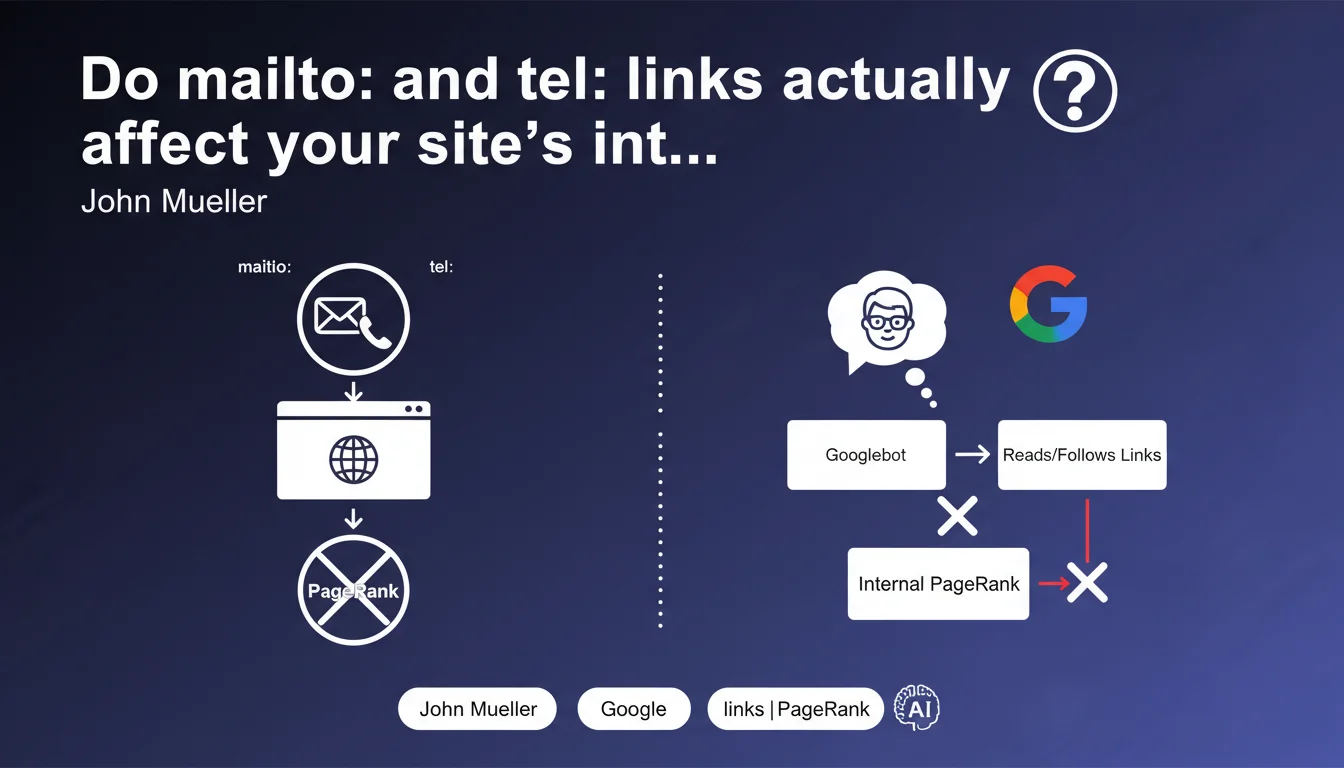
Google has officially confirmed that mailto: and tel: links are neither read nor followed by its indexing robots. This clarification is important because it removes any ambiguity about how these specific types of links are treated.
Concretely, this means that these links are completely ignored by the algorithm when crawling your pages. They therefore have no impact on Googlebot's behavior.
Why does the question of internal PageRank matter?
Internal PageRank refers to the distribution of link equity between pages of the same site. Each link present on a page theoretically dilutes this authority among all linked destinations.
So the real question was: do mailto: and tel: links consume a share of this PageRank? The answer is no, and that's excellent news for internal linking optimization.
How does Google technically handle these links?
These links use different protocols (mailto: and tel:) from the standard HTTP/HTTPS protocol. Google simply considers them as functional elements for the user, with no value for SEO.
The indexing robot detects them but does not analyze them, does not follow them, and does not integrate them into its authority distribution calculations. They are treated as if they didn't exist from an SEO perspective.
- mailto: and tel: links are completely ignored by Googlebot
- They do not consume internal PageRank
- They do not dilute the authority transmitted to other links on the page
- Their presence has no negative impact on internal linking
- They obviously remain functional and useful for users
SEO Expert opinion
Is this statement consistent with practices observed in the field?
Absolutely. SEO professionals had never observed any measurable impact of these links on SEO performance. This official confirmation simply validates what had been observed empirically for years.
However, the clarification about internal PageRank brings new value. Some SEOs might have thought that a page with numerous mailto: or tel: links would dilute its authority, even if these links weren't followed. That's not the case.
What implications does this have for site architecture?
This clarification frees webmasters from a potential constraint. You can now place clickable contact information without any negative SEO afterthought.
It also means that in your internal linking optimization calculations, you should not count these links. A page with 10 HTTP links and 5 mailto: links really only has 10 links in the SEO sense of the term.
Are there any special cases to consider?
The only situation that could cause confusion concerns hybrid links. Some sites use HTTP links that redirect to messaging or telephony applications. In this case, the first HTTP link is indeed followed by Google.
Similarly, contact buttons that use JavaScript to trigger an action are not covered by this statement. Their SEO impact depends on their specific technical implementation.
Practical impact and recommendations
What should you actually do on your site?
First, don't hesitate to use mailto: and tel: links wherever it's relevant for user experience. In your header, footer, contact pages, or product sheets, these links improve navigation without SEO penalty.
Second, if you had limited their use for fear of PageRank dilution, you can now add them freely. Accessibility and user experience should take priority over unfounded SEO concerns.
How can you optimize your internal linking with this information in mind?
During your internal linking audits, systematically exclude mailto: and tel: links from your counts. Focus your analysis only on HTTP/HTTPS links that actually transmit PageRank.
If you use analysis tools like Screaming Frog or Sitebulb, configure them to filter these protocols. This will give you a more accurate view of the real authority distribution on your site.
- Add clickable mailto: and tel: links on all your contact and contact information pages
- Never count these links in your internal linking calculations
- Configure your SEO audit tools to exclude mailto: and tel: protocols
- Review your high-value SEO pages to maximize internal HTTP links rather than "wasting" them on contact links
- Document this rule in your internal SEO guidelines for your team
- Verify that your CMS or templates don't use HTTP redirects to mailto: (which would consume PageRank)
💬 Comments (0)
Be the first to comment.