
Official statement
What you need to understand
Why isn't the quality of the source site enough to qualify a link?
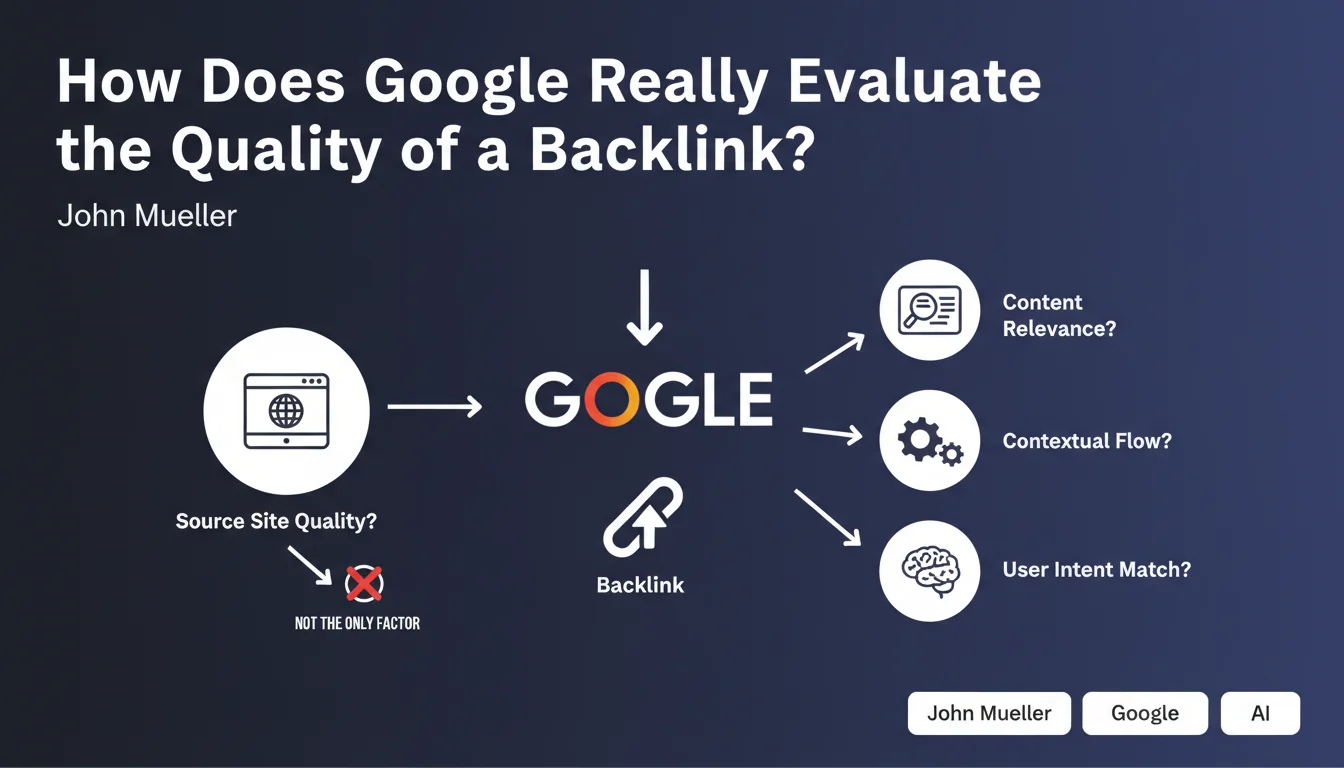
Google uses a multifactorial algorithm to evaluate the value of a backlink. Contrary to popular belief, obtaining a link from a high-authority site does not automatically guarantee a significant SEO benefit.
The search engine analyzes the specific context of the link: its placement on the page, its thematic relevance, and associated behavioral signals. A link in the footer of a reputable site may thus be worth less than a contextual editorial link from a lower-authority site.
What criteria actually determine the quality of a link?
Beyond domain authority, Google examines several qualitative dimensions. The link anchor indicates thematic relevance and the semantic context of the recommendation.
Placement on the page plays a crucial role: a link in the main editorial content transmits more value than an isolated link in the sidebar. Thematic consistency between the source page and target page also amplifies the positive impact.
- Link anchor: indicator of semantic relevance
- Contextual placement: position in editorial content vs peripheral areas
- Thematic consistency: alignment between the subject of the source page and target page
- User behavior: click-through rate and engagement on the link
- Link environment: quality and relevance of surrounding content
Does this approach change how you should evaluate your link profile?
This statement requires a granular analysis of each backlink rather than a superficial evaluation based solely on domain metrics. Traditional SEO tools mainly measure the overall authority of sites.
An effective backlink audit must now integrate contextual analysis: where does the link appear, how is it anchored, what is the theme of the source page. This complexity requires expert insight and advanced analysis tools.
SEO Expert opinion
Is this statement consistent with real-world observations?
Absolutely. Empirical testing has confirmed for years that the impact of a backlink varies considerably depending on its context. I've observed cases where links from DR 30-40 sites (well-placed, well-anchored) outperformed links from poorly integrated DR 70+ sites.
Mass link-building based solely on domain authority shows disappointing results. Conversely, targeted strategies prioritizing contextual relevance generate measurable gains, even with fewer links.
What nuances should be brought to this analysis?
The weighting of criteria varies by sector. In YMYL niches (health, finance), the authority of the source domain regains predominant weight for trust reasons. Anchor and placement remain important but don't compensate for an authority deficit.
Temporal context also matters. A link on a freshly published page that is actively promoted can transmit more value than a static link on an old, rarely visited page. Google integrates engagement and freshness signals.
What are the most impactful criteria in my experience?
The link anchor remains the most powerful signal for transmitting thematic relevance, provided it's natural and varied. An over-optimized anchor profile triggers penalties, even from quality sites.
Placement in editorial content comes in second: a link naturally integrated into a 1500+ word paragraph transmits significantly more value than an isolated link. Scroll depth and link visibility also influence its evaluation.
Practical impact and recommendations
How can you effectively audit the contextual quality of your backlinks?
Go beyond domain authority metrics. For each significant backlink, manually examine the context: open the source page and evaluate thematic relevance, quality of surrounding content, and link placement.
Create a multi-criteria evaluation grid: domain authority (20%), thematic relevance (25%), anchor quality (25%), contextual placement (20%), engagement signals (10%). This weighting will give you a more realistic view of your profile's value.
What priority actions should you implement in your link-building strategy?
Systematically prioritize contextual quality over quantity. A link obtained through relevant editorial contribution is worth 10 times a directory link, even if domain authority is similar.
Diversify your anchors while respecting a natural ratio: 40-50% brand/URL, 30-40% generic, 10-20% optimized. Negotiate with partners for placement in the body of content rather than in peripheral areas.
- Manually analyze the 50 most recent backlinks to evaluate their real context
- Identify and disavow links from thematically irrelevant pages
- Prioritize guest-blogging opportunities on thematically aligned sites
- Systematically negotiate contextual editorial placement for new links
- Vary anchors according to a natural ratio (avoid over-optimization)
- Document the contextual quality of each link obtained (not just the domain's DR)
- Review partnerships that systematically produce footer/sidebar links
- Create linkable content (studies, original data) to attract natural editorial links
How can you avoid common mistakes in backlink evaluation?
Never rely solely on SEO tool metrics. A high DR sometimes masks poor contextual quality links. Conversely, low DR sites can offer excellent opportunities if thematic relevance is strong.
Avoid automated link-building services that promise hundreds of links from high-authority sites. These approaches completely ignore context, creating an artificial profile that Google penalizes increasingly effectively.
💬 Comments (0)
Be the first to comment.