
Official statement
What you need to understand
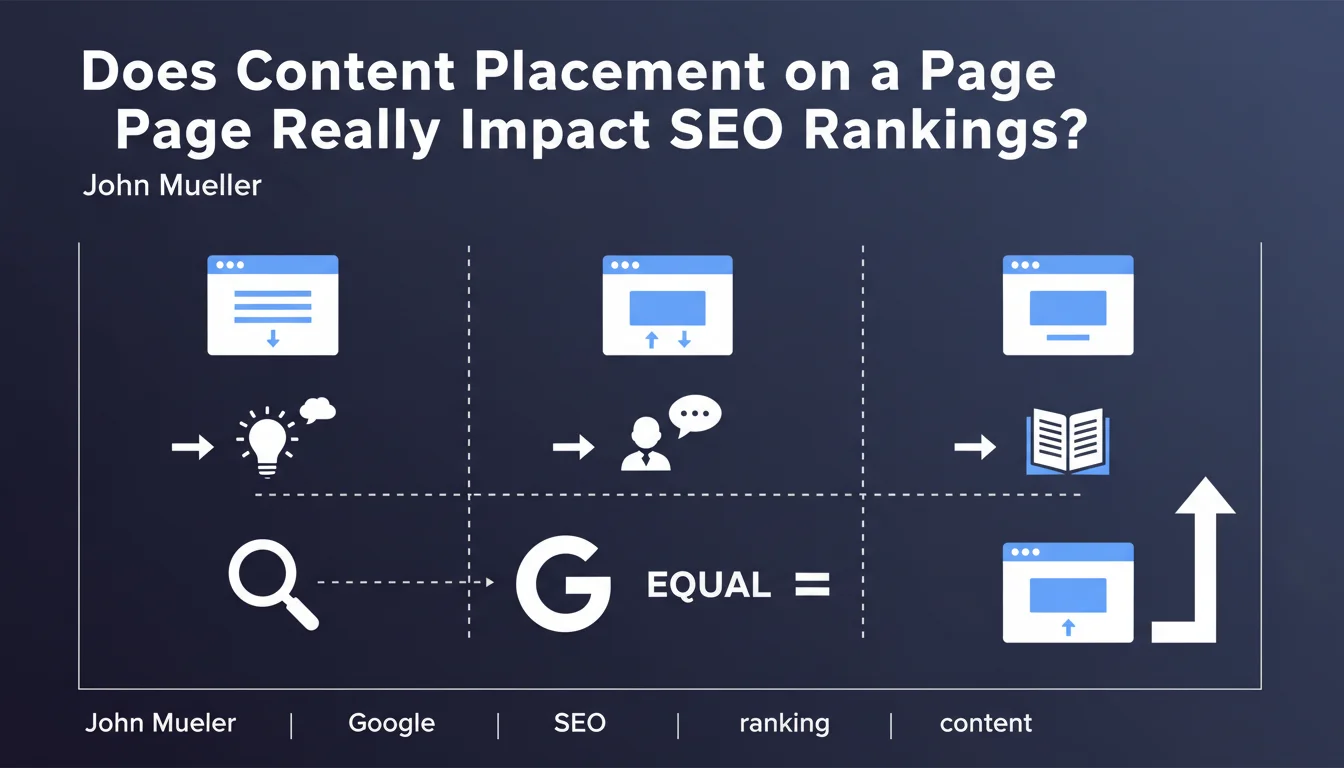
John Mueller from Google has clarified a question that's been debated for years: the geographical position of text on a page (top, middle, or bottom) doesn't affect its importance in Google's eyes. Relevant and interesting content will be analyzed the same way, whether it's placed at the beginning or end of the page.
This statement specifically concerns the main editorial zone of the page. It doesn't apply to structural elements like the header, footer, sidebars, or navigation menus, which have always been treated differently by algorithms.
For SEO practitioners, this means that content quality and relevance take precedence over its vertical position on the page. Google relies on semantic and contextual signals rather than simple geographical positioning.
- The vertical placement of editorial content is not a direct ranking factor
- Relevance and quality remain the determining criteria
- Structural zones (header, footer, sidebar) are still treated differently
- This approach reflects the growing sophistication of Google's algorithms
SEO Expert opinion
This statement is generally consistent with field observations from recent years. The era when systematically placing keywords at the top of the page guaranteed better rankings is over. Modern algorithms, particularly with BERT and MUM, understand the overall context of a page.
Nevertheless, important nuances need to be addressed. While Google doesn't penalize content placed at the bottom of the page, user experience remains crucial. Essential content relegated too far down can increase bounce rate, which indirectly impacts SEO. Additionally, the DOM and HTML rendering order can influence Googlebot's initial understanding of the page.
In practice, we also observe that semantic proximity between different content elements matters more than their absolute position. A paragraph at the bottom of the page but strongly related to the main topic can have more value than generic text placed at the top.
Practical impact and recommendations
Following this official clarification, here are the concrete actions to implement in your SEO strategy:
- Prioritize editorial logic: structure your content according to a natural narrative flow rather than forcing key information to the top of the page
- Optimize for user experience: ensure that essential information remains quickly accessible, even if its position doesn't directly impact SEO
- Check the DOM order: even if visual position matters little, the order in the HTML code should remain logical for crawling
- Don't sacrifice conversions: calls to action and critical information should remain visible without excessive scrolling
- Avoid artificial stuffing: no longer systematically repeat your keywords in the introduction if it's not natural
- Test different structures: take advantage of this freedom to A/B test innovative content architectures
- Maintain semantic consistency: ensure that each section, regardless of its position, remains relevant to the main topic
💬 Comments (0)
Be the first to comment.