
Official statement
What you need to understand
What Does This Statement from John Mueller Really Mean?
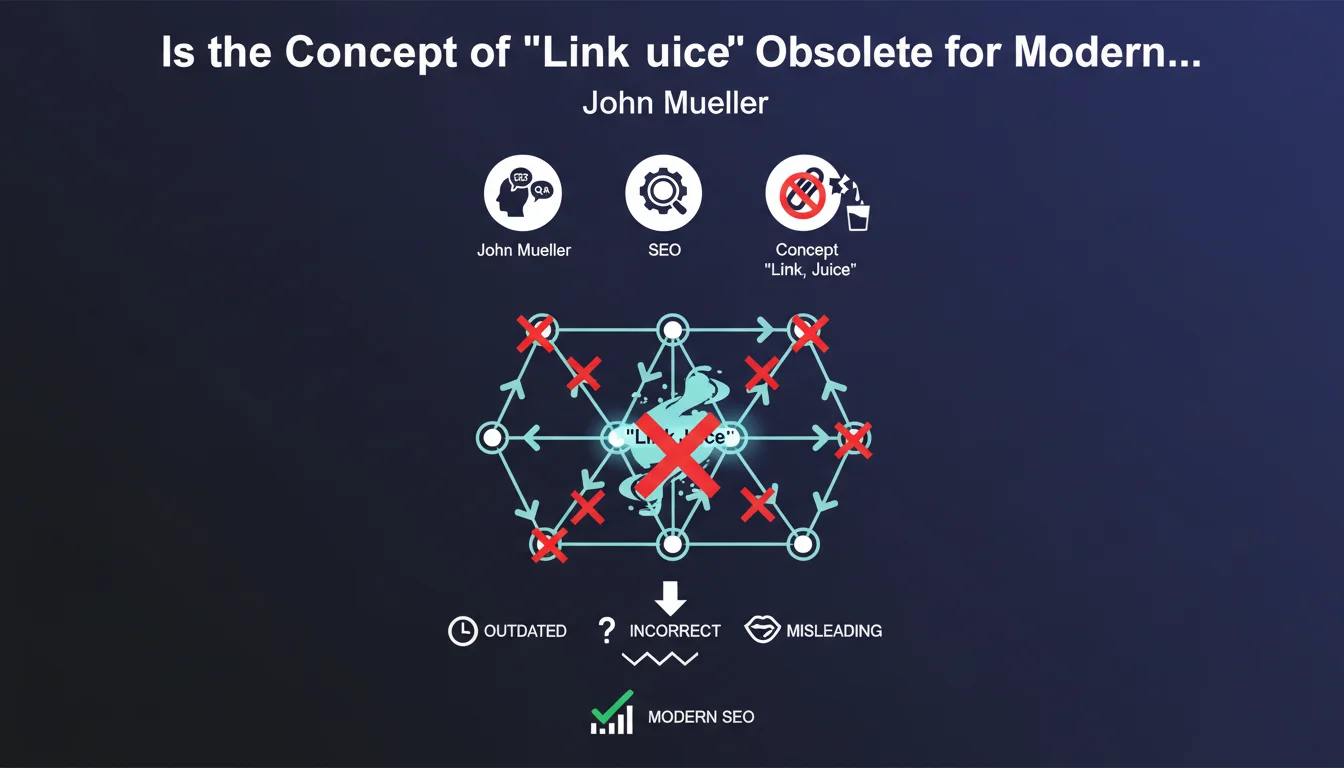
John Mueller is challenging the concept of "link juice", this metaphor popularized in the 2000s to explain how authority is transmitted between pages via links. His statement suggests that our current understanding of this mechanism is probably outdated.
This position comes at a time when Google's algorithms have evolved considerably. Simplistic models of authority transmission no longer reflect the complexity of current ranking systems based on machine learning.
Why Would This Vision of Internal Linking Be Obsolete?
The classic Link Juice model was based on a simplified hydraulic vision: a fixed amount of authority being divided among all links on a page. This approach ignores the many factors that Google now integrates into its evaluation.
Today, Google analyzes the semantic context of links, thematic relevance between linked pages, user behavior, and hundreds of other signals. Authority transmission is no longer a simple mathematical division calculation.
What Aspects Have Become Misleading in the Old Model?
Old practices consisted of mechanically optimizing the number of links per page, using nofollow tactically to "sculpt" PageRank, or creating rigid silo structures. These techniques have lost their effectiveness.
- Nofollow became a simple hint in 2019, not an absolute barrier
- The quality and contextual relevance of links take precedence over their raw quantity
- Behavioral signals can compensate or amplify the effect of internal links
- Google can ignore links it deems unnatural or manipulative
- Architecture must serve the user before serving the bots
SEO Expert opinion
Is This Statement Consistent with What We Observe in the Field?
Yes and no. While the term "Link Juice" is indeed an excessive simplification, the fundamental principle of authority transmission remains observable and measurable. SEO tests show that internal linking still significantly influences rankings.
What Mueller is probably criticizing is the mechanistic and dated vision of this phenomenon, not the concept itself. Professionals who get results no longer talk about "juice" but about relevance, crawl depth, and user experience.
What Important Nuances Should Be Added to His Statement?
Mueller is right that outdated content dominates the French-speaking web on this subject. Many articles recycle advice from 15 years ago without updating. However, rejecting the entire concept outright would be a strategic mistake.
Authority transmission still exists, but it operates in a much more sophisticated ecosystem. Internal links remain a powerful lever, but their effectiveness now depends on multiple contextual and qualitative factors.
In Which Cases Do the Old Recommendations Remain Valid?
Some fundamental principles stand the test of time: linking your important pages from the homepage, creating logical navigation paths, avoiding orphan pages, using descriptive anchors. These basics remain relevant.
It's the obsession with mathematical distribution calculations and micro-technical optimizations that have become counterproductive. The modern approach favors user-centric architecture and thematic coherence.
Practical impact and recommendations
What Should You Actually Do with Your Internal Linking Today?
Abandon purely calculative approaches like "not exceeding X links per page" or "evenly distributing authority." Instead, adopt a vision centered on content discoverability and user experience.
Focus on contextual relevance: link thematically related content, use natural and descriptive anchors, facilitate logical user journeys. Google will naturally reward this qualitative approach.
- Audit your linking to identify strategic pages that are poorly linked
- Create links from your high-authority pages to those you want to boost
- Use varied and contextual anchors, not mechanical repetitions
- Structure your content into coherent thematic clusters
- Monitor crawl depth with Search Console
- Eliminate internal links to non-strategic pages from your key pages
- Test the impact of your modifications on segments of similar pages
What Critical Mistakes Must Be Absolutely Avoided?
Don't fall into the trap of mechanical over-optimization. Overly artificial patterns (all your articles with exactly 3 internal links, identical over-optimized anchors) can trigger algorithmic filters.
Also avoid completely neglecting linking on the grounds that Mueller criticizes the concept. The absence of an internal linking strategy penalizes the discoverability of your content and its ability to rank.
How Can You Verify the Effectiveness of Your Current Strategy?
Use Google Search Console to analyze which pages receive the most crawling and impressions. Compare with your strategic pages: are there discrepancies? Important content that's poorly discovered?
Conduct A/B tests on groups of similar pages: strengthen linking to one group, leave the other as a control, and measure the evolution over 2-3 months. This empirical approach is better than any theory.
💬 Comments (0)
Be the first to comment.