
Official statement
What you need to understand
What is Google's official position on licensed images?
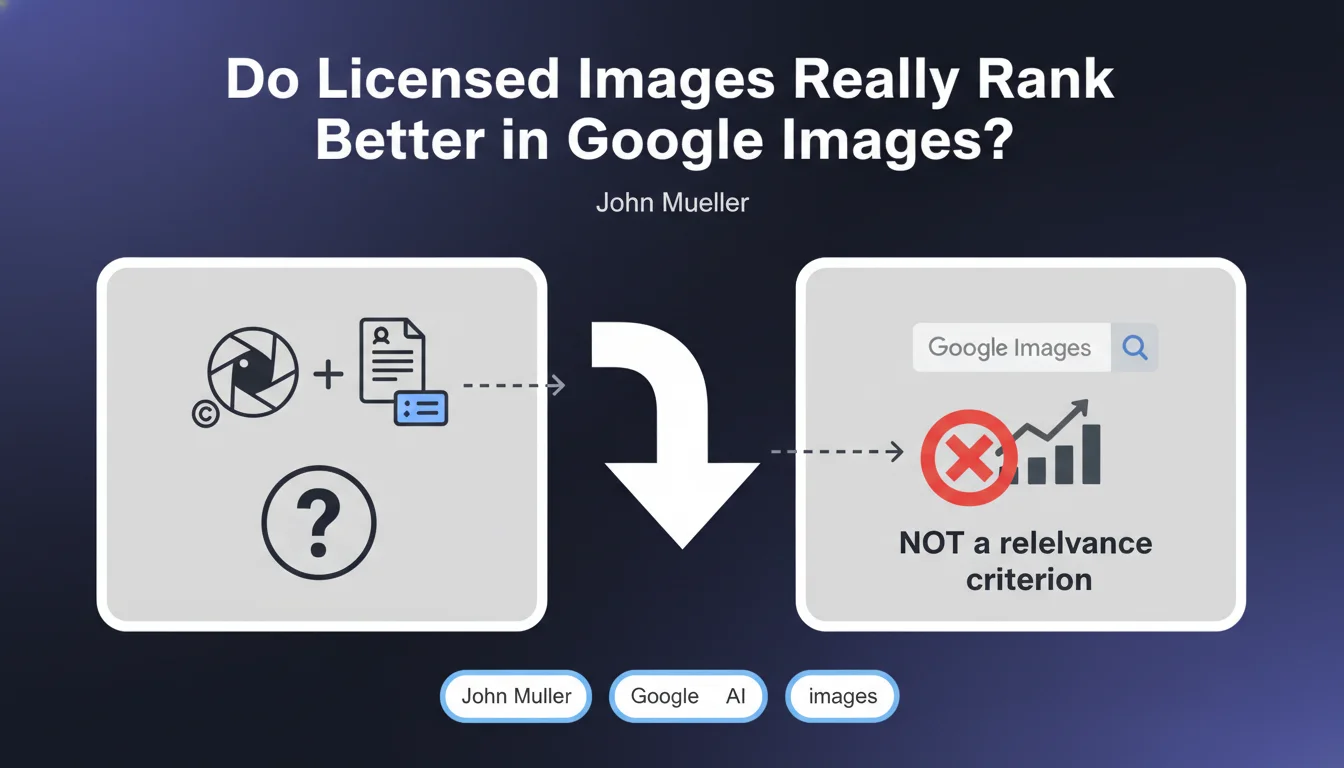
Google has clarified its position: an image's license status is not a ranking criterion in Google Images. Whether an image is copyrighted, royalty-free, or available under a specific license (Creative Commons, GPL, etc.) does not influence its visibility in search results.
This statement is important because it puts an end to a widespread confusion within the SEO community. Many professionals believed that adding license metadata could improve the positioning of their images.
Why does Google offer a report on image licenses in Search Console then?
The existence of a dedicated report for image license structured data in Search Console does not mean that this information influences rankings. Google collects this data for other purposes, notably to allow users to filter results according to usage rights.
The goal is to improve user experience by enabling the discovery of reusable images, without this impacting the relevance algorithm itself.
What's the difference between a ranking criterion and a user filter?
It is crucial to distinguish algorithmic ranking criteria from user filters. License data allows users to specifically search for royalty-free images, but provides no advantage in default rankings.
- No SEO advantage: adding a license doesn't boost your images in results
- Better user experience: license metadata helps users find reusable images
- Targeted visibility: your images appear in license-based search filters
- Legal transparency: license information clarifies usage rights
SEO Expert opinion
Is this statement consistent with field observations?
As an SEO expert, this clarification from Google does indeed correspond to what we observe in the field. Images that rank well in Google Images do so thanks to traditional factors: contextual relevance, quality alt text, host page authority, and technical performance.
Top-ranking sites haven't systematically filled in license structured data. Conversely, adding this metadata alone has never resulted in significant ranking improvements in our tests.
What nuances should we add to this statement?
Although license is not a direct ranking criterion, it can have an indirect impact on your visibility. If a user specifically filters results to find Creative Commons licensed images, your properly tagged images will appear in this subset of results.
Furthermore, transparency about licenses can improve user trust and potentially increase engagement, which could indirectly influence other behavioral signals.
In which cases is this metadata still recommended?
If you manage a stock photo site, a visual resource platform, or any site offering reusable images, implementing license structured data remains relevant. It facilitates the discovery of your content by users specifically looking for free or licensed images.
For e-commerce sites, blogs, or traditional media with primarily illustrative images, the implementation effort generally doesn't provide significant return on investment in terms of pure SEO visibility.
Practical impact and recommendations
Should you implement license metadata on your images?
The answer depends on your business model and objectives. If you monetize your images or want them to be found by users looking for reusable content, implementation is justified. Otherwise, focus your efforts on higher-impact optimizations.
For a typical website, it's better to prioritize the fundamentals: descriptive alt texts, optimized file names, image compression, relevant textual context, and quality user experience.
Which image optimizations should you prioritize for SEO?
Rather than focusing on licenses, invest in the genuine performance drivers for Google Images. These elements have a proven impact on your rankings and traffic.
- Optimize alt texts with precise, natural descriptions incorporating your target keywords
- Name your files intelligently with descriptive terms rather than IMG_1234.jpg
- Compress your images to improve loading speed without sacrificing visual quality
- Use modern formats like WebP to optimize file size while maintaining quality
- Create rich textual context around your images with captions and relevant content
- Implement an image sitemap to facilitate indexing of your visuals
- Ensure mobile compatibility with responsive images adapted to different screens
- Avoid lazy loading on primary images to guarantee their indexation
How should you prioritize your image SEO optimization efforts?
Focus first on high-impact optimizations: technical performance, semantic relevance, and quality of surrounding content. These elements generate measurable results quickly.
License metadata can be added later if your content strategy justifies it, but should never be a priority at the expense of fundamentals.
💬 Comments (0)
Be the first to comment.