
Official statement
Other statements from this video 10 ▾
- 1:07 Crawling et indexation : pourquoi Google insiste-t-il sur la distinction entre ces deux processus ?
- 1:37 Le nouveau rapport de crawl dans Search Console rend-il vraiment les logs serveur obsolètes ?
- 2:39 Pourquoi les grands sites doivent-ils repenser leur stratégie de crawl ?
- 2:39 HTTP/2 pour le crawl Google : faut-il vraiment s'en préoccuper ?
- 3:40 Faut-il vraiment utiliser la demande d'indexation manuelle dans Search Console ?
- 3:40 Faut-il vraiment arrêter de soumettre manuellement vos pages à Google ?
- 4:14 Comment le nouveau rapport de couverture d'index de Search Console va-t-il changer votre diagnostic d'indexation ?
- 4:45 Faut-il vraiment renoncer à acheter des liens pour son SEO ?
- 5:15 Le contenu créatif est-il vraiment la clé pour obtenir des backlinks naturellement ?
- 5:46 Faut-il migrer vers le nouveau test de données structurées après la dépréciation de l'ancien outil Google ?
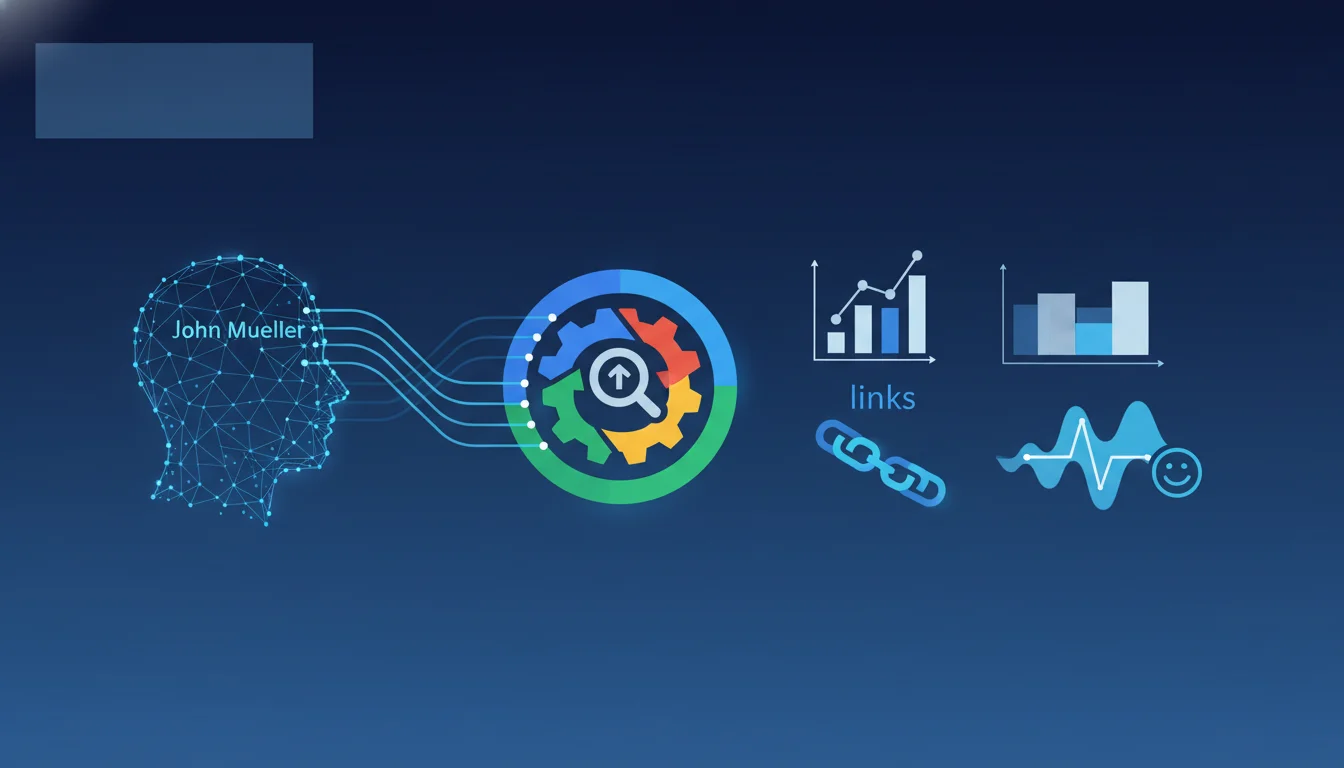
Google confirms that links play a dual fundamental role: discovering new pages and understanding their context within the web ecosystem. Contrary to some misconceptions, links have not lost their importance despite the diversification of ranking signals. For an SEO professional, this means that a consistent link-building strategy remains essential, even if it must be part of a broader approach that includes content, technical aspects, and user signals.
What you need to understand
Why does Google emphasize this dual role of links?
Mueller's statement clearly distinguishes two distinct functions of links in Google's algorithm. The first, discovery, relates to crawling: a bot that traverses the web follows links to identify new URLs to index. Without links pointing to a page, even with an XML sitemap, that page is harder to detect and index quickly.
The second function, contextual understanding, goes much further. The anchor text, the theme of the source site, the position of the link on the page—all these elements feed into Google's semantic analysis. A link from an authoritative site in your domain does not just pass PageRank: it signals to Google that your page fits within that thematic universe.
Does this statement contradict the evolution of recent algorithms?
Since the arrival of RankBrain, BERT, and MUM, some practitioners have bet on a gradual obsolescence of links. The argument: if Google understands natural language and user intent, why still rely on a manipulable signal like backlinks?
Mueller's response cuts short this interpretation. Links have not been replaced—they have been complemented by other signals. While Google certainly uses hundreds of factors, the link graph remains a fundamental infrastructure. Think about it: how would a purely semantic algorithm determine that an obscure page deserves more attention than another without any external signal?
What is the difference between "discovering" and "understanding context"?
Discovery is basic crawling: Googlebot arrives at your page. Without incoming links, even a technically perfect page can remain invisible for weeks. XML sitemaps speed up the process, but a link from a page already crawled remains the fastest signal.
Context is more subtle. Imagine two identical pages on "car insurance". One receives links from financial comparison sites with anchors like "car insurance quote", the other from tuning forums with "insurance for modified sports cars". Google will not rank them on the same queries, because the link profile defines the thematic angle.
- External links accelerate indexing and reinforce the thematic authority of your pages
- Internal linking distributes crawl budget and guides Google towards your priority pages
- Anchor text remains a powerful semantic signal for contextualizing a page
- Diversity of sources matters as much as volume: 50 links from 50 domains > 500 links from 5 domains
- Nofollow links still contribute to discovery, even if they no longer pass traditional PageRank
SEO Expert opinion
Is this statement consistent with real-world observations?
Absolutely. SEO audits regularly show that orphan pages—with no internal or external links—remain ignored by Google for months, even with a sitemap. Conversely, a mediocre page on a high domain authority site can be indexed in a matter of hours due to its dense internal linking.
On the understanding side, A/B testing confirms that strategically altering anchor text of internal links to a target page impacts its ranking for corresponding queries. Not instantly, but the signal is captured and integrated during subsequent recrawls. That said, the effect remains modest compared to an on-page content change—don't overestimate the anchor at the expense of real relevance.
What nuances should be added to this statement?
Mueller states, "links are an integral part of the web," not "the dominant factor." This distinction matters. A site can rank respectably on niche queries with zero external backlinks if the content is ultra-relevant and competition is low. But once you target competitive queries, links become indispensable again.
Another nuance: "many different factors" now includes behavioral signals (CTR, dwell time), Core Web Vitals, E-E-A-T expertise... For some YMYL queries (health, finance), a perfect link profile does not compensate for a lack of credible editorial authority. Links remain necessary but are rarely sufficient on their own.
In what cases does this rule not fully apply?
High-profile branded sites benefit from different treatment. Google indexes and positions their new pages almost instantaneously, sometimes even before they receive external links. Direct brand searches and direct traffic volume seem to create an authority signal that partially circumvents dependence on traditional backlinks. [To be verified]—Google has never officially confirmed this mechanism.
For niche sites or startups, this exception obviously does not apply. You start with zero authority: without links, your content remains invisible. It’s harsh, but it’s the reality of the web as Google maps it—a graph where disconnected nodes simply do not exist.
Practical impact and recommendations
What should be done concretely to optimize link discovery?
Start by eliminating orphan pages from your architecture. A crawl with Screaming Frog or Oncrawl reveals these indexable URLs that are never linked. Integrate them into your internal linking via contextual links from your most crawled pages. An important product page that receives no internal link from the homepage or main categories? That’s a problem that needs immediate fixing.
On the external side, don't rely solely on directories or press releases. Google values editorial links from relevant content. A guest post on a thematic blog, a customer testimonial on a partner site, a case study cited by a specialized media—these backlinks combine discovery AND semantic context.
How to enhance contextual understanding through links?
Refine your internal link anchors. If you're targeting "advanced SEO training", the exact anchor works better than a generic "click here". But be cautious of over-optimization: varying the formulations ("SEO training for experts", "advanced level SEO course") avoids suspicious patterns.
For backlinks, anchor text matters, but the surrounding content does too. A link from a paragraph dealing with your exact subject reinforces contextual relevance. That’s why a link from a thematic article beats a link from a footer or sidebar—even with equal domain authority.
What mistakes to avoid in your link strategy?
Never sacrifice quality for volume. Buying 1000 links from poor PBNs exposes you to a manual or algorithmic penalty. Google detects suspicious patterns: a sudden explosion of backlinks, repeated exact anchors, source sites without traffic or history.
Another classic mistake: neglecting internal linking in favor of external link building. You might have 500 backlinks to your homepage, but if it doesn't redistribute the juice through strategic internal links, your deep pages will remain underutilized. Architecture matters as much as acquisition.
- Conduct monthly audits of orphan pages and integrate them into the internal linking
- Diversify backlink sources (media, blogs, partners, institutions)
- Vary internal link anchors to avoid over-optimization
- Monitor link profile with Search Console and disavow toxic backlinks
- Prioritize contextual editorial links over footer/sidebar links
- Maintain a balanced ratio between internal and external links (neither too closed nor too diluted)
❓ Frequently Asked Questions
Les backlinks sont-ils toujours le facteur de ranking le plus important ?
Un sitemap XML suffit-il pour indexer mes pages sans backlinks ?
Les liens nofollow ont-ils encore une utilité pour le SEO ?
Faut-il privilégier le maillage interne ou l'acquisition de backlinks externes ?
Comment Google détecte-t-il qu'un lien sert à comprendre le contexte d'une page ?
🎥 From the same video 10
Other SEO insights extracted from this same Google Search Central video · duration 6 min · published on 27/01/2021
🎥 Watch the full video on YouTube →
💬 Comments (0)
Be the first to comment.