
Official statement
Other statements from this video 9 ▾
- 3:13 Faut-il vraiment indexer toutes ses pages AMP pour qu'elles soient mises en cache par Google ?
- 4:42 Pourquoi Google affiche-t-il plusieurs URLs d'un même site dans les SERP ?
- 24:24 Faut-il vraiment mettre vos pages catégories en noindex ?
- 28:26 L'expérience utilisateur est-elle vraiment un levier SEO ou juste un discours de façade ?
- 31:36 Les clics des utilisateurs influencent-ils vraiment le classement de vos pages dans Google ?
- 33:50 Les erreurs de validation HTML impactent-elles vraiment le référencement Google ?
- 43:00 Réécrire du contenu existant : stratégie légitime ou risque de duplicate content ?
- 47:00 Pourquoi vos positions SEO fluctuent-elles constamment malgré vos efforts ?
- 52:37 L'attribut hreflang suffit-il vraiment à cibler correctement vos pages multilingues ?
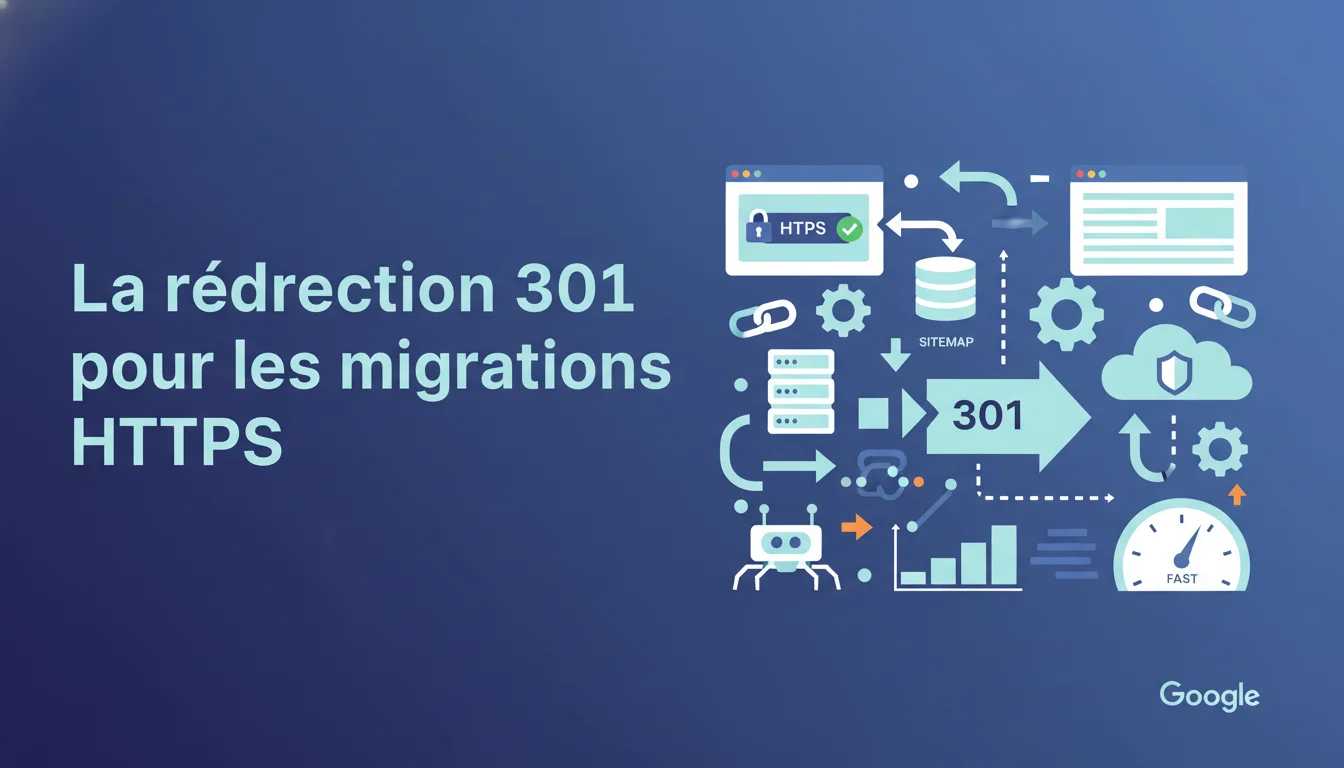
Google emphasizes that migrating from HTTP to HTTPS relies on three key pillars: well-implemented 301 redirects, declaring the preferred domain in Search Console, and submitting HTTPS sitemaps to expedite indexing. The challenge for SEOs? Orchestrating this transition without losing rankings or authority. A poorly executed migration can lead to traffic drops of 20% to 40% for several weeks.
What you need to understand
Why does Google put so much emphasis on 301 redirects?
The 301 redirect informs Google that a page has permanently moved to a new URL. In the context of an HTTPS migration, each HTTP URL must point to its HTTPS counterpart using a 301 status code.
The issue? Many migrations fail due to poorly configured redirect chains or temporary redirects (302). Google then misallocates PageRank and page history, resulting in sometimes severe position losses.
What is the preferred domain and why should you declare it?
The preferred domain in Search Console tells Google which version of the URL should be considered canonical: http or https, with or without www. Without this explicit declaration, Google may index both versions simultaneously, diluting your ranking signals.
In practice, this configuration prevents duplicate content and consolidates authority on a single version. Neglecting this parameter means letting Google decide for you, which rarely leads to optimal results.
How do sitemaps speed up the discovery of HTTPS URLs?
The HTTPS sitemap provides Google with a comprehensive list of new URLs to index. Without an updated sitemap, Googlebot must discover each page through natural crawling, a process that can take weeks for medium-sized sites.
Submitting the new sitemap in Search Console triggers a priority recrawl of the HTTPS URLs. This is particularly critical for e-commerce or news sites where every hour without proper indexing represents lost revenue.
- 301 redirects must be direct, without any intermediate chains or loops
- The preferred domain must be declared in Search Console to avoid authority dilution
- HTTPS sitemaps speed up indexing and reduce the transition period
- A poorly prepared migration can lead to traffic losses of 20% to 40% for several weeks
- Monitoring in Search Console allows for quick detection of redirect or indexing errors
SEO Expert opinion
Is this declaration sufficient for a successful migration?
Google summarizes the three basic technical pillars here, but real-world experience shows that this is far from exhaustive. HTTPS migrations rarely fail due to a lack of 301 redirects; they fail due to details that Google does not mention here: mixed canonicals, hard-coded HTTP resources, outdated hreflang tags, and internal backlinks still pointing to HTTP.
This declaration is therefore correct but incomplete. It creates the impression that an HTTPS migration consists of just three checkboxes, while the devil is in the implementation details. [To verify]: Google does not specify the complete time frame for transferring PageRank via 301, which we observe varies between 2 and 8 weeks.
What does Google say about temporary ranking losses?
Nothing, and that's a concern. The official statement does not mention that any migration leads to a period of instability, even if perfectly executed. Google needs to recrawl, reindex, and recalculate ranking signals.
In practice, we consistently observe a visibility decrease of 5% to 15% for 2 to 4 weeks, even with flawless technical migration. Clients need to be warned: this is not a bug, it’s Google's normal behavior when faced with a massive URL change.
What pitfalls does Google fail to mention?
The declaration overlooks several critical points. Mixed content blocks the HTTPS padlock and degrades user trust. Canonicals must point to the HTTPS versions; otherwise, Google receives contradictory signals.
Hard internal links to HTTP waste crawl budget and slow down the migration. External backlinks to HTTP continue to work via 301 but lose a bit of juice with each hop. Finally, the Search Console properties need to be reconfigured for HTTPS; otherwise, you lose data history.
Practical impact and recommendations
What should you do in practice before the migration?
Start by auditing all resources called in HTTP within your source code: images, CSS, JavaScript, iframes. A single HTTP element breaks the green padlock and generates security alerts. Use a crawler like Screaming Frog in HTTPS mode to identify these mixed resources.
Prepare a complete mapping of your HTTP URLs to HTTPS. On a site with 10,000 pages, a handful of poorly redirected URLs can create significant traffic losses. Test your 301 redirects locally or in a staging environment before going live.
What critical mistakes should you avoid on migration day?
Never redirect all HTTP URLs to the HTTPS homepage. This is a classic mistake that destroys your SEO architecture in one click. Each HTTP URL must redirect to its exact HTTPS counterpart, page by page.
Avoid redirect chains: HTTP without www → HTTPS without www → HTTPS with www. Googlebot follows a maximum of 5 hops, but each hop dilutes the PageRank being passed. Configure your redirects to be direct in a single hop.
How can you verify that the migration went well?
Within 48 hours after the migration, monitor Search Console: crawl errors, indexed pages, coverage, Core Web Vitals. An abnormal spike in 4xx or 5xx errors indicates a configuration problem. Ensure that the number of indexed pages in HTTPS increases while that in HTTP decreases.
Conduct a full crawl with Screaming Frog in HTTPS mode to detect internal links still pointing to HTTP. Correct them quickly to optimize crawl budget. Monitor your rankings in a tracking tool (Semrush, Ahrefs): a drop of more than 20% beyond 4 weeks signals an unresolved issue.
- Implement direct 301 redirects from each HTTP URL to its exact HTTPS counterpart
- Declare the preferred HTTPS domain in Search Console (with or without www based on your choice)
- Submit an updated XML sitemap containing only HTTPS URLs
- Correct all internal links to point directly to HTTPS
- Update canonical tags, hreflang, and Open Graph to the HTTPS versions
- Check for mixed content (images, CSS, JS in HTTP)
- Monitor Search Console and tracking tools for 4 to 6 weeks post-migration
❓ Frequently Asked Questions
Combien de temps faut-il à Google pour transférer le PageRank via une redirection 301 ?
Les redirections 301 font-elles perdre du PageRank ?
Faut-il garder les redirections 301 de manière permanente ?
Que se passe-t-il si je soumets un sitemap contenant des URL HTTP après la migration ?
Dois-je créer une nouvelle propriété Search Console pour HTTPS ou Google bascule-t-il automatiquement ?
🎥 From the same video 9
Other SEO insights extracted from this same Google Search Central video · duration 1h03 · published on 16/02/2017
🎥 Watch the full video on YouTube →
💬 Comments (0)
Be the first to comment.