
Official statement
Other statements from this video 4 ▾
- 0:46 Le contenu dupliqué est-il vraiment pénalisé par Google ?
- 6:03 Comment l'URL canonique consolide-t-elle vraiment vos signaux de classement ?
- 10:32 Rel=canonical cross-domain : Google dit non, mais est-ce vraiment inutile ?
- 12:07 Faut-il vraiment multiplier les domaines pour vos sites internationaux ?
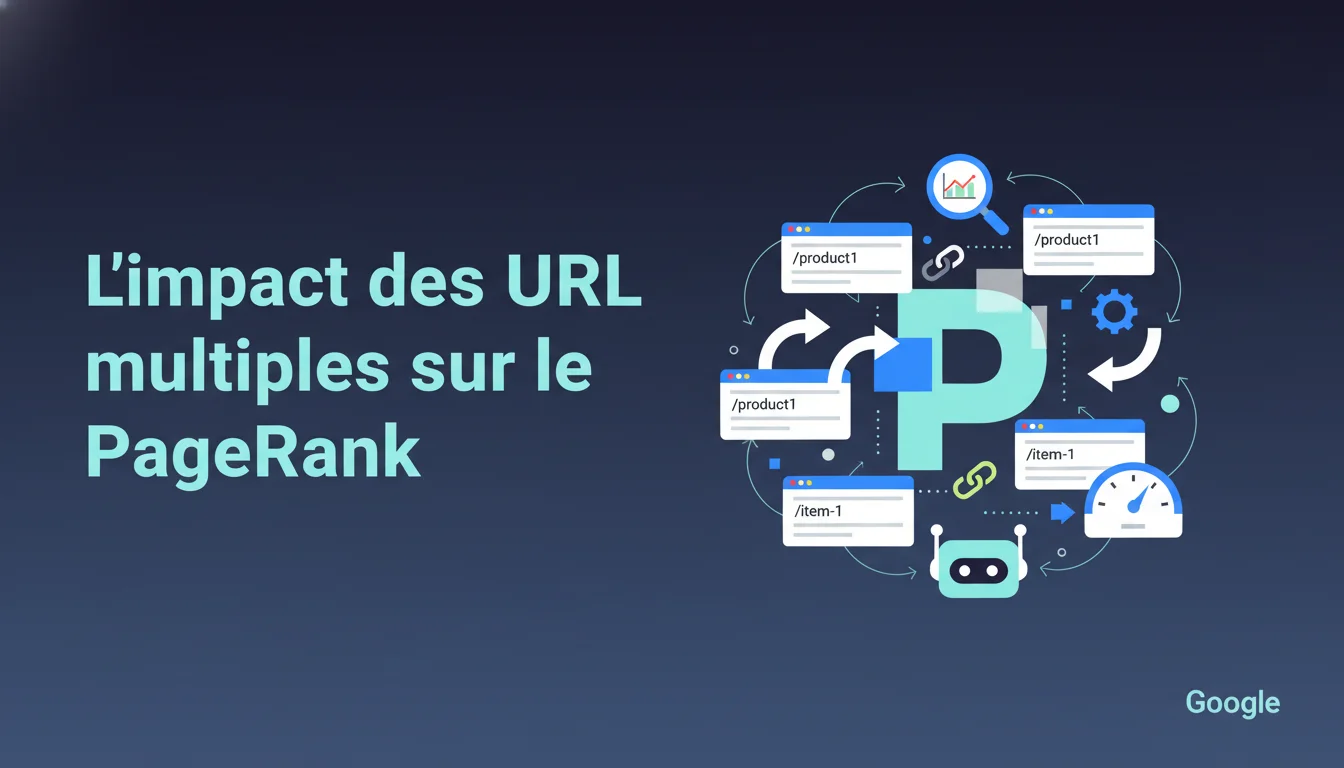
Google confirms that duplicate content across multiple URLs fragments PageRank: backlinks are dispersed instead of concentrated. The result? Your quality signals crumble, and visibility drops. For SEO, it's simple: every piece of content should exist on a single canonical URL; otherwise, you waste your link juice and authority.
What you need to understand
Why does PageRank dilute with multiple URLs?
PageRank works like a flow: each incoming link brings a certain amount of 'juice' that strengthens a page's authority. When the same content exists on three different URLs, backlinks are naturally spread among those three addresses.
In concrete terms? If you have 30 backlinks pointing to your article, but it is accessible via /article, /article/, and /article?ref=123, those 30 links become fragmented. Google can't properly add these signals to a single URL, so none of the three versions reaches the ranking potential it would have with the 30 consolidated links.
What does Google mean by 'quality link signals'?
Quality signals refer to the array of data a backlink transmits: authority of the source domain, anchor text, thematic context, position on the page. Google aggregates these signals to assess the relevance and credibility of a URL.
When these signals are scattered across multiple duplicate URLs, no version accumulates enough weight to stand out. You create internal competition: your own pages cannibalize each other instead of helping one another. Google then has to decide which version to display, often without consistency, destabilizing your rankings.
Does this dilution of PageRank really impact ranking?
Yes, and in a measurable way. A page that concentrates 50 backlinks on a single URL consistently performs better than a page whose 50 backlinks are spread across five variations. The accumulation factor is fully at play: PageRank, Trust Flow, thematic authority... all these indicators do not combine well when signals are fragmented.
In practice, this results in fluctuating positions, reduced visibility on competitive queries, and a waste of crawl budget. Google spends time crawling your duplicates instead of exploring your strategic content. It's a double handicap.
- Fragmentation of PageRank: backlinks are dispersed among multiple URLs instead of converging.
- Internal competition: your own pages compete within the SERPs.
- Ranking instability: Google hesitates between several versions, your positions fluctuate.
- Waste of crawl budget: Google's resources are exhausted on duplicates.
- Loss of visibility: no URL capitalizes enough signals to break through on competitive queries.
SEO Expert opinion
Does this statement from Google align with real-world observations?
Absolutely. For years, SEO audits have confirmed this pattern: sites with non-canonical duplicated content consistently show fragmented authority metrics. Ahrefs, Majestic, SEMrush... all show backlinks scattered across URL variants that, if consolidated, would raise Domain Rating or Trust Flow.
A classic case? E-commerce sites with filter or sorting parameters generating hundreds of nearly identical URLs. Each variant captures a few links, but none reach the critical mass to dominate the SERPs. When correctly canonicalized and redirected, the results are spectacular: +30 to 50% organic traffic in a few weeks, simply because the signals finally consolidate.
What nuances should be added to this statement?
Google remains vague about the true extent of dilution. Is it a linear loss (3 URLs = PageRank divided by 3) or a more subtle degradation? [To verify] because Google never publishes specific figures. Internal tests suggest a non-linear degradation: the dispersion primarily impacts pages with low authority, while heavyweights (Wikipedia, major media) cope better due to their sheer volume of backlinks.
Another nuance: canonicalization is not always respected. Google reserves the right to ignore your canonical tag if its algorithms detect an inconsistency (content too different, chaining redirects, conflicting signals). In this case, even with a correct canonical, you can still suffer dilution if Google indexes the variants anyway.
When does this rule not strictly apply?
Multilingual or multi-regional sites partially escape this logic. If you have /fr/article and /en/article with correct hreflang tags, Google treats these URLs as distinct entities targeting different audiences. There’s no dilution here, as signals are compartmentalized by language and geographic area.
Another exception: AMP and separate mobile versions. With a correct canonical/amphtml implementation, Google consolidates signals between versions. But beware, if misconfigured, AMP can become a vector for dilution. Many sites have abandoned AMP for this reason: the technical complexity outweighed the benefits.
Practical impact and recommendations
What concrete steps should be taken to avoid PageRank dilution?
The first step: audit all indexed URLs via Google Search Console (Coverage report) and a Screaming Frog or Botify crawl. Identify duplicates: trailing slash (/page vs /page/), GET parameters (?utm, ?sessionid), HTTPS/HTTP versions, www/non-www, uppercase/lowercase.
Next, standardize your structure. Choose ONE canonical version for each piece of content and enforce it via permanent 301 redirects for all variants. Complete this with a <link rel="canonical"> tag pointing to this unique version. In your XML sitemap, include only canonical URLs — zero duplicates tolerated.
What technical errors worsen this dilution?
Chained redirects (A → B → C) fragment PageRank with each hop: you lose about 10-15% of juice per redirect. Limit yourself to a direct redirect (A → C). Another trap: canonical loops where two pages mutually designate each other as canonical. Google then abandons consolidation and indexes both.
Improperly managed pagination is a classic issue. If /blog?page=1, /blog?page=2, etc. compete for the same keywords, canonicalize everything to /blog or use rel="next"/"prev" (though Google has devalued this signal). Never allow pagination pages to accumulate backlinks without a clear strategy.
How can I check if my site is properly consolidating PageRank?
Use the URL inspection tool in Search Console: enter your suspected URL variants and check which version Google considers canonical. If the declared canonical differs from what Google has retained, dig deeper: content inconsistency, shaky redirects, or ignored canonical tag.
Analyze your backlink profiles in Ahrefs or Majestic. If you see incoming links scattered across ten variations of the same page, it's a red flag. Redirect these variations in 301 and monitor the evolution of your Domain Rating: a successful consolidation produces a visible increase within 4 to 8 weeks.
- Crawl your site and list all indexed URLs (Search Console + Screaming Frog).
- Identify duplicates: trailing slash, parameters, HTTP/HTTPS, www/non-www.
- Choose ONE canonical version for content and redirect all variants in 301.
- Implement consistent
<link rel="canonical">tags on each page. - Clean your XML sitemap: only one URL per content, no variants tolerated.
- Check in Search Console that Google respects your canonicals (URL Inspection tool).
- Audit your backlinks: if links point to non-canonical variants, contact webmasters or redirect.
- Monitor your authority metrics (DR, TF) post-consolidation: an increase confirms success.
❓ Frequently Asked Questions
Une balise canonical suffit-elle ou faut-il aussi des redirections 301 ?
Les paramètres UTM diluent-ils aussi le PageRank ?
Dois-je canonicaliser mes pages de pagination vers la page 1 ?
La dilution du PageRank impacte-t-elle aussi les liens internes ?
Comment gérer le contenu dupliqué sur des sous-domaines différents ?
🎥 From the same video 4
Other SEO insights extracted from this same Google Search Central video · duration 14 min · published on 15/09/2009
🎥 Watch the full video on YouTube →
💬 Comments (0)
Be the first to comment.