
Official statement
Other statements from this video 4 ▾
- 0:46 Le contenu dupliqué est-il vraiment pénalisé par Google ?
- 4:05 Comment les URLs multiples diluent-elles le PageRank et plombent-elles votre SEO ?
- 10:32 Rel=canonical cross-domain : Google dit non, mais est-ce vraiment inutile ?
- 12:07 Faut-il vraiment multiplier les domaines pour vos sites internationaux ?
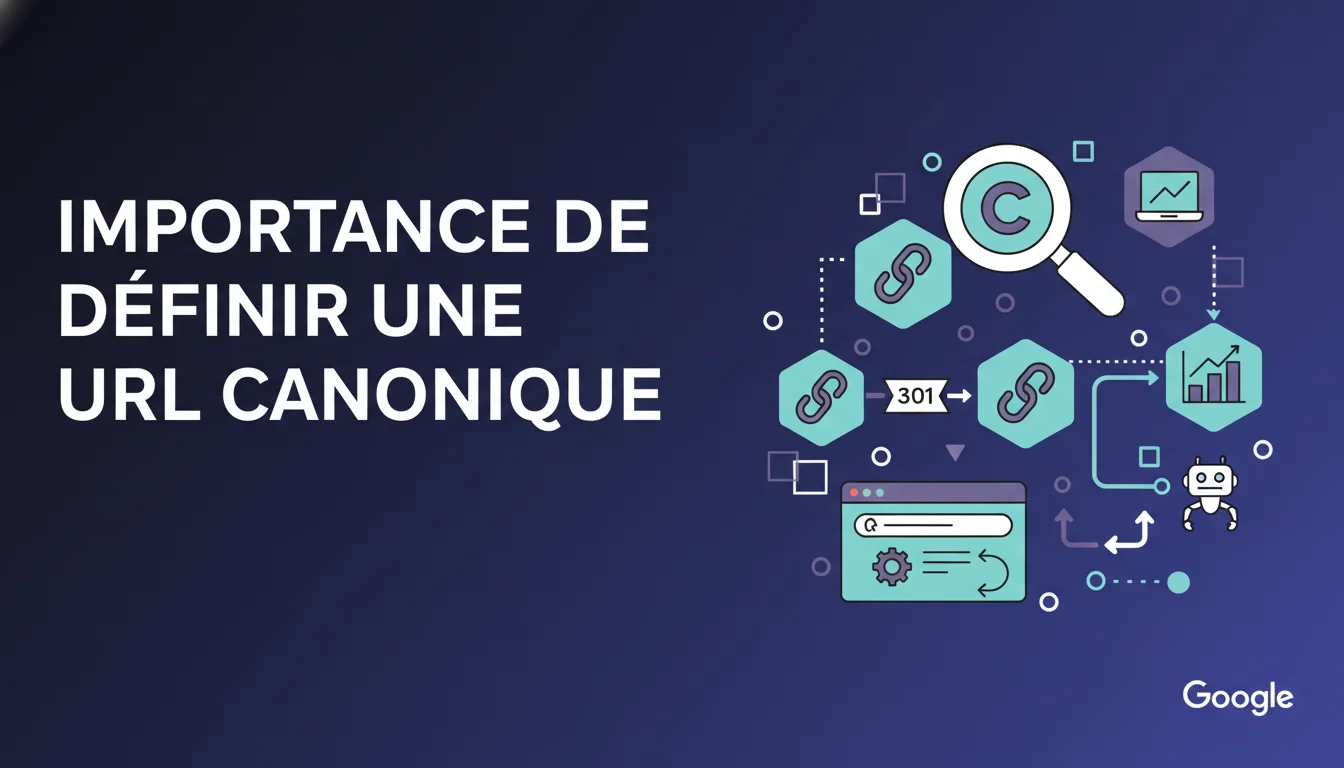
Google confirms that the canonical tag helps focus ranking signals on a single page version. Three methods coexist: internal link structure, 301 redirects, and the rel=canonical tag. The choice of method depends on your technical context and the nature of duplicate content, but ignoring this consolidation dilutes your authority and visibility.
What you need to understand
Why does Google emphasize the concept of a canonical URL?
The web is filled with unintentional duplicated content: a product page accessible through multiple categories, UTM parameters generating distinct URLs, HTTP/HTTPS variations or www/non-www going together. Each variant is crawled and indexed separately unless something prevents it.
Google then has to choose which version to display in the results. Without clear indication, ranking signals (incoming links, age, user behavior) are scattered among all variants. The result: no version reaches its full ranking potential.
Canonicalization explicitly tells Google: "All these URLs show the same content, but here's the one you should prioritize in the index". It's a consolidation mechanism, not a prohibition on crawling.
What are the three methods mentioned and how do they differ?
The internal link structure is the most natural method: all your links systematically point to the canonical version. If your product page exists at /product?color=red and /product, all your internal links target /product. Google detects this pattern and understands your preference.
The 301 redirect is the coercive solution: it physically forces the browser and bots towards the canonical URL. This is the most powerful method because it completely eliminates the variants from the equation. But it is not always applicable: you cannot redirect a page that is legitimately accessible via two different paths.
The rel=canonical tag is the technical compromise. It keeps all URLs accessible but signals the preference to Google via an HTML tag or HTTP header. It's flexible, but it is also a simple advisory signal: Google can choose to ignore it if it detects inconsistencies.
What does "consolidating ranking signals" actually mean?
Imagine an article accessible via three URLs, each collecting 5 backlinks. Without canonicalization, Google sees three moderately popular pages. With a well-defined canonical, it attributes the 15 backlinks to a single URL, which becomes much more competitive.
This consolidation applies to all ranking factors: inherited domain authority, CTR history, time spent on page, and social signals. The more concentrated the authority, the higher the page rises in SERPs.
- Canonicalization concentrates dispersed authority among multiple URLs on a single preferred version
- Three methods coexist: consistent internal links, 301 redirects, and the rel=canonical tag
- Google treats the canonical as a strong but not absolute signal: it can ignore it if your signals are contradictory
- Without a defined canonical URL, you leave it up to Google to choose arbitrarily, risking a poor version being indexed
- Consolidation impacts all ranking factors: backlinks, history, user behavior
SEO Expert opinion
Does this statement reflect the observed on-the-ground reality?
Totally. In thousands of audits, issues with failing canonicalization rank in the top 5 measurable SEO barriers. An e-commerce site that allows 15 variants of each product page to be indexed (filters, sorting, pagination) sees its authority diluted catastrophically.
Google's statement is, however, simplistic: it presents three methods as equivalent while the hierarchy of effectiveness is clear. A 301 transfer approximately 99% of PageRank according to our measurements, a well-implemented canonical about 95%, and an internal link structure alone can drop to 70-80% if Google detects inconsistencies elsewhere.
The real issue: Google never specifies how long it takes for the consolidation to fully operate. Our observations indicate that depending on the crawl frequency, it can take anywhere from 2 weeks to 6 months. During this period, performance can fluctuate dramatically.
What pitfalls does Google not mention?
The canonical tag is an advisory signal, not a directive. If your canonical points to URL A but all your strong backlinks point to URL B, Google may choose to ignore your canonical and index B instead. I've seen this scenario dozens of times during poorly managed migrations.
Another classic pitfall is canonical chains. Page A pointing to B, which points to C. Google rarely follows beyond the first jump. The result: consolidation fails silently, and you only discover it by analyzing the Search Console.
Google also omits that the canonical does not resolve the waste of crawl budget. If 500 duplicate URLs remain crawlable, Google still visits them, slowing down the discovery of your strategic pages. The canonical helps indexing, not crawl optimization.
In what cases does this logic not apply as expected?
Multilingual or multi-regional sites pose a specific issue. If your content in French and English is nearly identical (literal translation), Google may force you to choose a single canonical version, sacrificing the other language. The hreflang tag is supposed to resolve this case, but in practice, canonical/hreflang conflicts create unpredictable behaviors. [To be verified] on a case-by-case basis with Search Console tests.
On sites with very high volume (millions of pages), I've found that Google sometimes completely ignores canonicals to favor its own heuristics. It then thinks it "knows better" which version to index, especially when a non-canonical variant receives significantly more backlinks. It's frustrating but documented in several public case studies.
Practical impact and recommendations
What should you prioritize auditing on your site?
Start by extracting all indexed URLs via the Search Console and compare them to your XML sitemap. Indexed URLs that do not appear in the sitemap are often parasite variants. Identify the patterns: session parameters, sorting, badly managed filters, pagination.
Then crawl your site with Screaming Frog or Oncrawl while enabling the extraction of canonical tags. Look for inconsistencies: canonicals pointing to 404s, chains of canonicals, pages that declare themselves canonical while they should point elsewhere. These errors are silent but destructive.
Also, check your existing 301 redirects. A well-intentioned redirect can conflict with a canonical tag and create contradictory signals. Google generally favors the 301, but not always.
How to implement a robust canonicalization strategy?
For simple variants (HTTP vs HTTPS, www vs non-www), go for 301 redirects without hesitation. It's clean, definitive, and avoids any crawl waste. Set them up at the server level (nginx, Apache) rather than in PHP for performance gains.
For content legitimately accessible through multiple paths (products in multiple categories), implement dynamic canonicals that always point to the shortest or oldest URL. Ensure that your internal links respect this hierarchy: an internal link to a non-canonical variant sends a contradictory signal.
On large sites, prefer canonicals in HTTP headers rather than in HTML for PDFs, images, and non-HTML files. It's more reliable and does not depend on Google's HTML parsing.
What errors systematically block consolidation?
The classic mistake: defining a canonical but continuing to generate internal links to variants. If your category menu points to /product?sort=price while the canonical is /product, you're sabotaging your own strategy. Google receives contradictory signals and can decide to ignore the canonical.
Another frequent sabotage: XML sitemaps listing non-canonical variants. Your sitemap should only contain canonical URLs. Any non-canonical URL present in the sitemap weakens the signal and pushes Google to re-crawl unnecessarily.
Finally, beware of WordPress plugins or CMS that generate automatic canonicals without consistent logic. I've seen sites where each page declared itself canonical, rendering the tag totally useless.
- Extract and compare indexed URLs (Search Console) with your XML sitemap to detect parasite variants
- Crawl the site to identify chains of canonicals, canonicals pointing to 404s, and inconsistencies
- Redirect all simple technical variants (HTTP/HTTPS, www/non-www) using 301
- Implement coherent dynamic canonicals on multi-path content
- Align all internal links to the declared canonical URLs
- Clean XML sitemaps to keep only canonical URLs
❓ Frequently Asked Questions
La balise canonical suffit-elle ou faut-il obligatoirement rediriger en 301 ?
Google peut-il ignorer ma balise canonical ?
Faut-il mettre une canonical sur toutes les pages du site ?
Combien de temps faut-il pour que la consolidation opère pleinement ?
Les canonicals résolvent-elles les problèmes de crawl budget ?
🎥 From the same video 4
Other SEO insights extracted from this same Google Search Central video · duration 14 min · published on 15/09/2009
🎥 Watch the full video on YouTube →
💬 Comments (0)
Be the first to comment.