
Official statement
What you need to understand
What is the real role of keywords in URLs according to Google?
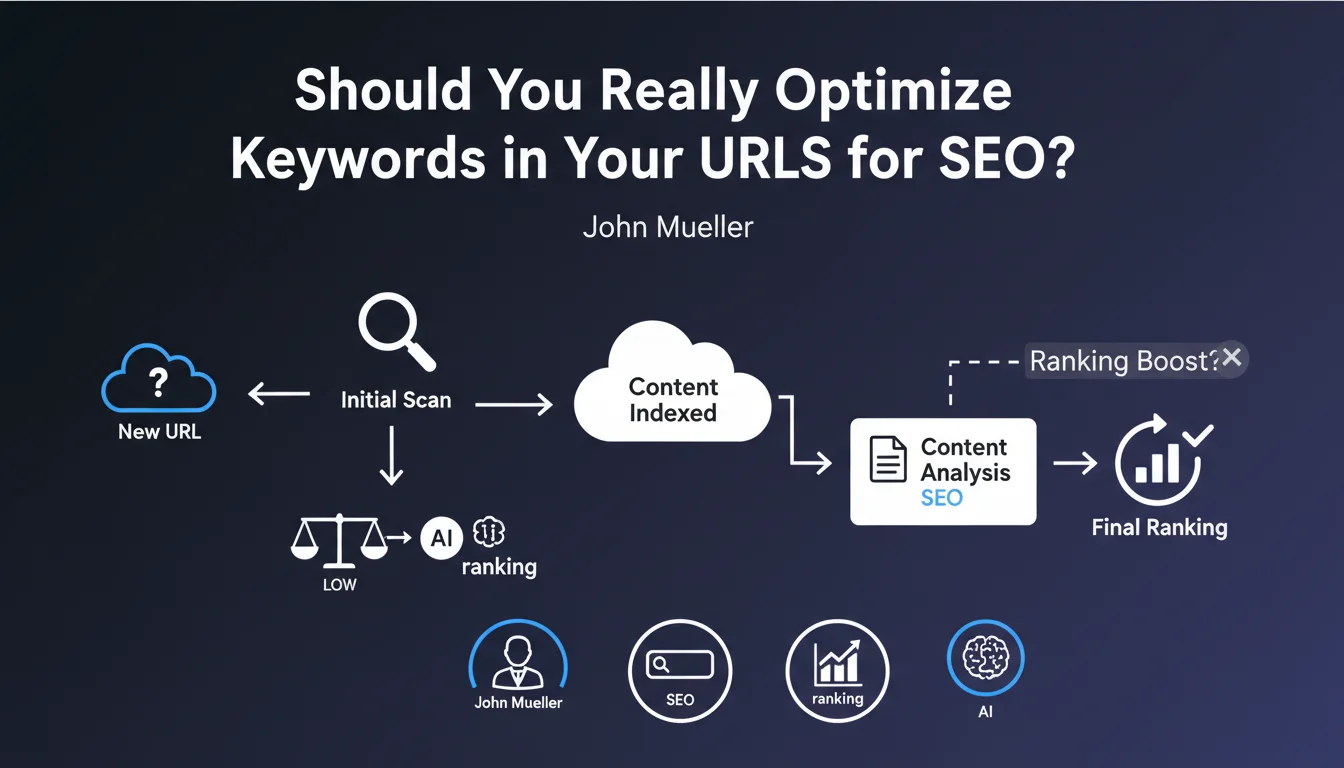
John Mueller clarified Google's position on this topic during a hangout: keywords present in the URL constitute an extremely weak ranking factor. This signal is truly only used during the very first discovery of a URL, even before the content is crawled.
Once the content is indexed, Google has hundreds of other much more relevant signals to evaluate and rank a page. The URL then becomes almost negligible in the ranking algorithm. This statement confirms what many SEOs have been observing empirically for years.
Why does this information change our approach to URLs?
This clarification allows us to refocus our SEO priorities toward higher-impact optimizations. Too many practitioners still spend considerable time perfecting each URL, debating whether or not to include an additional keyword, or restructuring site architecture for purely SEO reasons.
The reality is that Google primarily analyzes the textual content of the page, title and meta tags, HTML structure, backlinks, and many other factors. Words in the URL play a marginal role compared to these elements.
In what cases do keywords in URLs still have utility?
There are two contexts where descriptive URLs retain some value. First, during the initial discovery phase: if Google finds a new URL via a sitemap or external link before crawling its content, keywords can provide a preliminary indication of the page's topic.
Second, and this is crucial, descriptive URLs have value for user experience. A clear and readable URL inspires trust, can be shared easily, and allows users to understand where they are on your site. It's therefore more a UX factor than a pure SEO factor.
- Keywords in the URL have very little weight in Google's algorithm
- This signal is really only used before the first crawl of the content
- Once indexed, Google relies on hundreds of more relevant signals
- The language of the URL (German, Japanese, English) has no significant impact
- The primary goal of a URL should be clarity and comprehension
SEO Expert opinion
Is this statement consistent with field observations?
Absolutely. Large-scale SEO tests conducted in recent years consistently show that modifying only a page's URL (via 301 redirect) to add or remove keywords generates no significant change in ranking. The measured impact is so minimal that it falls within the statistical margin of error.
The best-performing sites often have very varied URL structures: some use short, cryptic URLs, others use very descriptive URLs. What really makes the difference is content quality, semantic relevance, and domain authority.
What nuances should be added to this recommendation?
Nevertheless, there are some special cases where URL structure deserves attention. For local SEO, including a city in the URL can reinforce overall semantic consistency, even if the direct impact remains minimal. For multilingual sites, the URL structure helps Google identify the target language (via subdomains, subdirectories, or parameters).
Moreover, let's not confuse SEO weight and architecture. A good URL structure facilitates technical site management, improves crawling, and enables better organization of internal linking. These indirect benefits are real, even if the direct impact on ranking is negligible.
Where should SEOs redirect their efforts?
Rather than spending hours optimizing URLs, focus on elements with much higher ROI: improving content quality and depth, optimizing title tags and Hn tags, working on search intent, and developing strategic internal linking.
Link building also remains a major factor, as does optimizing loading speed and mobile experience. These elements have a measurable and significant impact on your rankings, unlike URL micro-optimizations that generate virtually no return.
Practical impact and recommendations
What should you actually do with your URLs?
Adopt a pragmatic and balanced approach. Create URLs that are clear, descriptive, and readable that reflect your site's hierarchy. Use keywords naturally, without forcing them, and favor simplicity: a short, understandable URL is better than a URL stuffed with keywords.
Absolutely avoid massive URL restructurings solely for keyword reasons. Every URL change requires a 301 redirect, which slightly dilutes PageRank and can temporarily impact your rankings. It's simply not worth the effort.
For new content, establish a consistent naming convention: use hyphens to separate words, avoid special characters and capital letters, and keep your URLs as short as reasonably possible while remaining descriptive.
What critical mistakes should you avoid with your URLs?
Don't fall into the trap of keyword stuffing in URLs. URLs like "/best-plumber-paris-cheap-emergency-plumbing-repair" are counterproductive: they add nothing to SEO, look spammy to users, and can even harm your click-through rate in search results.
Also avoid complex dynamic URLs with numerous parameters when unnecessary. Even though Google handles them correctly, they harm user experience. Favor static, clean URLs when technically possible.
Never change URLs without implementing proper 301 redirects. And above all, don't restructure your URLs simply because a competitor has optimized theirs differently: focus on factors that actually make a difference.
How can you verify that your URL strategy is optimal?
Audit your site to identify problematic URLs: too long (over 100 characters), containing special characters, capital letters, or unnecessary parameters. Fix these issues on new pages, but don't rush to massively modify existing URLs that are ranking well.
Verify that your URL structure reflects your site architecture logically. A clear hierarchy (/category/subcategory/product) facilitates navigation, crawling, and internal linking, even if it doesn't directly impact ranking.
- Create descriptive and readable URLs without keyword stuffing
- Use hyphens to separate words, no underscores or special characters
- Keep your URLs as short as reasonably possible
- Avoid massive restructurings of existing URLs for simple semantic adjustments
- Prioritize consistency: establish a convention and stick to it
- Focus your SEO efforts on content, tags, and link building rather than URL micro-optimizations
- Ensure that any URL modification is accompanied by a proper 301 redirect
- Regularly audit your URLs to identify and correct technical anomalies
In summary: Keywords in URLs have negligible SEO impact according to Google. Your priority should be to create URLs that are clear, logical, and user-friendly, without spending hours over-optimizing them. Focus your time and energy on factors that truly influence your rankings: quality content, solid architecture, and link strategy.
Implementing a comprehensive and coherent SEO strategy often requires sharp technical expertise and an overall vision that only experience can provide. If you want to maximize your organic visibility without dedicating considerable internal resources to these complex optimizations, support from a specialized SEO agency can help you identify and prioritize actions that have real impact on your business.
💬 Comments (0)
Be the first to comment.