
Official statement
What you need to understand
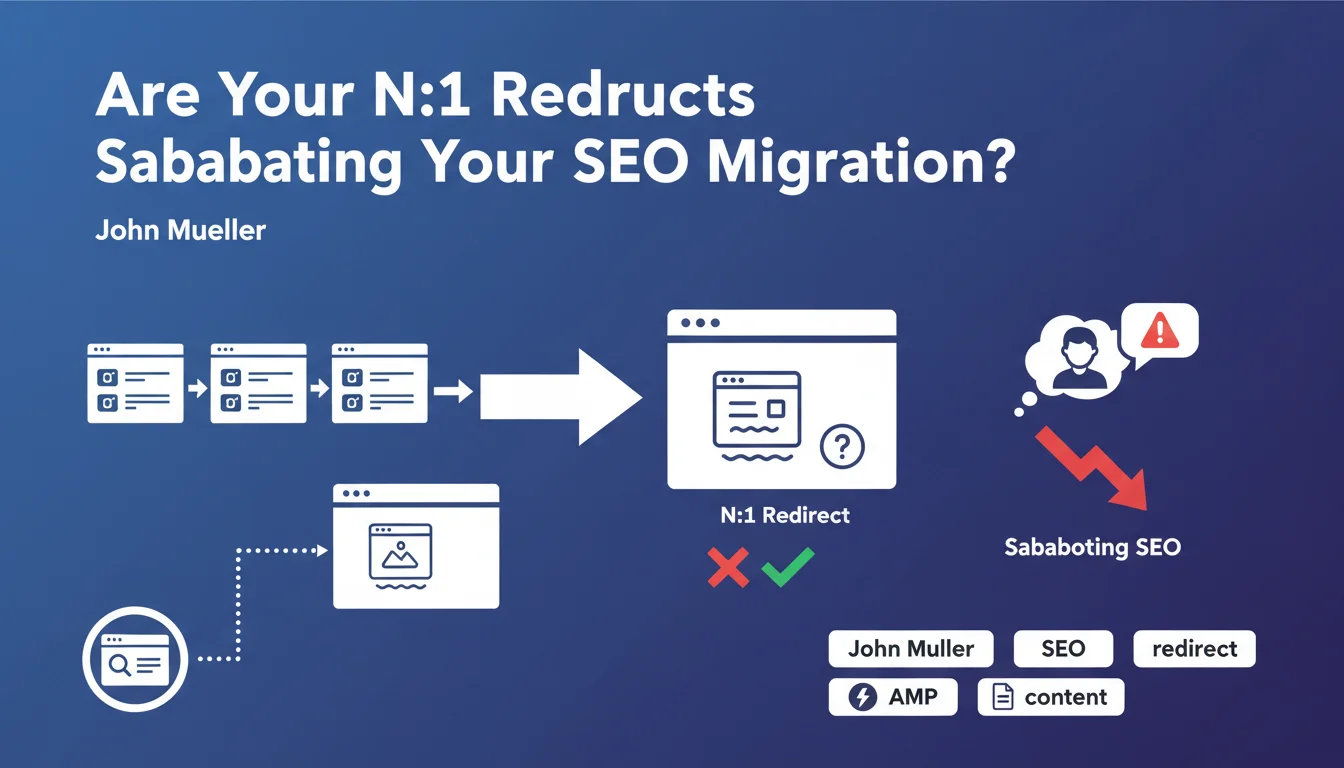
This statement addresses a common scenario during domain migrations: redirecting all pages from an old site to a single page on the new site, known as an N:1 redirect (many-to-one).
In the analyzed example, an e-commerce site redirected all of its old URLs to the homepage or a single landing page on the new domain. This practice can give the illusion of working since the destination page may actually appear in search results.
However, John Mueller describes this approach as a "soft redirect" or "crypto redirect", meaning a redirect that doesn't properly transmit SEO signals from one page to another. The major problem is that Google cannot understand the logical correspondence between the old and new content.
- N:1 redirects prevent the transfer of authority in a granular and contextual manner
- Google struggles to interpret which old page corresponds to which new page
- PageRank and topical relevance signals become diluted instead of concentrated
- A migration should ideally follow a 1:1 mapping (one old URL to one corresponding new URL)
- Even if the destination page appears in results, this is not proof of a successful optimization
SEO Expert opinion
This clarification from Google is perfectly consistent with what SEO experts have been observing for years during site migrations. N:1 redirects are one of the most costly mistakes in terms of organic traffic loss.
What's interesting here is that Google clearly distinguishes between the appearance of success and actual optimization. A page can indeed rank temporarily thanks to the volume of redirects it receives, but this doesn't mean the migration is successful. In the medium term, a significant erosion of traffic and rankings is typically observed.
There are, however, a few legitimate cases for N:1 redirects: when a site permanently abandons an entire section with no equivalent on the new site, or during the voluntary consolidation of similar content. But even in these cases, it's preferable to create a transition page explaining the change rather than a simple blind redirect.
Practical impact and recommendations
- Audit your ongoing migrations: immediately identify if you've implemented N:1 redirects and correct them before damage accumulates
- Create comprehensive mapping before any migration: each old URL must correspond to a specific new URL presenting equivalent or similar content
- If a page has no equivalent, redirect to the most relevant parent category page, never to the homepage by default
- Document your redirect choices: maintain an Excel/Google Sheets table with the old URL, new URL, and justification for the correspondence
- Use permanent 301s only when the correspondence is clear and definitive, not as an easy solution
- Test a representative sample before full deployment: validate that redirects preserve topical relevance
- Monitor Search Console after migration: verify that old URLs are properly replaced by new ones in the index, not ignored
- Avoid redirect chains: ensure your new URLs don't themselves redirect to other pages
- Prioritize destination content quality: a content-poor page will never compensate for a good redirect strategy
Domain migrations represent a critical moment for your organic visibility. Every redirect error can translate into lasting traffic losses that are difficult to recover. Given the technical complexity of these operations and the considerable business stakes involved, working with an SEO agency specialized in migrations can secure your project and maximize the preservation of your accumulated SEO capital.
💬 Comments (0)
Be the first to comment.