
Official statement
What you need to understand
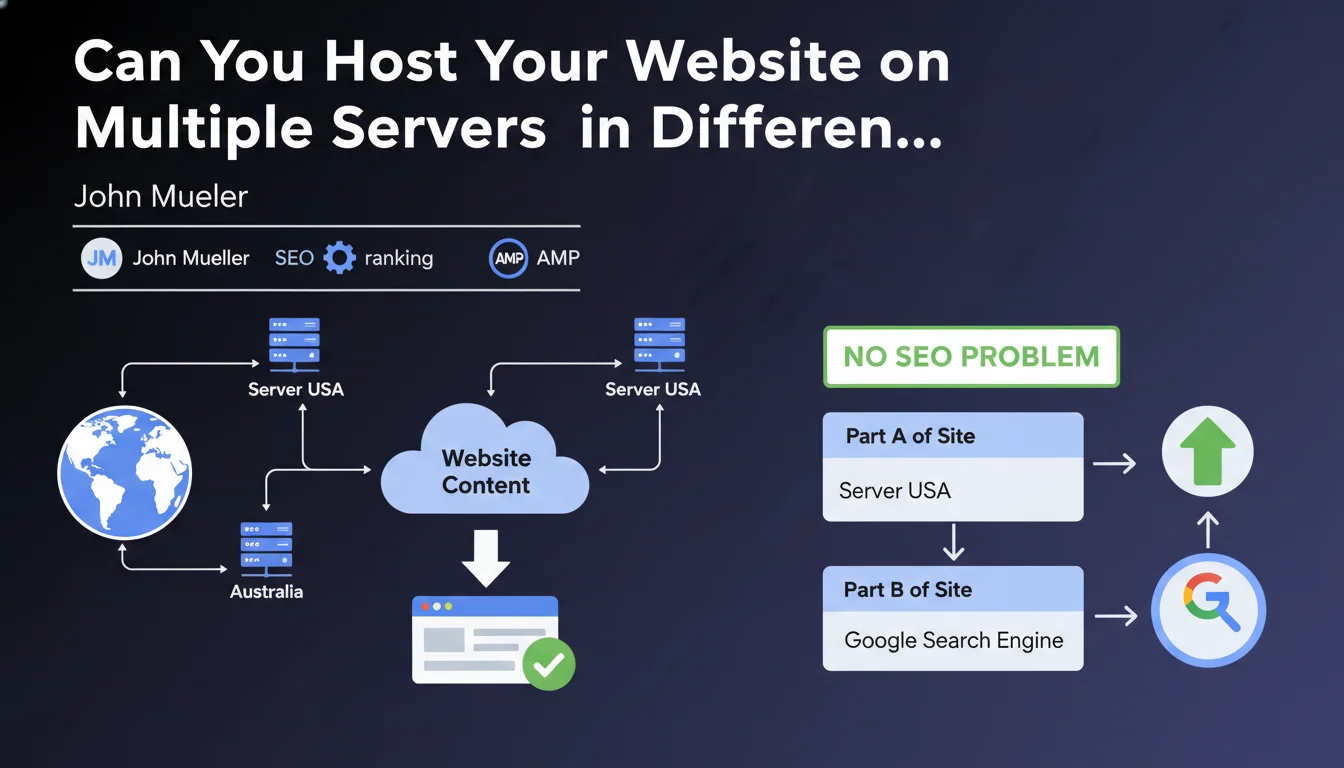
Google confirms that a website can be hosted on multiple servers located in different countries without negatively affecting its ranking in search results. Concretely, you can have your main pages on a server in the United States and your images or other resources on a server in Australia.
This flexibility is particularly useful for international websites that use CDNs (Content Delivery Networks) or distribute their infrastructure across the world to improve performance. The server's IP address is therefore not a direct ranking criterion.
However, this technical freedom comes with an essential condition: the geographic targeting configuration must be impeccable. Without proper implementation of international signals, Google might misinterpret your site's geographic target.
- The server's IP address is not a determining ranking factor
- Multi-server distribution is compatible with a good SEO strategy
- Correct geographic targeting is the key to avoiding any issues
- CDNs and distributed architectures are perfectly acceptable
SEO Expert opinion
This statement is consistent with field observations, but the nuance provided is crucial. In practice, many sites use CDNs like Cloudflare, AWS CloudFront, or Fastly that distribute content from dozens of different countries without ranking problems.
The real question is not the IP itself, but the consistency of signals sent to Google. A French site hosted in the United States can perfectly rank in France if the hreflang tags, Search Console, domain extension (.fr), and linguistic content are aligned. Conversely, a poorly configured site can create confusion even with a "local" IP.
Problematic cases mainly concern poorly configured international e-commerce sites or server migrations without updating Search Console settings. In these situations, Google may temporarily misinterpret the geographic target until the signals stabilize.
Practical impact and recommendations
- Check the geographic targeting in Search Console for each linguistic or regional version of your site
- Properly implement hreflang tags if you have multiple linguistic or geographic versions
- Use appropriate top-level domains (.fr, .de, .co.uk) or clear subdomains/subdirectories (fr.site.com, site.com/fr/)
- Configure your CDN transparently so Google can access your content from any location
- Ensure your linguistic content matches your target (don't target France with English content)
- Document your hosting architecture to facilitate audits and maintenance
- Monitor your performance by country in Analytics and Search Console after any migration or infrastructure change
- Test the accessibility of your servers from different geographic locations
Setting up an international infrastructure optimized for SEO involves coordinating technical, linguistic, and strategic aspects that go far beyond simply choosing hosting. Between Search Console configuration, hreflang implementation, URL architecture, and multi-country monitoring, the parameters to master are numerous and interdependent. For international projects of significant scale, support from an SEO agency specialized in geographic targeting helps secure these strategic choices and avoid costly mistakes that could compromise your visibility in your target markets.
💬 Comments (0)
Be the first to comment.