
Official statement
What you need to understand
Since 2017, Google has officially taken a stance against intrusive mobile interstitials, those windows that cover the main content when visiting a page. The clarification provided distinguishes between two distinct impacts on organic search.
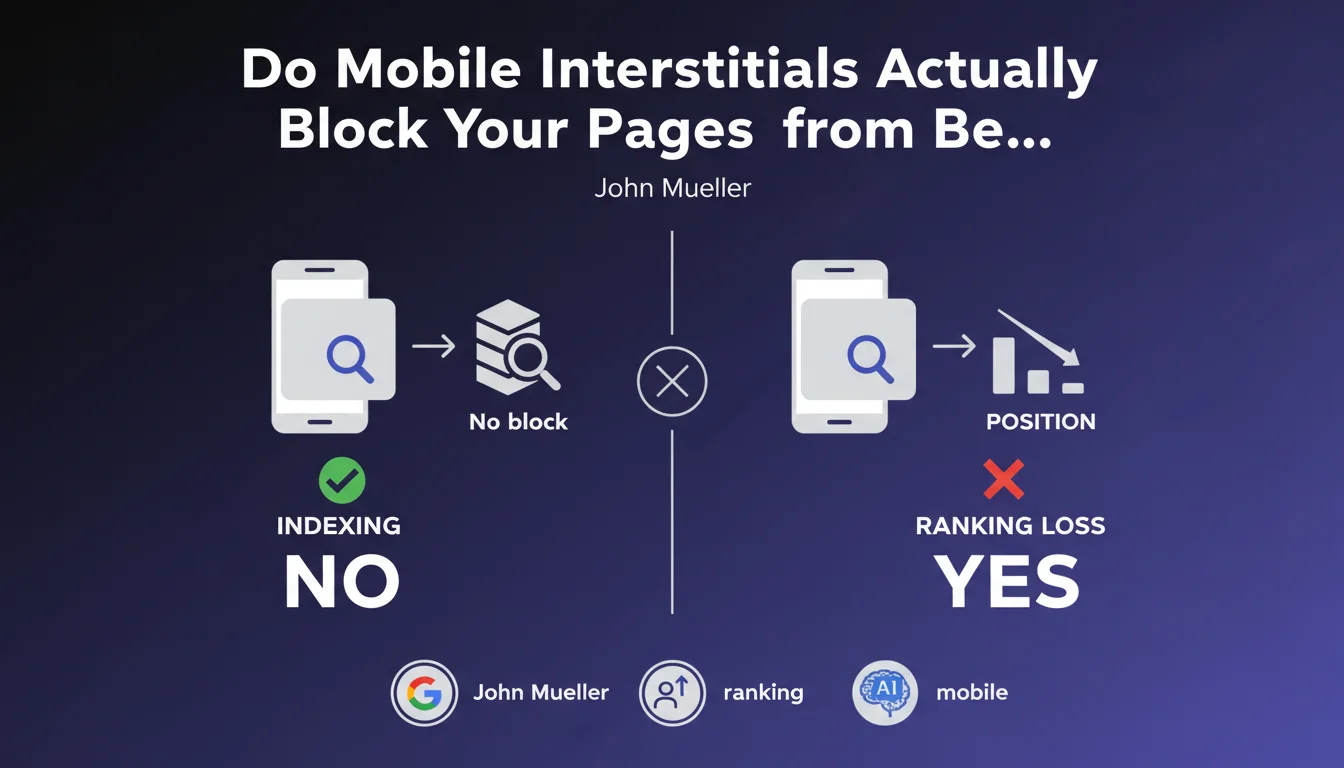
Contrary to popular belief, these interstitials generally don't block indexing of pages by Googlebot. The crawler manages to crawl and index the content located behind these pop-up windows. This is an important technical nuance to understand.
However, these interstitials can trigger an algorithmic ranking penalty on the affected pages. Google downgrades positions in mobile search results when the user experience is deemed too intrusive.
- Mobile interstitials don't prevent technical indexing of content
- They trigger a mobile-specific ranking penalty
- This sanction affects positions in SERPs, not presence in the index
- The penalty remains relatively rare according to observations
- Google primarily targets interstitials that significantly degrade mobile UX
SEO Expert opinion
This distinction between indexing and ranking is consistent with Google's technical architecture. The indexing system and the ranking algorithm operate as two separate layers, which explains why a page can be indexed while suffering a positioning penalty.
In practice, we indeed observe that this penalty remains relatively targeted. Google doesn't penalize all interstitials indiscriminately. Legal pop-ups (cookies, age verification), small non-intrusive banners, or easily dismissible interstitials generally escape this sanction.
There's also a gray area: interstitials displayed after a few seconds of browsing or during scroll. These formats often escape immediate detection but degrade user experience, which translates into measurable negative signals in your analytics.
Practical impact and recommendations
- Audit your existing mobile interstitials: identify all pop-ups, overlays, and modal windows displayed on your site's mobile version
- Remove full-screen interstitials that appear immediately upon arrival on a page from Google search results
- Favor discreet banners occupying less than 15% of the screen and easily dismissible with a simple tap
- Keep only mandatory interstitials: GDPR-compliant cookie banner, legal age verification, necessary authentication
- Use alternative formats: sticky bars, side slide-ins, or interstitials triggered after significant interaction (30+ seconds, full scroll)
- Test Google Search Console's mobile inspection tool to verify how Googlebot perceives your pages with interstitials
- Monitor your Core Web Vitals: a poorly optimized interstitial degrades CLS (Cumulative Layout Shift) and FID (First Input Delay)
- Analyze engagement metrics: compare bounce rate and time on page between versions with/without interstitials
- Implement intelligent display timing: if you absolutely must use an interstitial, wait at least until the user has consumed part of the content
Optimizing mobile experience involves a delicate balance between marketing objectives and SEO compliance. Interstitials represent a measurable risk for your organic positions, even if the direct penalty remains infrequent.
The complexity lies in technical implementation: managing legal exceptions, optimizing display timing, maintaining acceptable Core Web Vitals, and measuring real impact on your conversions. These trade-offs require sharp technical expertise and a comprehensive strategic vision.
For sites with heavy mobile traffic or e-commerce projects where every ranking point counts, guidance from a specialized SEO agency helps secure these optimizations while preserving your business objectives. An in-depth audit and personalized recommendations avoid costly mistakes and maximize your mobile visibility.
💬 Comments (0)
Be the first to comment.