
Official statement
What you need to understand
What was the info: syntax and what did it offer previously?
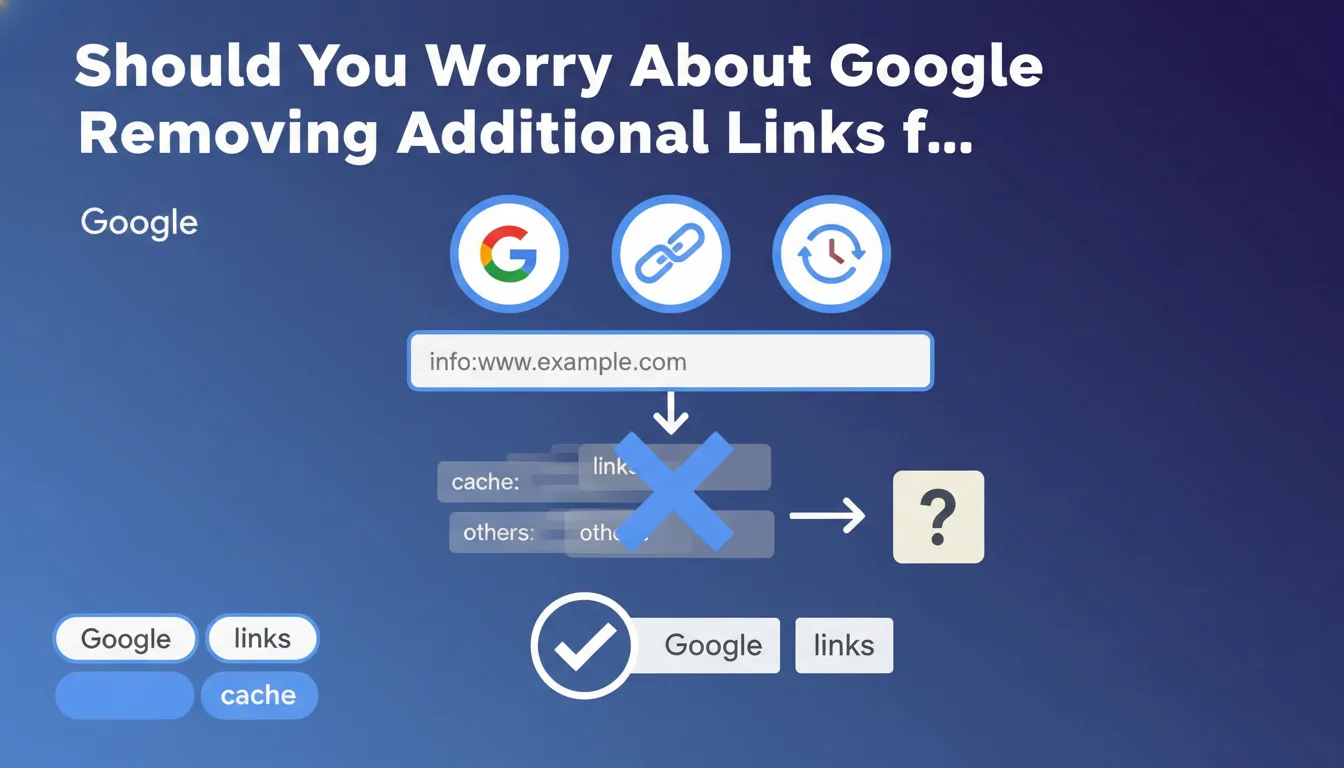
The info: syntax was an advanced search command that allowed users to obtain specific information about a given URL. When a user typed info:www.example.com into Google, the search engine displayed not only the main result, but also practical additional links beneath that result.
These links included access to the cached version of the page (equivalent to cache:), information about links pointing to the site (link:), and other technical data. These features were particularly used by SEO professionals and webmasters for their analyses.
Why did Google remove these additional links?
Google decided to simplify the interface of the info: syntax by removing these complementary links. This decision is part of a logic of streamlining the tools offered directly in search results.
The removal doesn't mean that this information disappears completely. Google considers that truly useful data remains accessible via other dedicated syntaxes or via Search Console.
What are the concrete implications for SEO professionals?
- The info: syntax becomes more basic and only displays the main result of the searched URL
- Other information remains available via specific commands like cache: or site:
- The link: syntax was anyway obsolete and unusable for years to obtain reliable data
- This evolution reflects Google's desire to centralize professional tools in Search Console rather than in SERPs
- The operational impact is minimal for SEO professionals who already use the right tools
SEO Expert opinion
Does this removal represent a significant loss for SEO professionals?
Honestly, no. Most professional SEOs hadn't been using these additional links for a long time anyway. The information provided was either redundant with other syntaxes, or completely unusable like the infamous link: syntax.
The link: syntax had only returned a tiny and unrepresentative sample of backlinks for over 10 years. No serious professional used it for link building analysis. As for the cache, the dedicated cache: syntax remains functional for those who really need it.
What are the genuinely effective alternatives?
For backlink analysis, SEO professionals have long used professional third-party tools like Ahrefs, Majestic or SEMrush, which offer infinitely more complete and reliable data than what Google provided.
For cache and indexing, Search Console and the URL Inspection tool provide much more precise and actionable information. To check indexed pages, the site: syntax remains the most relevant option.
Does this decision reveal a broader trend from Google?
This removal is part of a coherent strategy from Google: reducing technical functionalities accessible directly in SERPs and directing professionals toward dedicated tools like Search Console.
Google clearly wants to distinguish the general public search experience from the professional needs of SEO practitioners and webmasters. This is a logical evolution that shouldn't surprise anyone who has followed announcements in recent years.
Practical impact and recommendations
What should you change in your daily SEO practices?
Practically nothing. If you regularly used the additional links from info:, you just need to memorize the alternative syntaxes that remain active.
To check a page's cache, use cache:www.example.com directly. To analyze indexing, prioritize site:www.example.com or the URL Inspection tool in Search Console.
What mistakes should you avoid following this change?
- Don't try to use the link: syntax to analyze your backlinks - it was already useless before this removal
- Don't panic thinking that data is no longer accessible - it is via other more effective means
- Don't neglect Search Console which remains your main tool for indexing and performance data
- Don't waste time looking for workarounds - focus on appropriate professional tools
How can you optimize your technical analysis workflow?
This is an opportunity to review your habits and adopt a more modern workflow. Systematically integrate Search Console into your audits, use professional crawl tools like Screaming Frog, and invest in a reliable backlink platform.
For occasional checks, create a cheat sheet of truly useful syntaxes: site:, cache:, filetype:, intitle:, inurl:. These commands cover 95% of an SEO professional's daily needs.
💬 Comments (0)
Be the first to comment.