
Official statement
Other statements from this video 3 ▾
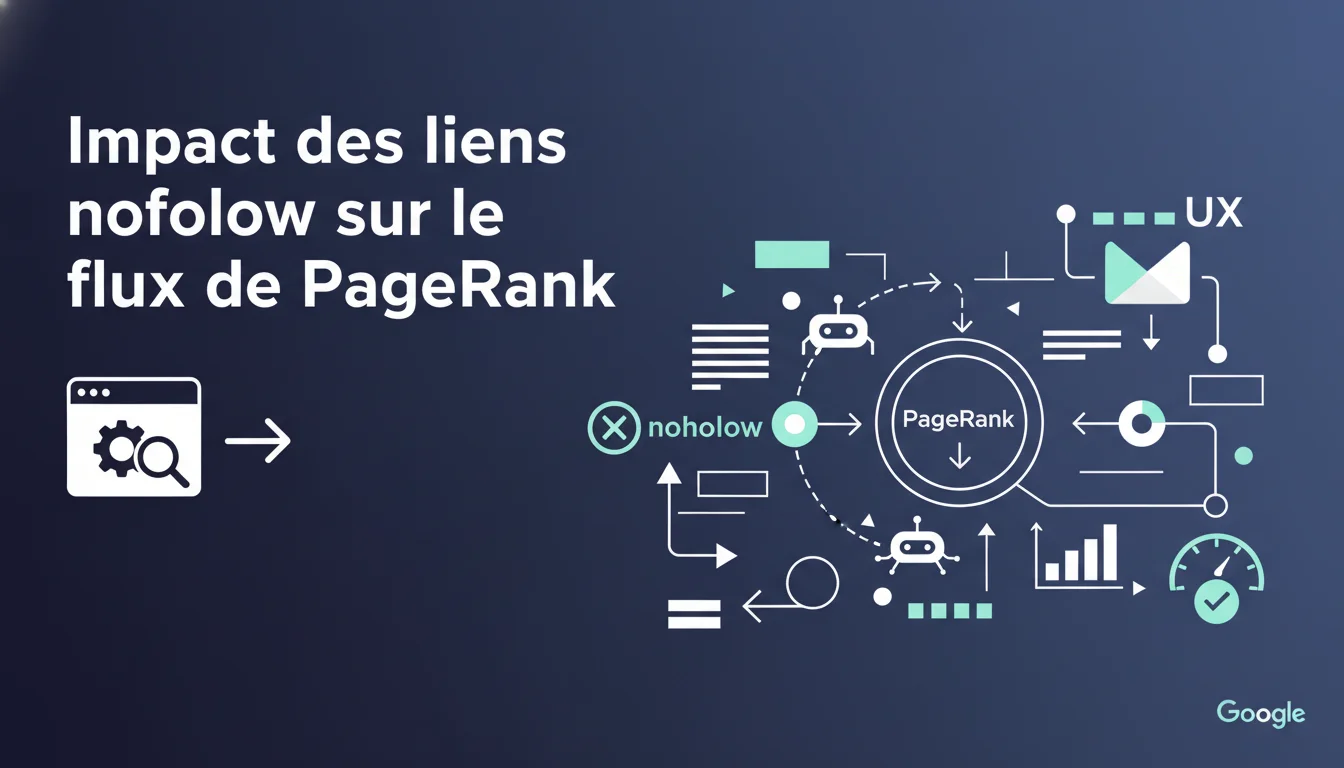
Google claims that nofollow links pass neither PageRank nor anchor text and are excluded from the link graph. For SEO practitioners, this means that sculpting internal PageRank using nofollow remains ineffective. It remains to be seen whether this statement covers all scenarios, particularly nofollow links converted to hints since March 2020.
What you need to understand
What Does This Statement Really Mean for the Link Graph?
When Google states that a nofollow link is not part of the link graph, it confirms that this link is not considered in the calculation of PageRank distribution. Specifically, if you place a nofollow attribute on an internal or external link, that link does not appear in the link modeling that Google uses to assess page authority.
This definitively contrasts with the old practice of PageRank sculpting, popular before 2009, which involved using nofollow on certain internal links to concentrate SEO juice on strategic pages. Google has explicitly eliminated this technique by changing how PageRank dissipates on pages containing nofollow links.
Why is This Clarification Coming Now?
Confusion has persisted since Google transformed the nofollow attribute into a hint rather than a strict directive. Now, Google may choose to ignore a nofollow if deemed relevant, particularly to better understand natural linking patterns or detect manipulations.
This statement serves as a reminder that even though Google can technically crawl a nofollow link, it does not pass either PageRank or anchor text. In other words, the link exists in the crawl but remains neutral from a ranking perspective. This is a crucial nuance for SEOs managing millions of links.
How is Anchor Text Treated in This Context?
Google clarifies that the anchor text of nofollow links is not passed. This means that a nofollow link pointing to a target page with the anchor "best SEO tool" will not enrich the semantic profile of that page in Google's eyes.
For a practitioner, this is strategic information: nofollow links on third-party sites can generate referral traffic but provide no thematic relevance signal. If you obtain a nofollow link from an influential media outlet, you gain visibility but not algorithmic authority.
- Nofollow links are excluded from the link graph used to calculate PageRank.
- Internal PageRank sculpting via nofollow has not worked since 2009.
- The anchor text of nofollow links is not passed, hence no semantic signal.
- Google can crawl nofollow links (hints) but does not prioritize them in ranking.
- A nofollow link is useful for referral traffic, not for SEO authority.
SEO Expert opinion
Is This Statement Consistent with Field Observations?
On paper, yes. Empirical tests show that a nofollow link does not improve the ranking of a target page, unlike an equivalent dofollow link. Backlink tracking tools confirm that nofollow links do not appear in domain authority metrics calculated by third parties like Ahrefs or Moz.
However, a gray area remains: since nofollow has become a hint, Google reserves the right to ignore it in certain contexts. [To be verified] if Google sometimes uses nofollow links to refine its understanding of a page's context without passing PageRank. Official documentation remains vague on this point.
What Nuances Should Be Considered Based on Link Type?
Not all nofollow links hold the same value. A nofollow link placed in an e-commerce site footer to comply with Google's guidelines (affiliate links, UGC) does not carry the same strategic weight as an editorial nofollow link in a leading press article.
The referral traffic generated by a quality nofollow link can indirectly boost SEO: more visitors, positive behavioral signals, or even social shares that attract secondary dofollow links. So even if the nofollow link transmits nothing directly, its leverage effect remains real.
Another nuance: sponsored and ugc links, introduced in 2019 alongside nofollow, are treated by Google as nofollow variants. They also do not pass PageRank but help Google better classify link types to refine its anti-spam filters.
In What Cases Does This Rule Not Really Apply?
There are situations where the boundary becomes porous. For example, Google has confirmed that links in JavaScript can be crawled and valued if rendered correctly. If a nofollow link is injected via JS and Google chooses to interpret it as a hint, it could theoretically consider it in certain relevance calculations.
[To be verified] also the cases where a nofollow link appears in a strong editorial content environment, surrounded by dofollow links. Google could use this context to better understand the source page, even if the link itself remains neutral. No official documentation settles this point.
Practical impact and recommendations
What Should You Do with Internal Nofollow Links?
Immediately cease any attempts at PageRank sculpting through nofollow on your internal links. This technique has been dead since 2009, and Google confirms it in black and white. If you are looking to optimize internal PageRank distribution, focus instead on an intelligent link architecture: clear hierarchy, contextual internal linking, links from high-authority pages to strategic pages.
Reserve internal nofollow only for cases where you really need to block crawl or authority transmission: login pages, e-commerce cart, product sorting filters, thank-you pages. Everywhere else, leave links as dofollow to maximize PageRank flow.
What Mistakes Should Be Avoided with External Nofollow Links?
Do not overload your pages with external nofollow links out of fear of "leaking PageRank". Google has designed its algorithm to naturally handle outgoing links. A dofollow link to a quality source can even enhance the relevance of your content in Google's eyes.
Use nofollow (or sponsored/ugc) only when justified: affiliate links, sponsored content, unmoderated comments, links added by users. If you nofollow all your outgoing links systematically, you send a strange signal to Google and deprive your content of useful semantic context.
How to Audit and Correct Misplaced Nofollow Links?
Conduct a complete crawl of your site with Screaming Frog or Oncrawl, export all internal links, and filter those marked as nofollow. Check if any strategic links (to your landing pages, key product pages, pillar articles) are accidentally set as nofollow. Correct these as a priority.
For external links, identify those pointing to quality editorial resources and remove the nofollow if added out of excessive caution. Keep the nofollow on commercial, affiliate, or UGC links to stay compliant with Google guidelines and avoid any manual penalties.
These optimizations may seem simple in theory, but they require careful analysis of your link architecture and SEO goals. If you manage a complex site with thousands of pages, it may be wise to hire a specialized SEO agency for personalized guidance to avoid costly errors.
- Remove all nofollow attributes from strategic internal links (unless technically justified).
- Keep nofollow on non-essential internal links: login, cart, filters, utility pages.
- Reserve nofollow/sponsored/ugc for commercial, affiliate, or user-generated external links.
- Allow dofollow links to quality editorial sources to enhance semantic context.
- Regularly audit your internal link profile to detect accidental nofollows.
- Document your nofollow policy to ensure consistency between editorial and technical teams.
❓ Frequently Asked Questions
Un lien nofollow peut-il quand même m'apporter du trafic ?
Faut-il nofollowtous mes liens sortants pour garder mon PageRank ?
Les attributs sponsored et ugc fonctionnent-ils différemment de nofollow ?
Puis-je encore utiliser nofollow pour le PageRank sculpting interne ?
Google peut-il ignorer un attribut nofollow depuis qu'il est devenu un hint ?
🎥 From the same video 3
Other SEO insights extracted from this same Google Search Central video · duration 2 min · published on 24/02/2011
🎥 Watch the full video on YouTube →
💬 Comments (0)
Be the first to comment.