
Official statement
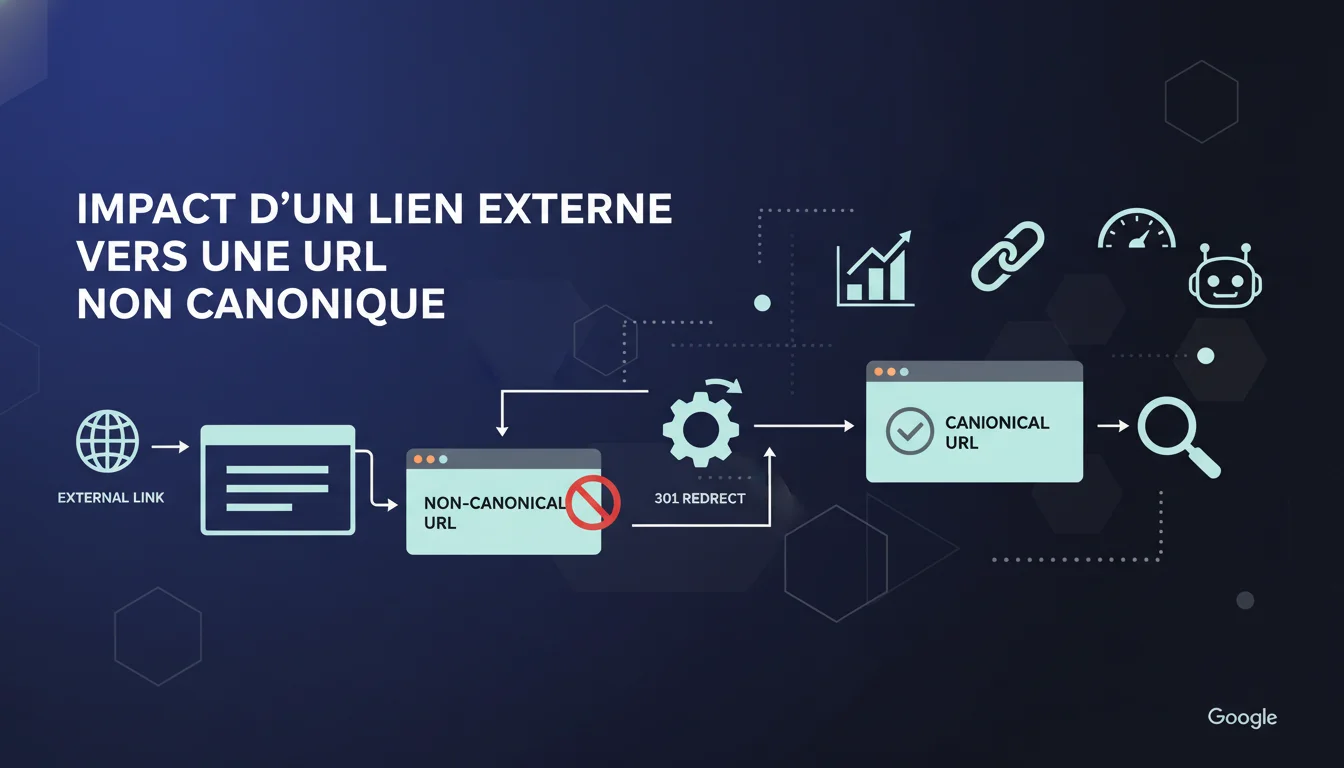
Google states that it attempts to combine signals from external links pointing to duplicate URLs to transfer them to the canonical URL. In practice, this transfer is neither automatic nor guaranteed: some PageRank dissipates. The stakes are twofold: first, prevent the proliferation of duplicate URLs, and second, implement 301 redirects or use the rel=canonical tag to limit losses. Relying on Google to automatically consolidate everything means leaving authority on the table.
What you need to understand
Does Google really consolidate all backlinks to the canonical URL?
Google claims to "try" to combine links pointing to non-canonical URLs so that they pass to the canonical URL. This vague formulation conceals a more nuanced reality. The engine detects duplicates through canonical signals (rel=canonical tag, 301 redirects, XML sitemaps, consistency of internal linking), then attempts to aggregate popularity signals onto a single version.
But this process is never perfect. Part of the PageRank dilutes in internal logical redirects, and Google guarantees no recovery rate. If ten backlinks point to five variations of URLs (with or without www, with trailing slash, UTM parameters, outdated HTTP versions), the engine will have to guess which version to favor. The more divergence there is, the greater the risk of authority fragmentation.
Why does Google mention three levels of solution (structure, 301, rel=canonical)?
The hierarchy is clear: the ideal is to never create duplicates upstream. In practical terms, this means normalizing URLs from the design phase (only one format for trailing slashes, one protocol, one reference subdomain). If duplicates already exist, the 301 redirect becomes the preferred solution: it consolidates PageRank with a low loss (estimated between 5 and 15% depending on the case).
The rel=canonical tag only comes in third place. Why? Because it is a directive, not an order. Google can ignore it if it detects inconsistencies (internal linking pointing to the non-canonical, contradictory hreflang tag, XML sitemap listing the wrong version). Furthermore, the rel=canonical does not transfer user signals (time on site, bounce rate) since the URL visited remains the one received by the browser.
What is the real loss if nothing is done?
Without intervention, Google will choose the canonical URL itself. Often, it is not the one you would have chosen. The engine may favor the version that receives the most raw backlinks, even if it is a parameterized URL or an outdated HTTP variant. The result: you lose control over the indexed version, and the PageRank disperses across multiple variants without optimal consolidation.
Field observations show that sites with 20 to 30% of their backlinks pointing to duplicates can lose 10 to 25% of their potential organic visibility. This is not a penalty; it is simply authority that does not properly rise to the canonical version.
- Google tries to consolidate backlinks, but it is neither automatic nor total.
- The 301 redirect remains the most reliable lever for transferring PageRank.
- The rel=canonical is an interpretable directive, not an absolute guarantee.
- The proliferation of duplicate URLs fragments authority even without a penalty.
- Without upstream normalization, Google chooses the canonical URL itself, often incorrectly.
SEO Expert opinion
Is this statement consistent with field observations?
Yes, but it minimizes the reality of loss. Google claims to "try to combine" links, which explicitly means that it sometimes fails. Controlled environment tests show that when multiple duplicate URLs receive backlinks without clear redirection or canonicalization, PageRank fragments in a measurable way. [To be verified]: Google does not publish any official recovery ratio or metrics in Search Console to quantify this loss.
What is certain is that sites with a clean URL architecture (no duplicates, well-configured redirects) rank better with the same backlink budget. Google's statement remains intentionally vague about cases where consolidation completely fails, especially when signals contradict each other (rel=canonical pointing to A, internal linking to B, sitemap listing C).
What nuances should be applied to the rel=canonical?
The rel=canonical is treated as a strong suggestion, not as an absolute directive. Google can ignore it if other signals contradict it. For example, if a non-canonical URL receives 80% of the backlinks and the internal linking mostly points to it, Google may decide to index it despite the tag. The result: your intention for canonicalization is circumvented.
Another limitation: the rel=canonical does not redirect user traffic. If a hundred visitors arrive via a backlink pointing to a non-canonical URL, they land on that version. Their behavior (bounce rate, time on site) is logged on the wrong URL. These UX signals do not necessarily rise to the canonical version, creating a disparity between link authority and behavioral signals.
When does consolidation completely fail?
Consolidation fails when the signals are too contradictory. Typically: a URL A is defined as canonical, but URL B receives 90% of the backlinks, appears in the XML sitemap, and is the only version with unique content. Google will interpret this as a configuration error and may index B anyway.
Another case: poorly managed UTM parameters. If your backlinks systematically include tracking parameters (utm_source, utm_campaign), and you have not normalized these URLs via rel=canonical or through URL parameters in Search Console, Google will create as many candidate versions as there are parameter combinations. Consolidation becomes impossible. [To be verified]: Google does not document the threshold at which it ceases to consolidate.
Practical impact and recommendations
What concrete steps should be taken to avoid PageRank fragmentation?
First step: audit indexed URLs using site:votredomaine.com in Google, then cross-reference with URLs present in your XML sitemap and those receiving backlinks (via Ahrefs, Majestic, or Search Console). Any divergence reveals a risk of fragmentation. Next, normalize URLs by choosing a unique convention (www or non-www, HTTPS, trailing slash or not) and enforce it everywhere: internal linking, sitemap, canonical tags.
Second lever: implement permanent 301 redirects for all variants to the canonical URL. This applies to old domains, HTTP variants, versions with or without index.php, etc. The 301 is the only way to ensure a PageRank transfer close to 100%. The rel=canonical is not sufficient if URLs remain directly accessible.
What mistakes to avoid when implementing the rel=canonical?
Classic mistake: pointing the rel=canonical to a URL that returns a 404 error or a redirect. Google then ignores the tag because the target is not valid. Another trap: chaining canonicalization (A canonicalized to B, B canonicalized to C). Google follows at most one or two hops, then gives up. The result: A is never consolidated to C.
Third mistake: using the rel=canonical on pages that are genuinely differentiated (unique content, distinct search intent) just to "merge" their authority. Google detects semantic inconsistency and ignores the tag. The rel=canonical is not a lever for manipulating PageRank; it is a signal for managing legitimate duplicates.
How to check that Google respects my canonicalization?
In Search Console, go to the "Coverage" section and then "Excluded," and check the URLs marked as "Duplicate, user-selected canonical URL different." If Google displays "Google-selected canonical URL different from user-selected," it means it has ignored your directive. Identify why: internal linking inconsistency, contradictory hreflang tag, non-canonical version receiving more backlinks.
Another check: extract URLs receiving backlinks via your preferred tool, then compare with indexed URLs in Google. If a non-canonical URL remains indexed despite the tag, it is because Google is not respecting it. You then need to strengthen signals: 301, consistency in linking, remove the non-canonical version from the sitemap.
- Audit indexed URLs, those in the sitemap, and those receiving backlinks.
- Normalize URLs (protocol, subdomain, trailing slash) uniformly.
- Implement 301 redirects for all variants to the canonical version.
- Check that each rel=canonical points to a valid URL (no 404s, no chains).
- Control in Search Console that Google respects the chosen canonicalization.
- Clean the XML sitemap: list only canonical URLs.
💬 Comments (0)
Be the first to comment.