
Official statement
What you need to understand
What is Google's official position on hyphens?
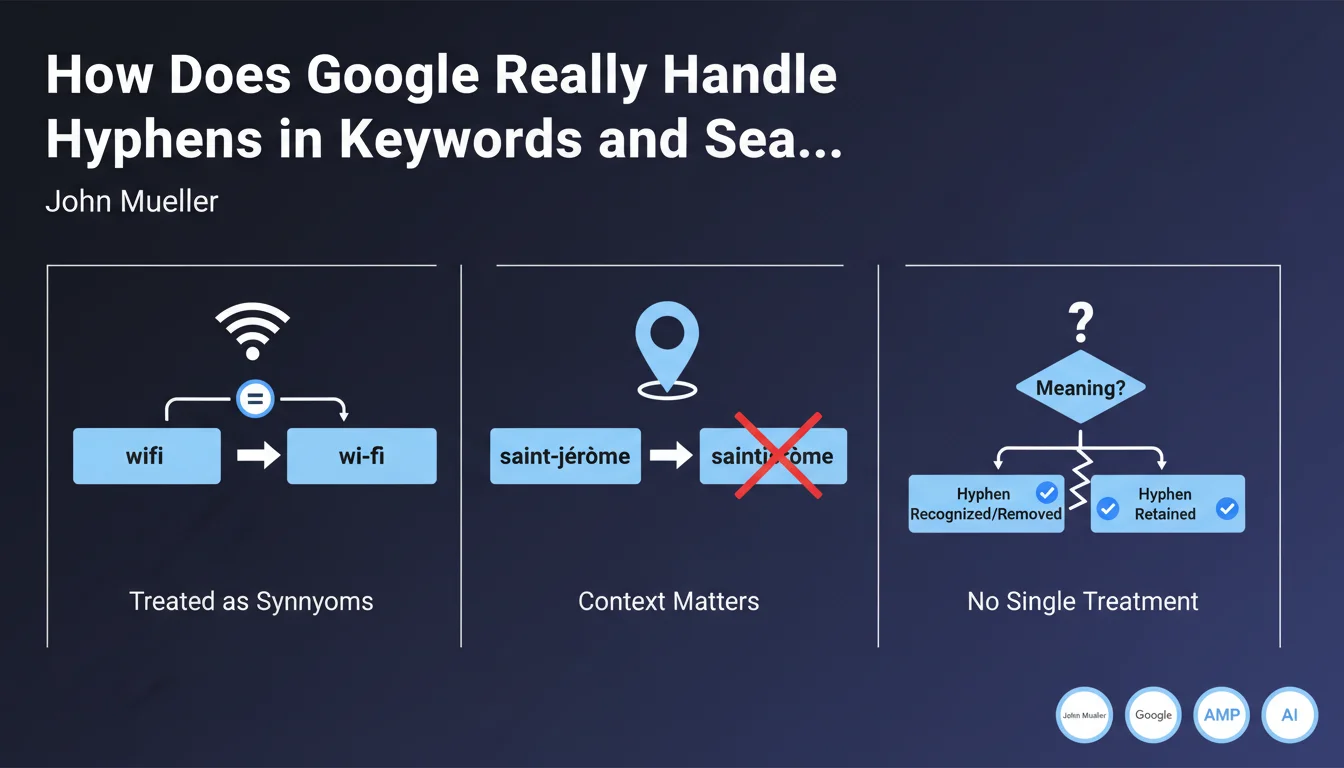
Google does not uniformly treat words containing hyphens. The search engine adapts its behavior according to the semantic context and linguistic usage of the term.
For example, "wifi" and "wi-fi" are considered interchangeable synonyms, while "saint-jérôme" (city) and "saintjérôme" (combined) will be treated as two distinct entities. This contextual intelligence allows Google to refine the relevance of results.
Why does this contextual approach change the game for SEO?
This statement confirms that Google uses advanced semantic analysis rather than a simple mechanical rule. The engine understands the intent and meaning behind words.
For SEO practitioners, this means there is no single formula to apply systematically. Each case must be evaluated individually based on the domain and industry vocabulary.
What are the key takeaways from this statement?
- Hyphen treatment is contextual and not systematic
- Certain terms with or without hyphens are treated as perfect synonyms
- Other expressions maintain a strong semantic distinction with or without hyphens
- Google relies on linguistic usage and context to decide on treatment
- You must test empirically each case rather than apply a general rule
SEO Expert opinion
Is this statement consistent with field observations from SEO professionals?
Absolutely. Empirical tests conducted over the years across different sectors confirm this treatment variability. Experienced SEO professionals regularly observe that Google sometimes offers identical results, sometimes different ones depending on the presence or absence of a hyphen.
This statement makes official what practitioners were already observing: Google uses its semantic intelligence to understand intentions rather than applying rigid orthographic rules. This fits into the natural language processing (NLP) logic that Google is massively deploying.
What important nuances should be added to this rule?
The main nuance concerns niche queries or specialized technical vocabulary. In these contexts, Google has less usage data to establish synonyms, and may therefore treat spelling variations more literally.
You must also consider proper names and brands. For these entities, spelling accuracy matters more, as "Jean-Pierre" and "Jeanpierre" may refer to two different people.
In what cases might this contextual intelligence fail?
Google may encounter difficulties with recent neologisms or ultra-specialized terms for which it hasn't accumulated enough usage data. In these situations, the engine may treat variants as distinct by default.
International markets or less-documented languages may also present less sophisticated hyphen treatment, with a more mechanical than intelligent approach.
Practical impact and recommendations
What should you actually do to optimize your content?
The first step is to identify all key terms in your sector potentially containing a hyphen. List common spelling variations in your domain.
Next, perform comparative searches on Google for each variant. Analyze whether the SERPs (search results pages) are identical or different. This empirical analysis will tell you how Google specifically treats your terms.
For your content, prioritize the most common spelling in your sector, while naturally including variants in your texts if they are used by your audience.
What critical mistakes should you absolutely avoid?
- Don't assume that a rule observed for one word applies to all others
- Avoid over-optimizing by artificially repeating all spelling variations
- Don't neglect analyzing actual queries typed by your users (Search Console)
- Never sacrifice editorial quality to force an unnatural spelling variant
- Avoid spelling inconsistencies within the same content (choose one version and stick to it)
How can you verify and monitor the treatment of your keywords?
Use Google Search Console to identify the exact queries generating impressions and clicks. You'll see which variants (with or without hyphens) are actually being searched and how Google associates your pages with these queries.
Set up regular monitoring of positions on strategic spelling variations. Rank tracking tools allow you to track evolution for each variant and detect potential differences in treatment.
Also analyze the behavior of featured snippets and PAA ("People Also Ask"). These elements often reveal how Google categorizes and connects different spellings of the same concept.
💬 Comments (0)
Be the first to comment.