
Official statement
What you need to understand
What Is the True Nature of the Hummingbird Algorithm?
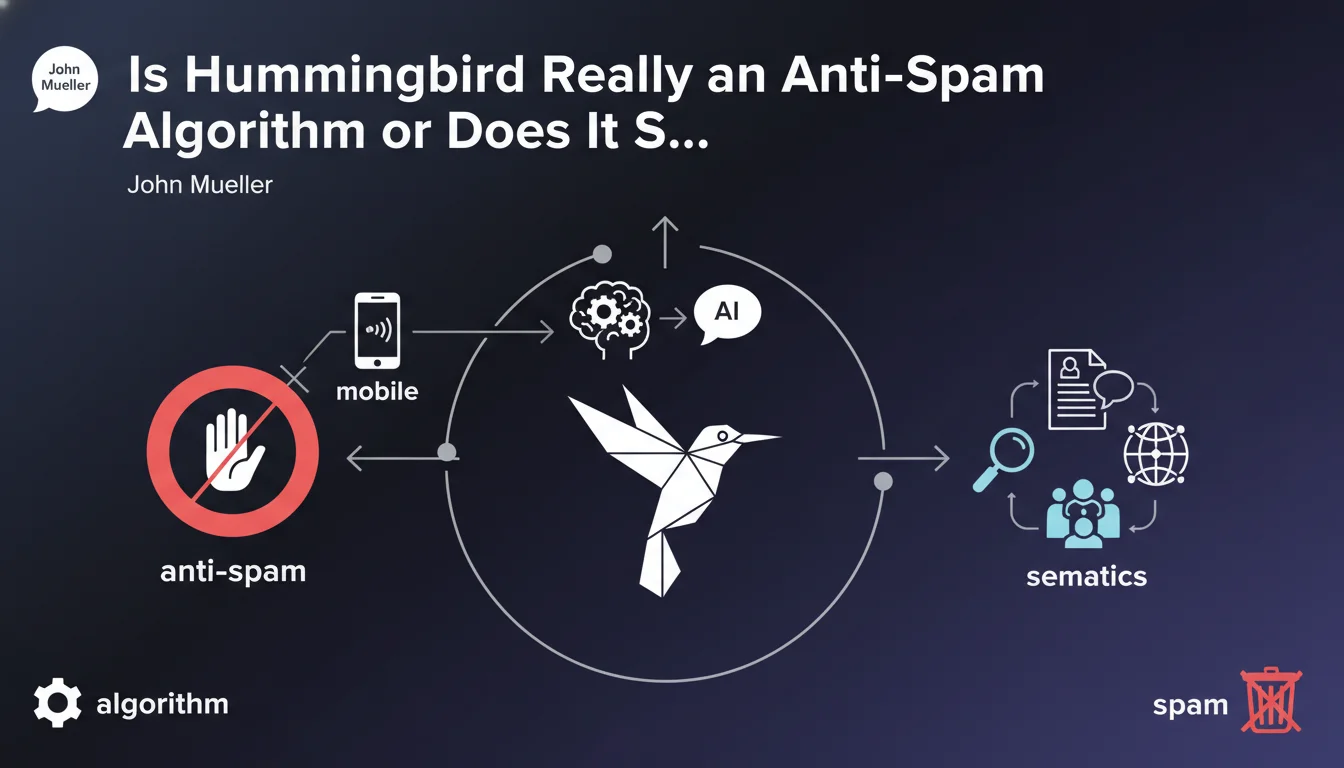
Launched in 2013, Hummingbird represents a major overhaul of Google's core algorithm, not just a simple anti-spam filter like Penguin or Panda. This fundamental update marked a turning point in how Google understands and interprets user queries.
The primary objective of Hummingbird is to shift from a literal understanding of keywords to a semantic analysis of the actual meaning of the query. Google no longer simply matches words, but seeks to understand the intent behind the search.
Why Was This Evolution Necessary in 2013?
The emergence of voice search and the explosion of mobile traffic made the traditional keyword-based approach obsolete. Users were now formulating queries in natural language, with complete, conversational sentences.
Hummingbird enabled Google to effectively process long-tail queries and complex questions, particularly those beginning with "how", "why", "where", typical of voice search.
How Are Hummingbird and RankBrain Connected?
RankBrain, integrated in 2015, is indeed a component born from Hummingbird. It uses machine learning to further refine the semantic understanding of queries and improve the relevance of results.
- Hummingbird is not an anti-spam filter but a fundamental evolution of the search engine
- It focuses on semantic understanding rather than keyword matching
- This update addresses the needs of voice and mobile search
- RankBrain is its logical extension based on artificial intelligence
- Search intent becomes more important than exact keywords
SEO Expert opinion
Is This Statement Consistent with What We Observe in Practice?
Absolutely. The analysis of SERP fluctuations since 2013 confirms that Hummingbird does not directly penalize spammy sites. Sites sanctioned for spam are targeted by other filters such as Penguin (artificial links) or updates for low-quality content.
What we observe with Hummingbird is rather a reclassification of results favoring content that precisely answers user intent, even if it doesn't use exactly the same keywords as the query.
What Important Nuances Should We Add to This Understanding?
While Hummingbird is not anti-spam, it can nonetheless indirectly disadvantage certain outdated SEO practices. Over-optimized pages with excessive repetition of exact keywords lose relevance compared to naturally written content.
The distinction is subtle: Hummingbird doesn't punish spam, but it rewards semantic quality. Poor or artificial content will simply have less chance of ranking, not because it's penalized, but because it doesn't meet the required level of relevance.
In Which Contexts Is Hummingbird's Impact Most Visible?
The impact is greatest on long, conversational queries, particularly those from voice search. E-commerce sites and informational content answering specific questions have been the big winners.
Conversely, sites basing their strategy solely on short generic keywords have often seen their visibility fragment in favor of competitors offering more specific and contextual answers.
Practical impact and recommendations
How Can You Concretely Adapt Your Content Strategy to Hummingbird?
The absolute priority is to think intent rather than keywords. For each page, clearly identify which user question you're answering and structure your content around this central problem.
Favor natural language in your content. Write as you would speak to a customer or colleague, using synonyms, variations and a rich lexical field rather than mechanically repeating the same keyword.
Develop semantic linking between your pages. Related concepts should be logically connected, allowing Google to understand the depth and thematic coherence of your site.
What SEO Mistakes Should You Absolutely Avoid in the Hummingbird Era?
Immediately stop over-optimization through exact keyword repetition. This practice has been ineffective since Hummingbird, and it harms user experience and can be interpreted as keyword stuffing.
Don't ignore long-tail queries and natural questions. These now generate most qualified traffic, especially from mobile devices and voice assistants.
Avoid creating separate pages for each minor keyword variation. Hummingbird understands synonyms and variants: one comprehensive page covering a topic is better than ten thin pages on variations.
How Can You Verify That Your Site Fully Benefits from Hummingbird?
Analyze your rankings on long-tail queries in Search Console. If you rank well only on your exact keywords but not on related variants and questions, your content probably lacks semantic richness.
Test voice search on your topic. Ask natural questions to your voice assistant and check if your site appears in the answers. This is an excellent indicator of your Hummingbird compatibility.
- Conduct a semantic audit of your main content to identify lexical gaps
- Create FAQ pages answering the natural questions of your audience
- Enrich your content with synonyms and related terms without forcing density
- Structure your articles with question-formatted subheadings (like in this article)
- Implement schema.org markup to help Google understand your content
- Analyze "People Also Ask" to identify associated questions to cover
- Optimize for featured snippets by directly answering questions
- Develop a semantic cocoon with relevant contextual links
- Monitor your performance on conversational queries in Search Console
💬 Comments (0)
Be the first to comment.