
Official statement
What you need to understand
Hreflang tags are essential technical elements for indicating to Google the linguistic and regional versions of your web pages. They allow the search engine to serve the right content version to users based on their language and location.
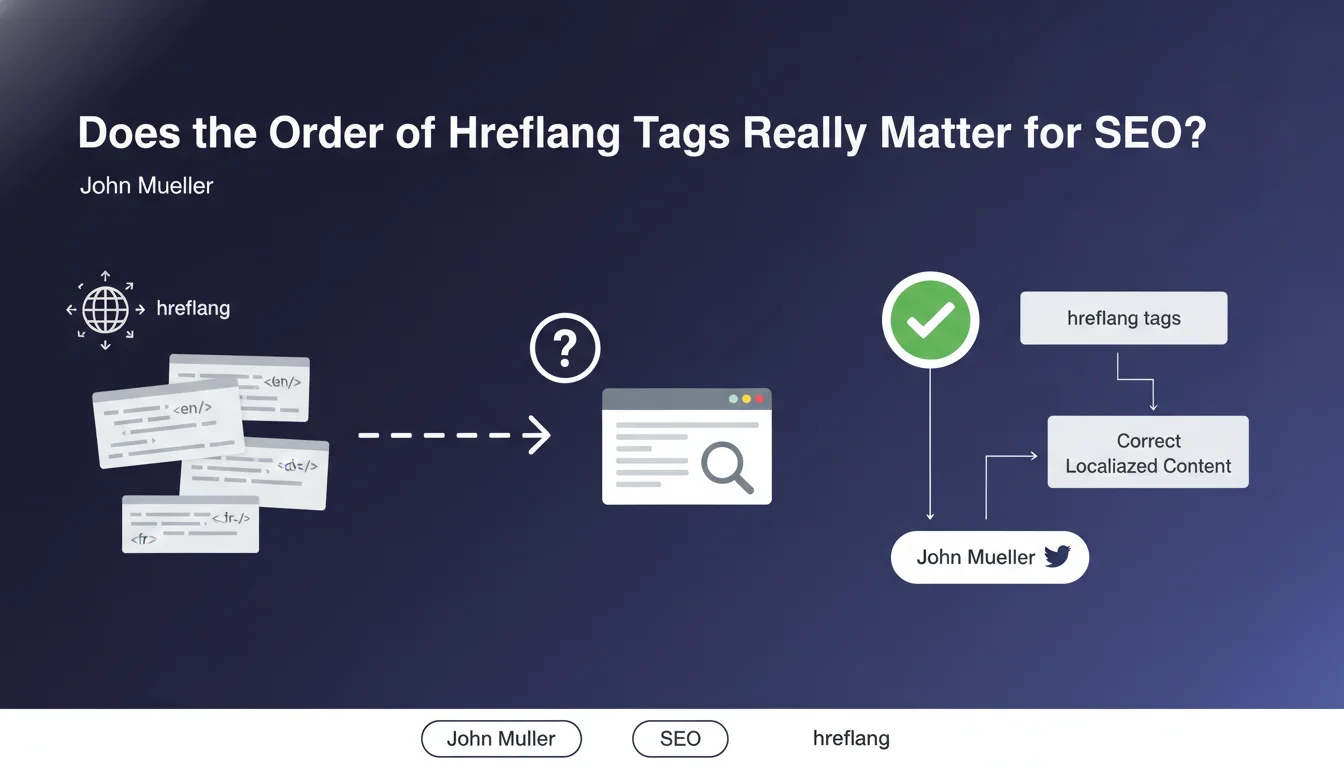
John Mueller's statement provides important clarification: the order in which you place these tags in the HTML code has no impact on how Google processes them. Whether you list the French version first then English, or vice versa, the result will be identical.
This information makes sense from a technical standpoint: Google reads and parses all hreflang tags present in the code, regardless of their sequence. The search engine treats these tags as a set of bidirectional relationships, not as a hierarchical list.
- The order of appearance of hreflang tags in the source code doesn't matter
- Google treats these tags as a complete set of declarations
- Priority should be placed on the consistency and accuracy of implementations
- Syntax errors or missing relationships remain the real problems to avoid
SEO Expert opinion
This statement is perfectly consistent with the field observations we've been making for years. In our international SEO audits, we have indeed found that the order of hreflang tags never influenced Google's behavior regarding geographic targeting.
What really matters is the reciprocity of declarations: if the FR page points to the EN page, the EN page must point back to the FR page. The most common errors actually concern these missing relationships, incorrect language codes (fr-fr instead of fr-FR), or malformed URLs.
The real complexity of hreflang lies in its consistent implementation across the entire site. A multilingual site with 5 languages and 1000 pages potentially requires 5000 perfectly synchronized declarations, which represents a considerable technical challenge.
Practical impact and recommendations
- Don't waste time optimizing the order of your existing hreflang tags: focus on their accuracy
- Check the reciprocity of all your hreflang declarations between different language versions
- Use Search Console to identify real hreflang errors (incorrect language codes, 404 URLs, missing relationships)
- Standardize your implementation according to a logic that suits you: alphabetical, by traffic volume, or any other criteria facilitating maintenance
- Document your approach so technical teams maintain consistency when adding new languages
- Prioritize automated testing to validate the integrity of your hreflang declarations with each deployment
- Regularly audit your entire multilingual architecture to detect inconsistencies over time
The order of hreflang tags is a false SEO problem. Focus your efforts on the quality and completeness of your declarations rather than their sequence.
The real added value lies in a coherent multilingual architecture, perfect bidirectional relationships, and rigorous maintenance of these technical elements.
Implementing and maintaining a robust hreflang strategy on an international site can prove particularly technical, especially during migrations or redesigns. Given the complexity of these configurations and the risks of errors that can significantly impact your international visibility, support from an SEO agency specialized in international SEO can help you secure your deployment and avoid the common pitfalls that affect many multilingual sites.
💬 Comments (0)
Be the first to comment.