
Official statement
What you need to understand
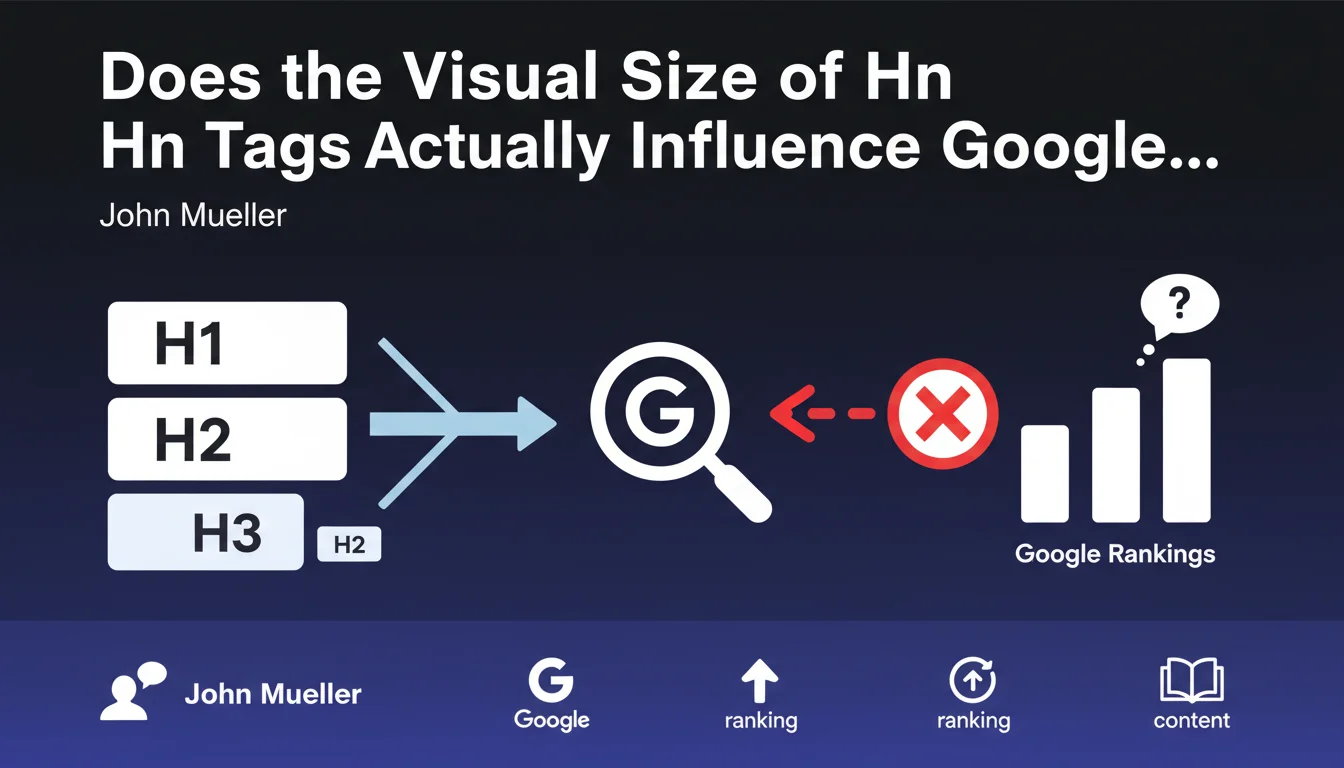
Google has clarified an important technical point regarding the analysis of HTML heading tags (H1, H2, H3, etc.). The display size of these tags, meaning their height in pixels defined by CSS styles, has no impact on content evaluation by search algorithms.
Concretely, this means that Google focuses solely on the presence and semantic structure of Hn tags in the HTML code. The search engine analyzes the textual content within these tags, their logical hierarchy, but completely ignores their visual appearance.
This clarification is important because it distinguishes between technical SEO optimization and visual design. Your H2 can perfectly well be styled smaller than a normal paragraph if it fits your brand guidelines, without any algorithmic penalty.
- Google analyzes HTML structure, not CSS rendering
- The pixel size of headings doesn't affect the SEO weight of keywords
- Semantic hierarchy (H1 > H2 > H3) remains important
- Common sense and user experience should take precedence over technical manipulations
SEO Expert opinion
This statement confirms what experienced SEO practitioners have long observed: Google has become sophisticated enough to separate the presentation layer (CSS) from the semantic structure (HTML). This is consistent with the evolution toward contextual content understanding.
Nevertheless, an important nuance is necessary. While Google doesn't directly evaluate heading size, it increasingly analyzes user experience signals. Headings that are too small or invisible would create a poor experience, which could indirectly impact rankings through metrics like bounce rate or time on page.
The recommended approach remains to design genuinely useful headings for users, with a clear hierarchy and a style that improves readability, regardless of purely technical considerations.
Practical impact and recommendations
- Free up your design: Don't hesitate to style your Hn tags according to your graphic needs without fear for SEO
- Prioritize logical hierarchy: Make sure your H1, H2, H3 follow a coherent and descriptive structure
- Avoid manipulations: Never create invisible or nearly invisible headings to stuff with keywords
- Optimize for the user: Your headings should improve readability and navigation, not just please robots
- Test accessibility: Verify that your headings remain visible and useful across all devices (mobile, tablet, desktop)
- Audit your structure: Use tools to check that your Hn hierarchy is correctly implemented
- Document your choices: Create a style guide that explains your use of Hn tags to maintain consistency
Optimizing the semantic structure of a site goes far beyond simple Hn tags and requires a comprehensive vision of information architecture. When these issues are part of a broader SEO strategy involving technical, editorial, and structural aspects, support from a specialized SEO agency can prove invaluable for orchestrating all these elements coherently and achieving lasting results.
💬 Comments (0)
Be the first to comment.