
Official statement
Other statements from this video 4 ▾
- □ Is Google finally addressing the technical complexity that plagues e-commerce sites?
- □ What technical problems are really dragging down e-commerce sites in Google search results?
- □ Does Google really offer free tools to help e-commerce businesses identify their SEO problems?
- □ Is Google finally showing you which technical SEO fixes will actually move the needle for your e-commerce site?
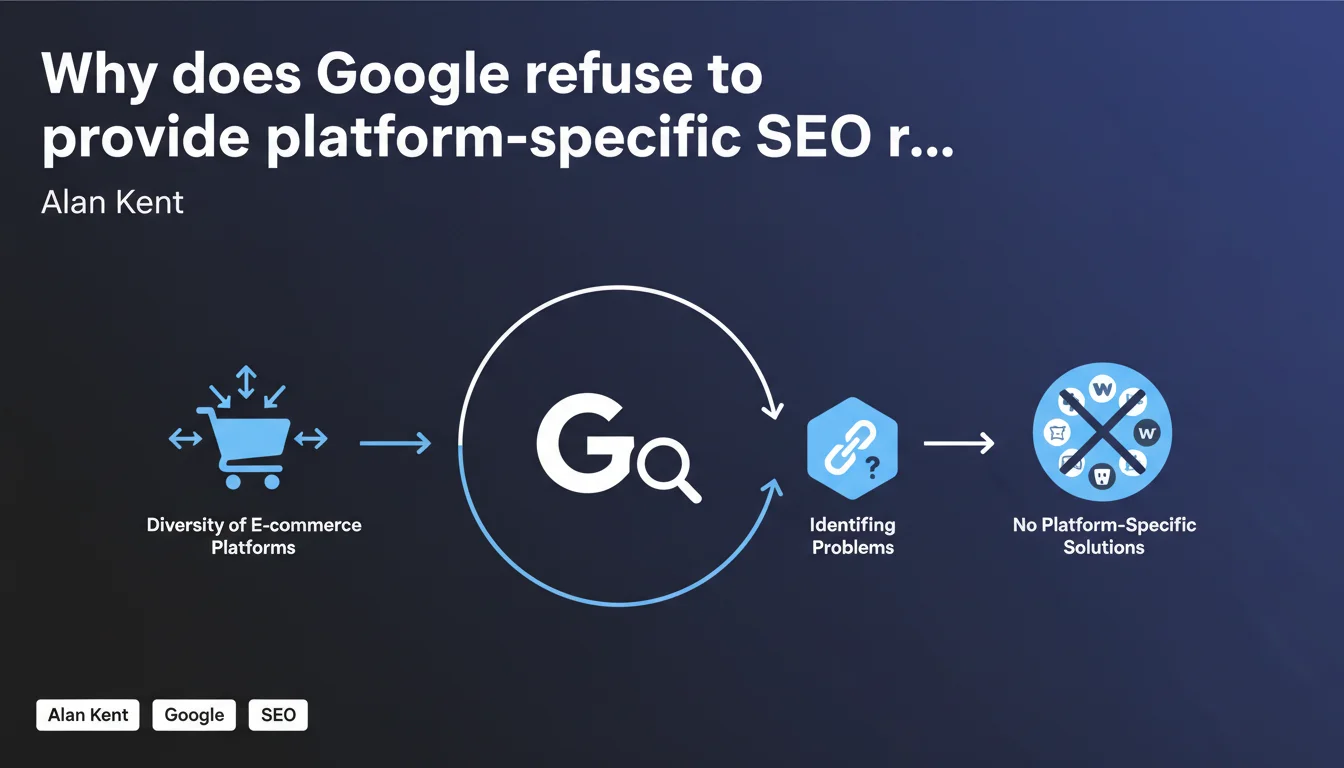
Google prioritizes generic SEO recommendations focused on problem identification rather than technical solutions specific to each platform. This approach is explained by the diversity of available e-commerce solutions, but it leaves SEO practitioners facing considerable adaptation work depending on the CMS they use.
What you need to understand
What is the logic behind Google's generic approach?
Google faces several thousand e-commerce platforms — from SaaS solutions like Shopify to open-source CMS like WooCommerce, including proprietary developments. Documenting technical solutions for each one would represent an enormous investment for teams that must keep these resources up to date.
The adopted strategy therefore consists of defining symptoms and problems rather than fixes. For example: identifying that a site generates too many indexable facets, without specifying how to disable this indexation in Magento versus PrestaShop.
Does this method really help SEO practitioners?
It's a double-edged sword. Experienced professionals know how to translate an identified problem into a technical solution adapted to their stack. Less experienced ones end up with a diagnosis without prescription — knowing that a site has a crawl budget issue without understanding how to solve it concretely.
Alan Kent confirms here what many observe: Google will not play the role of multi-platform technical documentation. It is up to editors, agencies and communities to fill this void.
What are the essential points to remember?
- Google concentrates its resources on identifying problems, not on implementation solutions
- The diversity of the e-commerce market makes exhaustive platform-by-platform documentation impossible
- Official recommendations remain intentionally technologically agnostic
- It is up to the SEO ecosystem to translate these principles into concrete actions according to the tools used
SEO Expert opinion
Is this position consistent with what we observe in the field?
Absolutely. The Search Central docs shine through their generality — sometimes frustratingly so. When Google mentions crawl budget or pagination, the technical examples remain superficial. No specific line of code, no reference to a particular plugin.
In practice, it is specialized communities that produce the real documentation: Shopify forums, WooCommerce groups, agency blogs. Google positions itself as the architect who describes the ideal building, not as the mason who shows you how to pour the foundation.
What nuances should be added to this statement?
There is a contradiction in execution. Google does maintain specific guides for certain verticals (news, jobs, recipes) with very detailed schema.org implementations. Why not for e-commerce when it's such a massive sector?
[To verify]: Does this generic position also serve to avoid taking responsibility for a technical recommendation that might become obsolete or cause damage? It's difficult to hold Google accountable when it never explicitly said how to do it.
In what cases does this rule not really apply?
Google makes exceptions for its own products. The docs on Google Merchant Center, product rich snippets or integrations with Google Shopping are much more precise. Naturally, it's their ecosystem.
We also observe that in off-record discussions, Google Developer Advocates sometimes provide technical hints for certain major platforms. But nothing official, nothing documented. It's the famous "it depends" that reigns supreme.
Practical impact and recommendations
What should you do concretely in light of this reality?
First rule: don't count on Google to spoon-feed you implementation work. Read the generic recommendations, then translate them in the context of your technical stack. Advice about canonical URLs should become an action in your CMS settings.
Invest in monitoring specific to your platform. Join active communities, follow experts who break down SEO issues specific to Shopify, Magento or others. They are the ones who will bridge the gap between Google's principles and code reality.
What mistakes should you absolutely avoid?
Don't fall into the trap of approximate interpretation. "Google says you must avoid duplicate content" doesn't mean the same thing depending on whether you manage a WordPress blog or a catalog of 50,000 products with variants.
Also avoid believing that a one-size-fits-all solution will work. An SEO plugin that works for a blog won't solve the structural issues of a multilingual store with dynamic inventory management.
How do you ensure that your e-commerce site is well optimized?
- Identify the specific problems of your platform through forums and community resources
- Cross-reference Google's generic recommendations with technical best practices specific to your CMS
- Test systematically: Search Console, regular crawls, crawl performance monitoring
- Document your technical choices and their measured impacts — you build your own knowledge base
- Stay up to date on your platform's developments, some updates can break existing optimizations
❓ Frequently Asked Questions
Google va-t-il publier un jour des guides spécifiques pour Shopify ou WooCommerce ?
Comment savoir si un problème identifié par Google s'applique à ma plateforme ?
Les recommandations génériques de Google sont-elles vraiment applicables à tous les CMS ?
Dois-je changer de plateforme si la mienne pose des problèmes SEO structurels ?
Où trouver des solutions techniques fiables pour ma plateforme e-commerce ?
🎥 From the same video 4
Other SEO insights extracted from this same Google Search Central video · published on 13/04/2022
🎥 Watch the full video on YouTube →
💬 Comments (0)
Be the first to comment.