
Official statement
What you need to understand
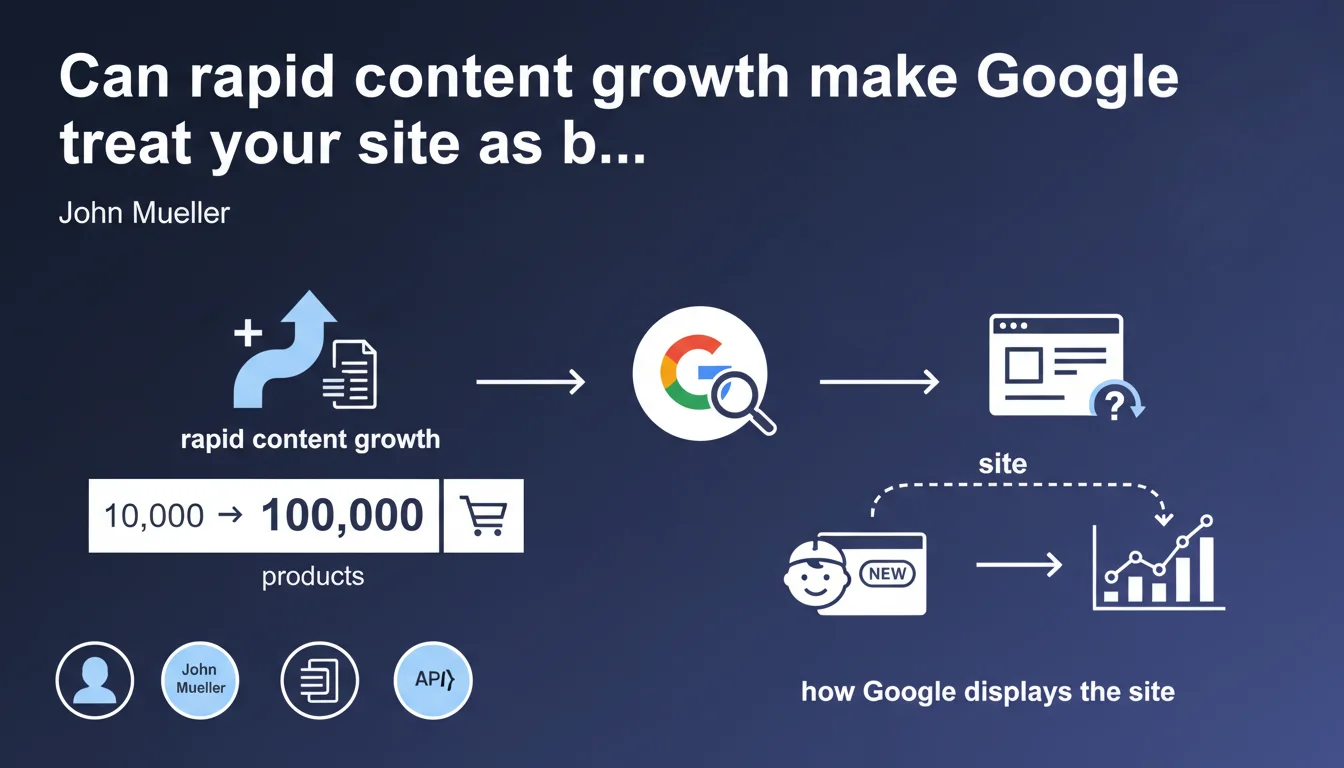
Google has algorithms that continuously evaluate the nature and credibility of websites. When a site experiences exponential content growth, this can trigger an alert signal in Google's systems.
Specifically, if your site suddenly goes from 10,000 to 100,000 pages or products, Google may interpret this change as a major transformation of your site. The search engine may then decide to completely reassess it, as if it were a new site.
This reassessment means your site could temporarily lose the trust it has accumulated and have to go through an extended observation phase again. Google will reanalyze the overall quality, content relevance, and legitimacy of this sudden expansion.
- Too rapid growth can be perceived as suspicious by Google
- The site may be treated as a new domain for several months
- Temporary loss of visibility can significantly impact organic traffic
- The reassessment process typically takes several months before stabilizing
SEO Expert opinion
This statement is perfectly consistent with the field observations we regularly make. Many e-commerce sites that have massively added products have indeed experienced significant fluctuations in their rankings, sometimes lasting 3 to 6 months.
However, this must be nuanced depending on context. A site that is already highly authoritative with a solid history can generally absorb greater growth than a recent site. Similarly, adding content to existing categories is less risky than creating entirely new sections.
The algorithm seems particularly sensitive to growth ratios that are unusual for your sector. A marketplace that doubles its catalog in one month will be judged differently from a blog that suddenly publishes 1,000 articles.
Practical impact and recommendations
- Plan your content additions over several months rather than publishing everything at once
- Establish a realistic publication calendar: for example, a maximum of 100-200 new pages per week for an established site
- Ensure that each wave of new content maintains a high and consistent quality level
- Monitor your metrics (crawl rate, indexing, rankings) during and after each expansion phase
- For large product catalogs, use a deployment strategy by successive categories rather than a global rollout
- Strengthen your internal linking progressively as you add content
- Avoid simultaneously activating thousands of pages that were in noindex or blocked from crawling
- Document your growth with consistent structured data to help Google understand your evolution
- If you absolutely must add content massively, prepare for a period of 3 to 6 months of potential volatility
These progressive deployment strategies require rigorous technical planning and constant monitoring of signals sent by Google. Orchestrating controlled content growth involves coordinating multiple levers: technical architecture, editorial calendar, crawl budget management, and predictive impact analysis. Faced with these complex challenges, many companies choose to collaborate with a specialized SEO agency that can establish a personalized roadmap, anticipate risks specific to your sector, and effectively manage this critical development phase.
💬 Comments (0)
Be the first to comment.