
Official statement
Other statements from this video 8 ▾
- 2:08 Do indexing errors really kill your Google traffic?
- 2:08 Are 'Valid with Warnings' pages really indexed by Google?
- 3:47 Should you rewrite your titles and descriptions when impressions skyrocket without clicks following?
- 3:47 Why are your target queries not showing up in Search Console?
- 4:50 Should you really create "comprehensive" content to rank on Google?
- 4:50 Should you really write unique titles and meta descriptions for every page?
- 4:50 Are header tags really a ranking factor or just a structural tool?
- 4:50 Has mobile-friendliness truly become an essential ranking criterion?
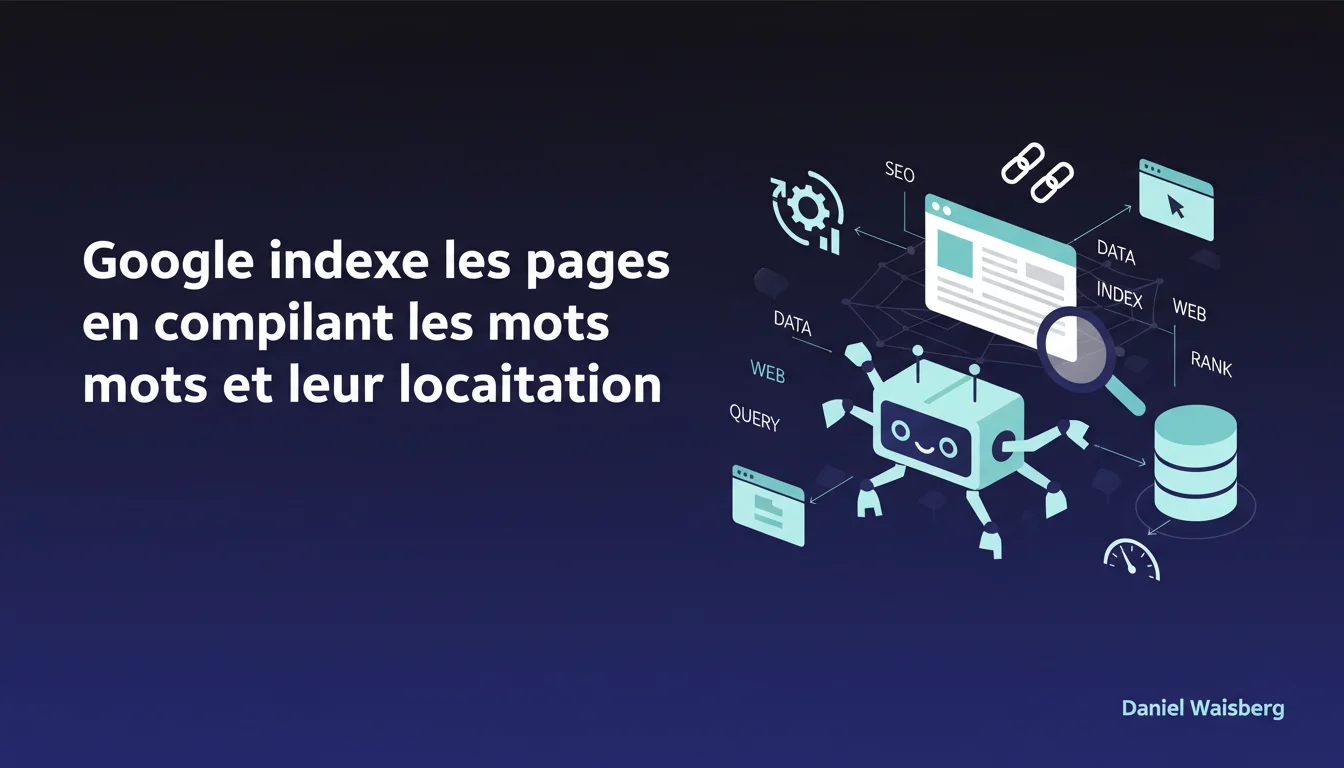
Google indexes the web by compiling every word it encounters and its precise location on each crawled page. This granularity of indexing means that the position, density, and context of your keywords directly influence the engine's ability to match your pages with relevant queries. For an SEO, this validates the importance of strategically placing important terms in high semantic visibility areas: titles, subtitles, and first paragraphs.
What you need to understand
Does Google index all words or does it selectively filter?
Daniel Waisberg's statement asserts that Google compiles all the words it sees on each crawled page. Contrary to some beliefs that persist among beginners, there is no pre-filtering based on a stop words list that would systematically exclude "the," "a," "of," or "and."
The engine stores the entire vocabulary encountered, but it's at the time of matching with the query that the algorithm weighs the relevance of each term. A function word alone will not trigger any significant ranking, but its presence in certain syntactical contexts can influence the overall semantic understanding of the page.
What does Google mean by "location" of words on a page?
The location is not limited to the linear position in raw HTML. Google analyzes the structural hierarchy of content: <title> tags, <h1> to <h6>, first paragraphs, internal anchor text, alt attributes of images.
This notion of location also includes semantic density zones — a word repeated five times in a block of 100 words will have different weight than if it appears just once in a 2000-word article. The immediate context (the words preceding and following) also plays a role in disambiguating meaning and qualifying intent.
Why does this statement matter for an SEO practitioner?
It reminds us that indexing precedes ranking and that without correct indexing of strategic terms, no positioning is possible. If a critical keyword is absent from the visible HTML (for example, hidden in client-side JavaScript without an SSR fallback), Google simply will not be able to integrate it into its index for that page.
It is also a clear signal about the value of semantic on-page optimization. Even though RankBrain, BERT, and MUM have significantly improved contextual understanding, the effective presence of searched terms and their strategic distribution remain essential fundamentals.
- Google indexes all words, not just the main keywords — lexical context matters.
- Structural location (semantic HTML tags) influences the weighting during query/page matching.
- Non-crawlable or non-rendered content (pure JS without SSR, external iframes, Flash) cannot be properly indexed.
- Google's index is massive but finite — crawl budget and indexing priorities remain real operational constraints.
- The location of words helps Google infer intent and the main theme of a page.
SEO Expert opinion
Is this statement consistent with field observations?
Yes, it aligns with recurring findings across thousands of audits. Pages that rank for competitive queries almost always show an explicit presence of searched terms in high semantic value areas (title, H1, first 100 words). The few exceptions involve sites with massive authority where Google infers relevance via overall context and named entities.
However, this statement remains deliberately generic. It does not specify how Google weighs locations, nor how it treats synonyms, morphological variations, or implicit entities. It also does not mention technical limitations: orphan pages never crawled, consolidated duplicate content, or insufficient crawl budget on large sites. [To be verified]: Does Google really index 100% of the visible text on a 10,000-word page, or does it apply truncation heuristics beyond a certain threshold?
What critical points does this statement overlook?
Firstly, it does not mention deduplication and canonicalization. Google may index words, but it massively consolidates duplicated or nearly-duplicated content. Two pages with 95% identical text will not be indexed separately with the same weight — one will likely be ignored or merged.
Secondly, no mention of off-page signals. Word indexing is necessary but not sufficient: a page may contain 50 occurrences of a keyword and never rank if it has no backlinks, no domain authority, and a terrible UX. Waisberg simplifies the pipeline here to make it accessible, but a practitioner knows that indexing is just the first step of the staircase.
In what cases does this rule not apply or is it insufficient?
For high transactional or local intent queries, the mere presence of words is not enough. Google prioritizes structured signals (Schema.org Product, LocalBusiness), user reviews, geographical proximity, and Google My Business data. A perfectly optimized e-commerce page in terms of keywords may be crushed by a competitor with less text but better reviews and a higher conversion rate.
Similarly, for YMYL (Your Money Your Life) queries, Google applies E-E-A-T filters that go beyond lexical indexing. A medical page can index all the right terms and remain invisible if the site lacks editorial authority, mentions of expert authors, or backlinks from recognized medical sources. [To be verified]: Does Google have minimum authority thresholds below which certain YMYL pages are simply not eligible for ranking, even if they are technically indexed?
Practical impact and recommendations
What concrete steps should be taken to optimize the indexing of critical words?
Start with a crawlability and rendering audit. Check with Google Search Console and a crawler (Screaming Frog, OnCrawl) that all your strategic pages are discovered and that their textual content is visible in the HTML cache. If you are using client-side JavaScript, test the rendering with the URL inspection tool in GSC.
Next, map out your priority keywords and ensure they appear in high-value structural locations: unique and descriptive title, explicit H1, H2/H3 subtitles that reflect semantic variations, first 150 words of content. Avoid grotesque over-optimization (keyword stuffing), but don't fall into the opposite excess — a keyword absent from the HTML will simply not be indexed for that page.
What indexing errors should absolutely be avoided?
Do not leave critical content hidden behind user interactions (accordions, tabs, modals) unless the source HTML contains the text. Google indexes what it sees in the DOM after rendering, but JS bugs or excessive loading delays can prevent complete indexing.
Also monitor inadvertent exclusion directives: accidental noindex tags, robots.txt blocking critical JS/CSS resources for rendering, canonical pointing to a wrong URL. A single misconfigured robots.txt file can exclude thousands of pages from the index. Regularly check the GSC coverage report for excluded pages or those indexed but not submitted.
How can you measure and validate that Google is correctly indexing your content?
Use the site: operator for spot checks, but do not rely on it for large volumes — it is notoriously inaccurate. Prefer Google Search Console, Coverage tab, for a comprehensive overview. Compare the number of pages submitted via XML sitemap and the number of pages effectively indexed.
To validate the indexing of keywords, conduct searches for long-tail and specific phrases present only on your target pages (e.g., an exact phrase of 8-10 words). If Google does not return your page as the first result, it is either not indexed, or it is considered duplicated or of very low quality. Also use the URL inspection tool to check the rendering and text retrieved by Googlebot.
- Audit crawlability: up-to-date XML sitemap, non-blocking robots.txt, solid internal linking.
- Check JavaScript rendering with the GSC URL inspection tool.
- Place your priority keywords in title, H1, H2, first paragraphs.
- Eliminate noindex tags, incorrect canonicals, and other unintentional blocks.
- Monthly monitor the GSC coverage report to detect regressions.
- Test the indexing of unique content with searches for long exact phrases.
❓ Frequently Asked Questions
Google indexe-t-il vraiment tous les mots d'une page, y compris les stop words ?
L'emplacement d'un mot-clé dans le HTML influence-t-il son poids pour le ranking ?
Si mon contenu est généré en JavaScript côté client, sera-t-il indexé correctement ?
Combien de temps faut-il pour qu'un nouveau contenu soit indexé par Google ?
Peut-on forcer l'indexation d'une page spécifique ou accélérer le processus ?
🎥 From the same video 8
Other SEO insights extracted from this same Google Search Central video · duration 5 min · published on 02/12/2020
🎥 Watch the full video on YouTube →
💬 Comments (0)
Be the first to comment.