
Official statement
What you need to understand
Why Is the Position of Country Indicators in the URL Important?
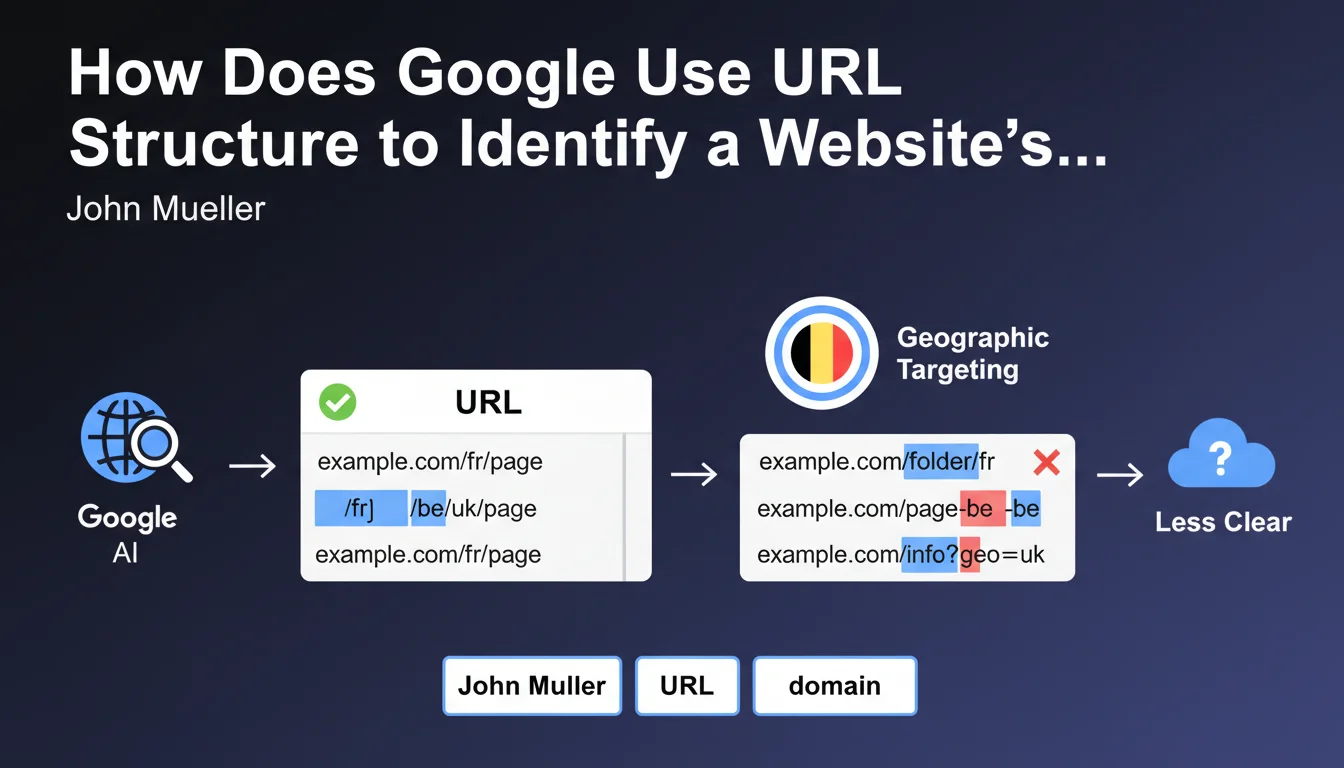
Google actively uses URL structure as a signal to identify the geographic target of content. When an international site uses country indicators like /fr/, /de/, /uk/, the position of these elements in the URL directly influences Google's ability to interpret them correctly.
Geographic indicators must appear immediately after the domain name (example.com/fr/category/page) and not at the end of a long URL chain. This rule allows Google to quickly understand that all content under this directory targets a specific country.
What's the Difference Between Country Targeting and Language Targeting?
A fundamental distinction in international SEO: you always target by country, never solely by language. French is spoken in France, Belgium, Switzerland, Canada, but each market has its specificities, search behavior, and expectations.
Google prioritizes geographic signals (country) rather than linguistic ones to display relevant results. A site with /fr/ will be interpreted as targeting France, not simply French speakers worldwide.
What Pitfalls Should You Avoid in International URL Structure?
The most common mistake consists of creating asymmetry in the structure: using a directory for certain countries (example.com/fr/) while leaving the root domain (example.com) for another country like the United States.
This approach creates ambiguity for Google and complicates geographic targeting. Each country version should have its own identifiable and consistent structure.
- Geographic indicators (/fr/, /be/, /uk/) must be placed right after the domain name
- Position in the URL directly influences Google's ability to identify targeting
- International SEO is done by country, not by language
- Avoid asymmetry: don't mix root domain without indicator and country subdirectories
- This structure helps Google segment and index each geographic version correctly
SEO Expert opinion
Is This Recommendation Consistent with Practices Observed in the Field?
Absolutely. Analyses of high-performing international sites confirm that URL structure clarity strongly correlates with better geographic positioning. Sites that place their country indicators immediately after the domain benefit from faster and more precise recognition by Google.
However, this rule must be combined with other signals: hreflang tags, geographic targeting in Search Console, local hosting, and backlinks from the targeted country. URL structure alone is not enough, but it constitutes an essential foundation.
What Nuances Should Be Added to This Statement?
The notion of "right after the domain name" deserves clarification. Google can tolerate an additional level if the structure remains consistent, but effectiveness decreases with complexity. A path like example.com/international/fr/ is less optimal than example.com/fr/.
For very large sites with complex architectures, there may be legitimate technical constraints. In these cases, reinforcing other geographic signals (hreflang, localized content, Search Console) becomes even more crucial to compensate.
In Which Cases Might This Rule Not Apply Fully?
Country code top-level domains (ccTLD like example.fr, example.de) already benefit from a strong geographic signal at the domain level. In this case, internal structure can be more flexible, although consistency remains recommended.
For sites with a subdomain strategy (fr.example.com), the geographic signal is also at the subdomain level. The URL position rule then applies differently, even though structural consistency remains important.
Practical impact and recommendations
What Should You Do Concretely to Optimize Your International URL Structure?
Start with a complete audit of your current architecture. Identify where your geographic indicators are located and verify consistency between different country versions of your site.
If you're creating a new international site, adopt from the outset a structure with country indicators immediately after the domain: example.com/fr/, example.com/de/, example.com/uk/. This structure must be uniform for all countries, without exception.
For an existing site with a problematic structure, plan a gradual migration. Well-managed 301 redirects allow authority transfer without major traffic loss, but require sharp expertise to avoid pitfalls.
What Critical Mistakes Should You Absolutely Avoid?
Never use the root domain (example.com) for one country and subdirectories for others. This asymmetry harms targeting and creates confusion for both Google and users.
Avoid placing geographic indicators at the end of URLs or in the middle of a long chain. A structure like example.com/products/clothing/fr/ is counterproductive and significantly reduces the geographic signal's effectiveness.
Don't mix approaches: choose between subdirectories, subdomains, or ccTLD, and remain consistent. Mixing these methods on the same site creates structural ambiguity that's difficult to manage.
How Can You Verify and Validate Your Current Structure's Compliance?
Use Google Search Console to verify international targeting for each section. Create distinct properties for each country version and configure appropriate geographic targeting in settings.
Test your hreflang tags with available validation tools. Ensure each page correctly points to its equivalents in other countries, with perfect consistency between URL structure and hreflang annotations.
Analyze your rankings in different targeted countries via geolocated position tracking tools. If a country version performs poorly in its target market despite good content, URL structure may be the cause.
- Place country indicators (/fr/, /de/, /uk/) immediately after the domain name
- Maintain symmetric structure: all countries with subdirectory, or all with ccTLD
- Configure geographic targeting in Google Search Console for each version
- Implement hreflang tags consistent with chosen URL structure
- Avoid root domain for one country and subdirectories for others
- Regularly audit international architecture consistency
- Plan careful 301 redirects in case of structure migration
- Localize content by country, not only by language
- Test geographic performance with localized positioning tools
💬 Comments (0)
Be the first to comment.