
Official statement
Other statements from this video 2 ▾
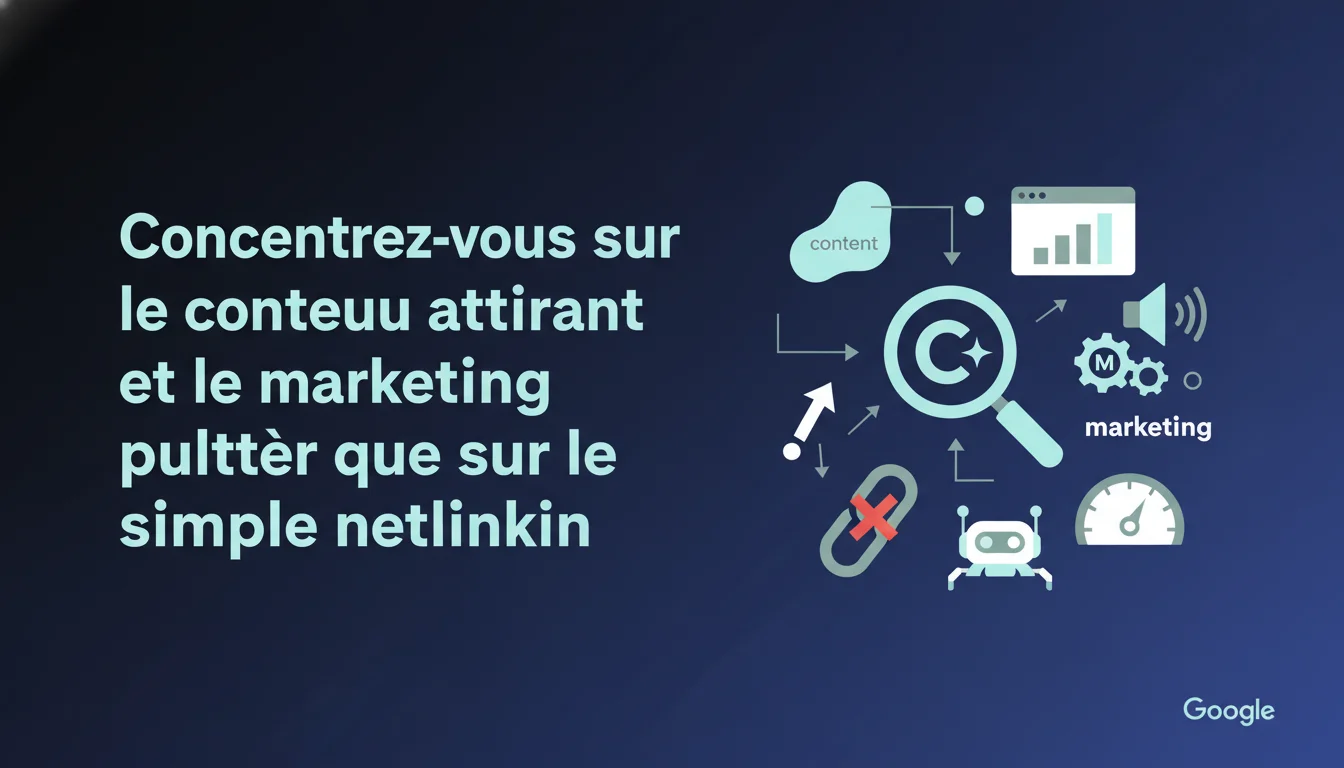
Google emphasizes the importance of creating engaging content and cross-channel marketing over solely focusing on link acquisition. This statement repositions link building as a natural outcome of an effective editorial strategy rather than its primary goal. Essentially, an SEO professional now needs to think about multi-lever distribution before considering raw backlinks.
What you need to understand
Is Google Questioning the Importance of Backlinks for Ranking?
No, Google is not saying that backlinks don’t matter anymore. That would be a misunderstanding of this statement. Links remain a major ranking signal, confirmed by all available patents and correlation studies.
What Google challenges is the purely mechanical approach to link building. Buying links on directories, artificially exchanging backlinks, or bombarding webmasters with guest post requests: these practices produce low-quality signals that the algorithm is filtering out increasingly better.
What Does "Creating Engaging Content" Really Mean According to Google?
Engaging content naturally generates citations. It meets a documentary need, offers a unique perspective, or provides actionable data. When you publish an industry study, a free tool, or an in-depth analysis that no one else has created, links come in without you having to request them.
Google promotes the idea that link building should be a secondary effect, not a goal in itself. Create something worth referencing, then use marketing (social media, emailing, press relations, paid ads if necessary) to distribute it widely. Backlinks will follow organically.
Does "Street Marketing" Really Fit into the SEO Strategy?
This mention of offline marketing may come as a surprise. Google is intentionally broadening the definition of marketing beyond pure digital. The idea is that a physical event, a booth at a trade show, or a street marketing campaign generates word-of-mouth, direct traffic, and brand searches.
These indirect signals (branded queries, increasing direct traffic, social mentions) strengthen the perceived authority by the algorithm. Google measures the actual popularity of a brand through Chrome, Android, and search volumes. An offline spike in awareness reflects in these metrics, even if the causal link remains indirect.
- Backlinks remain a ranking criterion, but their acquisition should not be the exclusive focus of the SEO strategy.
- Content must deserve attention before soliciting links: unique data, fresh angles, useful documentation.
- Cross-channel marketing (social, email, ads, offline) amplifies reach and generates complementary authority signals.
- Google values brands that create a real audience, not those that mechanically optimize isolated metrics.
SEO Expert opinion
Does This Statement Really Reflect the Current Functioning of the Algorithm?
Partially. In practice, sites with strong link profiles still dominate competitive SERPs. Excellent content without quality backlinks will not rank for high-volume queries in competitive sectors. The correlations between domain authority and rankings remain strong.
What Google hints at is that the quality of links outweighs quantity. An editorial link from a recognized media outlet is worth a hundred links from spammy blogs. The algorithm better filters out artificial patterns, making low-cost link building campaigns less effective. [To be verified]: Google does not provide any public metric on the relative weight of backlinks versus other ranking signals.
What Risks Are Involved in Following This Advice to the Letter?
If you launch a site in a niche dominated by established players, waiting for links to come "naturally" can take years. Content marketing without a targeted distribution strategy rarely produces spontaneous backlinks in the short term, unless you already have an audience.
Essentially, a launching e-commerce site that focuses ONLY on blog content without any active link acquisition will remain invisible. Google's advice is better suited for established brands or pure editorial projects, not transactional sites that need to generate revenue quickly.
In What Contexts Does This Approach Really Work?
It is highly effective for B2B brands that produce proprietary data. An industry study with transparent methodology, quantitative benchmarks, or useful free tools generates legitimate editorial citations. The SaaS sector successfully applies this strategy: publish a ROI calculator tool, promote it via LinkedIn Ads and press relations, and acquire backlinks from specialized blogs.
Conversely, for an e-commerce site selling commoditized products, creating "engaging" content that naturally deserves links is a challenging task. It's difficult to generate editorial citations with a product page for running shoes. In this case, tactical link building (partnerships, sponsorships, influencer collaborations) remains necessary, even if Google prefers not to say so explicitly.
Practical impact and recommendations
How to Reorient Your Content Strategy to Generate Natural Backlinks?
Identify the editorial angles that no one else covers in your sector. Analyze the content that generates links for your competitors using Ahrefs or SEMrush. Look for gaps: missing data, outdated studies, superficially covered topics. Produce the go-to resource on this subject.
Invest in formats that facilitate citation: infographics with sourced data, downloadable quantitative studies, interactive tools, comprehensive guides regularly updated. A journalist or blogger should be able to cite your content without risking credibility loss.
What Marketing Levers to Activate to Amplify Content Reach?
Use paid social tactically: sponsor your strongest content on LinkedIn targeting specific audiences (industry journalists, marketing managers, influencers). A well-targeted budget of €500 can expose your study to hundreds of decision-makers who might share it.
Activate digital press relations: identify journalists covering your topic, send them your content with a usable journalistic angle. A link from recognized media is worth more than ten links from obscure blogs. Automate monitoring with tools like Prowly or Meltwater.
Should We Completely Abandon Classic Link Building Campaigns?
No. Let's be pragmatic: a new or low-authority site needs a solid base of quality links to start. Organic-only works when you already have an audience. During the launch phase, combine creating premium content with tactical acquisition of editorial backlinks through partnerships, selective guest posting, or collaborations with industry influencers.
The nuance is to shift from mechanical link building to strategic link earning. Aim only for links that bring qualified traffic or sector authority. Reject link offers from irrelevant sites or those with low traffic. Prioritize editorial quality and thematic relevance.
These optimizations require specialized expertise and rigorous monitoring. If you lack the time or internal skills to orchestrate a premium content strategy combined with multi-lever distribution, hiring a specialized SEO agency can significantly accelerate results. An external perspective often identifies opportunities you no longer see.
- Audit existing content to identify those already generating natural backlinks and understand why.
- Produce at least one piece of premium content each quarter: quantitative study, free tool, or documented comprehensive guide.
- Allocate 20-30% of the SEO budget to paid distribution (social ads, digital PR) to amplify reach.
- Monitor unlinked brand mentions with tools like Mention or Brand24, then request conversion into links.
- Cease all link purchases on generalist platforms or PBNs: ROI turns negative with current algorithm detection.
- Collaborate with industry influencers through co-creation of content rather than isolated ad placements.
❓ Frequently Asked Questions
Google dit-il que les backlinks ne sont plus importants pour le SEO ?
Peut-on ranker sans aucun backlink en appliquant cette stratégie ?
Le marketing offline (street marketing, événements) a-t-il vraiment un impact SEO mesurable ?
Faut-il arrêter toute campagne de guest-posting après cette déclaration ?
Quel budget marketing allouer à la distribution de contenu pour générer des backlinks naturels ?
🎥 From the same video 2
Other SEO insights extracted from this same Google Search Central video · duration 4 min · published on 29/04/2013
🎥 Watch the full video on YouTube →
💬 Comments (0)
Be the first to comment.