
Official statement
What you need to understand
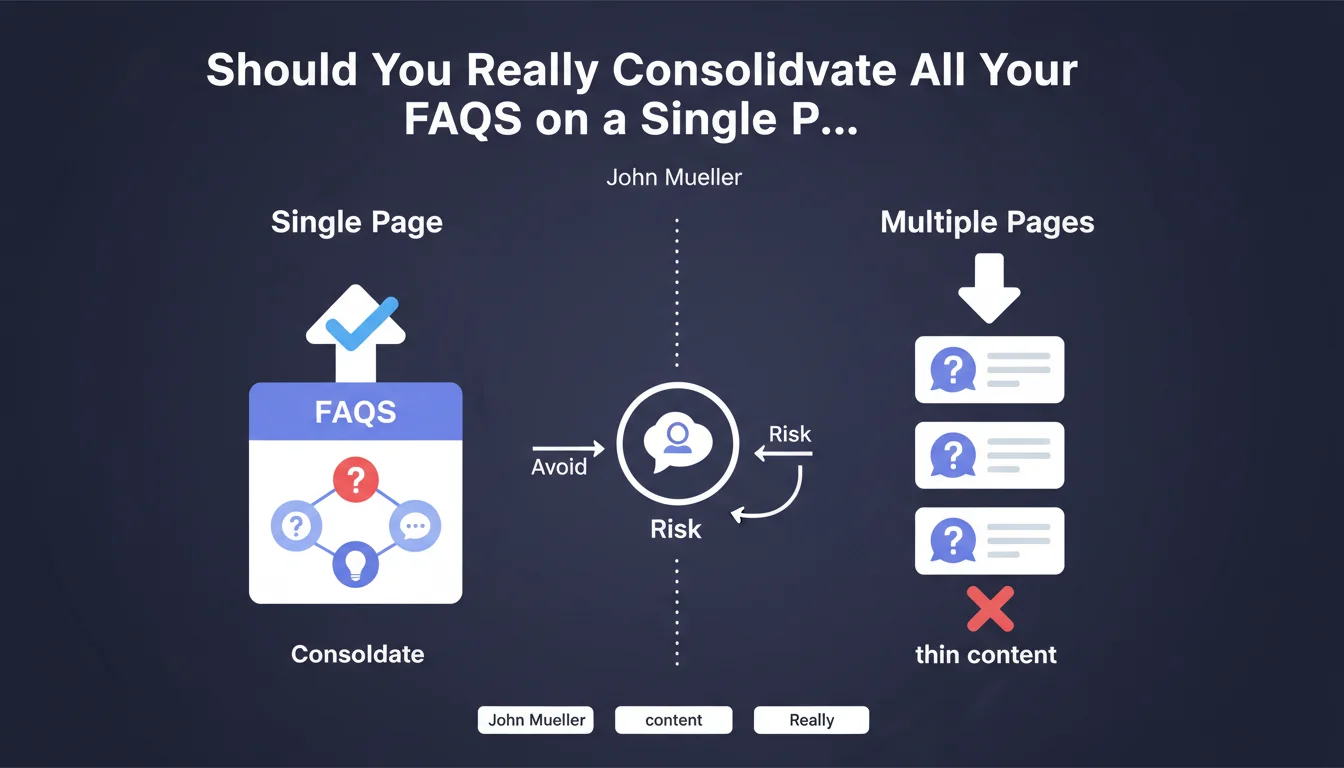
Google has recently issued a warning regarding splitting FAQ pages into multiple individual sub-pages. The warning focuses on the risk of creating a large number of pages each containing little substantial content.
This statement raises a fundamental question: how do you effectively structure a Questions/Answers section without diluting the quality perceived by algorithms? The search engine fears that multiplying pages with very little text creates a negative overall signal for the site.
Yet this position seems to contradict the established SEO principle: one page = one topic = one search intent. This granular approach normally facilitates targeting specific queries and improves relevance.
- The identified risk: creating dozens of ultra-thin pages with only a few lines of content
- The important nuance: the quality and depth of each answer completely changes the equation
- User intent: some questions require detailed dedicated pages, others can be grouped together
- Site context: an authority site with rich content will be judged differently than a content-poor site
SEO Expert opinion
This recommendation deserves to be strongly nuanced depending on context. In practice, sites that develop in-depth and structured answers on dedicated pages perform excellently in search results.
The real question isn't "one page or multiple pages" but rather "what is the added value of each page created". If each question receives a 500+ word answer, with examples, explanatory visuals and complementary information, the "one page per question" format becomes a major asset.
Conversely, if you create 50 pages each containing 2 lines of generic answer, you indeed enter the dangerous zone of large-scale thin content. Editorial depth is the determining factor, not the structure itself.
Practical impact and recommendations
- Audit your existing content: identify FAQ pages containing less than 200 words and evaluate whether they provide real value
- Define a quality threshold: only create a dedicated page if you can produce at least 300-400 words of useful and unique content
- Group strategically: very short questions with simple answers benefit from being consolidated on a common thematic page
- Develop important answers: for questions with high search potential, create dedicated pages with enriched content, examples, media
- Optimize the structure: use FAQPage structured data for consolidated pages, and QAPage for detailed individual pages
- Monitor metrics: analyze bounce rate and time spent on each type of page to validate your approach
- Test progressively: start with a segment of your FAQ to measure impact before deploying massively
This strategy for structuring and optimizing FAQ content requires fine analysis of your data, your audience and your competitive environment. The balance between granularity and content density demands deep expertise in the quality signals that Google values. For sites with significant volumes of Q&A content, support from a specialized SEO agency can prove valuable for defining the optimal strategy adapted to your specific context and avoiding thin content pitfalls while maximizing your visibility on informational queries.
💬 Comments (0)
Be the first to comment.