
Official statement
What you need to understand
The question of special punctuation in web titles and content regularly comes up among SEO practitioners. Some believe that adding [brackets], (parentheses) or "quotation marks" could influence how Google interprets and ranks pages.
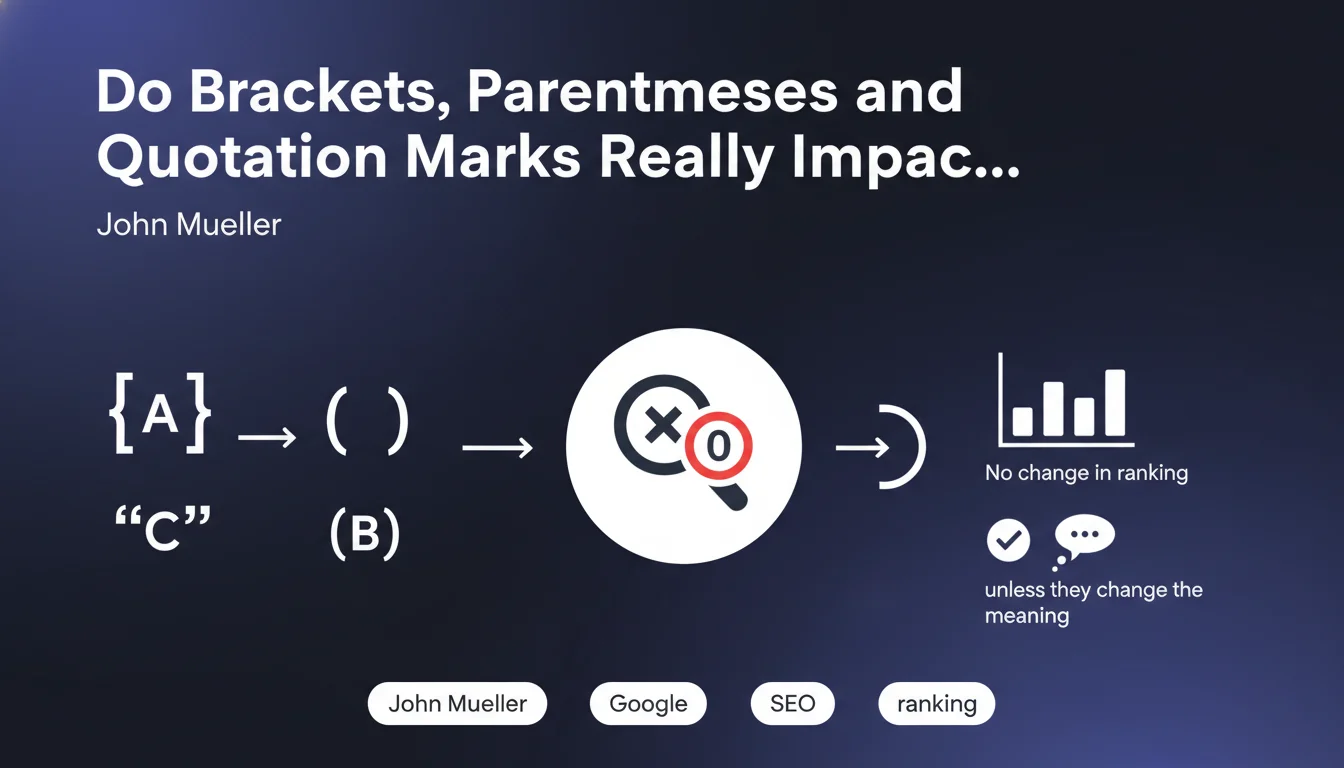
According to official clarifications, Google ignores these punctuation characters during indexing and ranking, provided they don't alter the understanding of the content. In other words, these delimiters are considered purely visual or organizational elements.
It's crucial to distinguish the use of these characters in page content versus their use in search queries. Quotation marks in a query, for example, activate exact match search and radically modify the results.
- Brackets, parentheses and quotation marks are treated equivalently by the algorithm
- They provide neither SEO advantage nor penalty as such
- Their impact is limited to readability and user experience
- The major distinction concerns their usage in queries versus in content
- What matters most is the clarity and relevance of the message conveyed
SEO Expert opinion
This position from Google is consistent with field observations and the evolution of natural language processing by search engines. Modern algorithms focus on semantics and intent rather than typographical flourishes.
However, there's an important nuance: these characters can indirectly influence CTR in SERPs. A title with parentheses or brackets can catch the eye, stand out visually and improve click-through rate. This indirect impact on engagement can then influence positioning.
Watch out for edge cases: In certain technical or brand queries, the use of these characters may be an integral part of the searched term. For example, for a product named "Module [Pro]" or a function "Format(Date)", the presence of these characters can become significant for matching.
Furthermore, excessive use of these punctuation marks can harm perceived readability and give an impression of spam or lack of professionalism, thus impacting users' behavioral signals.
Practical impact and recommendations
- Don't worry about the presence of brackets or parentheses in your titles and meta descriptions from a pure algorithmic perspective
- Use these characters only if they improve clarity and readability for your visitors
- Test the impact on click-through rate: these visual elements can differentiate your result in SERPs
- Avoid excessive use that could give a spammy or disorganized appearance
- Favor parentheses for additional information such as years, formats or specifications
- Maintain consistency in your typographical conventions across the entire site
- Never use these characters as an attempt at algorithmic manipulation
- For technical or brand queries including these characters, make sure to keep them in your content
In summary: Brackets, parentheses and quotation marks have no direct impact on SEO, but their strategic use can improve user experience and CTR. Focus on message clarity rather than these technical details.
Modern SEO optimization involves many subtle parameters where the balance between technical aspects, semantics and user experience becomes complex. For a comprehensive and coherent optimization strategy, guidance from a specialized SEO agency can help you prioritize high-impact actions and avoid time-consuming red herrings.
💬 Comments (0)
Be the first to comment.