
Official statement
What you need to understand
What exactly are the Standout and Editors' Picks tags?
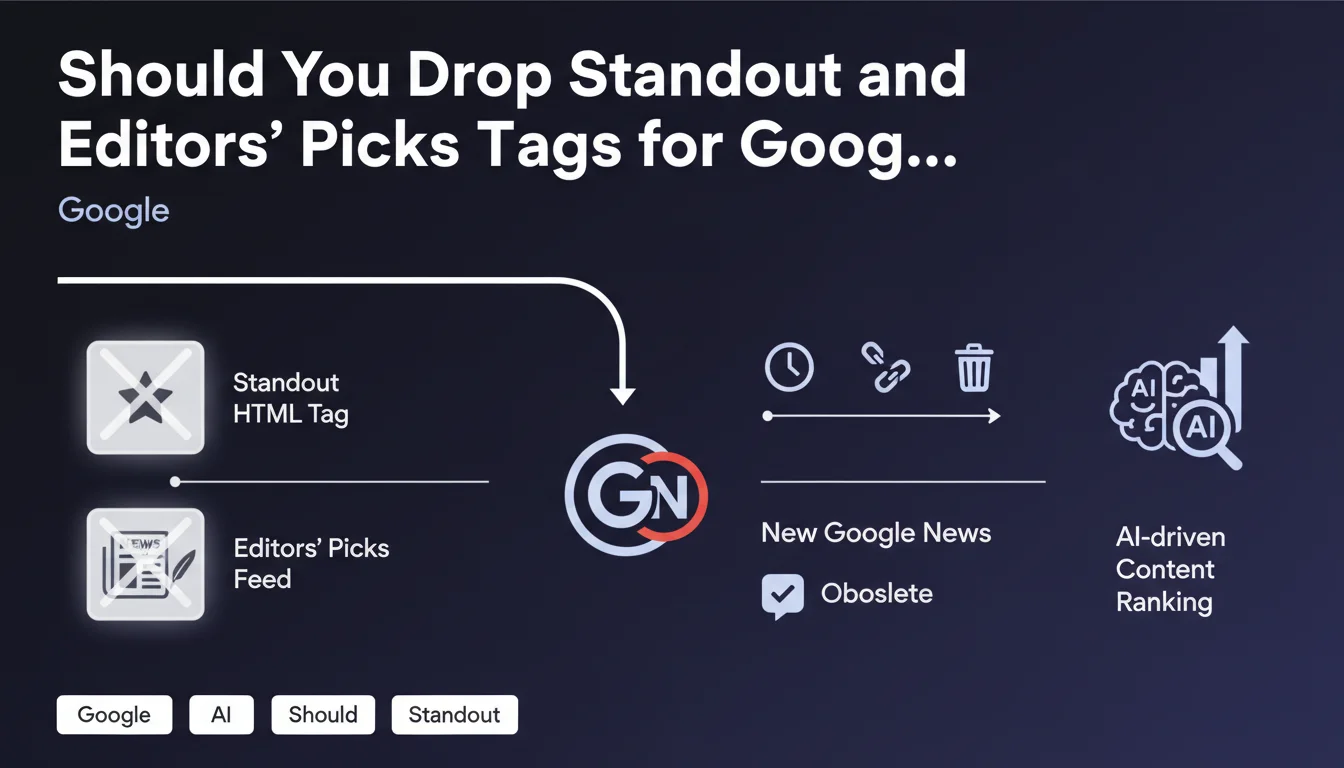
The Standout HTML tag was a specific markup allowing publishers to signal to Google their articles of exceptional quality. It aimed to identify premium content deserving increased visibility in Google News.
Editors' Picks, on the other hand, represented a specific news feed in Google News where articles selected by editorial teams appeared. Both of these features were designed to showcase quality editorial work.
Why did Google decide to discontinue these features?
With the launch of the new version of Google News, the architecture and content selection algorithms have been completely redesigned. Google has chosen to rely more heavily on its artificial intelligence systems to automatically detect quality content.
This evolution is part of Google's strategy to simplify its technical standards and reduce opportunities for manual manipulation of quality signals.
What are the immediate implications for news sites?
- Existing Standout tags are no longer taken into account by Google
- Time and resources invested in these implementations are lost
- Publishers must focus on other quality signals recognized by Google
- No migration or direct alternative is offered by Google
- This decision illustrates the risk of dependency on proprietary features
SEO Expert opinion
Was this removal predictable given Google's practices?
This type of abandonment is unfortunately part of a recurring pattern at Google. There are many examples: Google Authorship, article rich snippets, or certain Search Console features have met the same fate.
The lesson to be learned is that you should never rely exclusively on Google's proprietary features, however promising they may be. A resilient SEO strategy must be based on fundamentals: content quality, solid technical structure, and standard web signals.
What are the alternatives for signaling editorial quality?
Google continues to rely on numerous quality signals to evaluate news content. NewsArticle schema.org structured data remains relevant and recommended.
E-E-A-T (Experience, Expertise, Authoritativeness, Trustworthiness) becomes all the more crucial. Authority signals such as author mentions, detailed biographies, and solid external references take on greater importance.
What real impact does this removal have on SEO?
For the majority of sites, the impact will be minimal. These features were only used by a minority of publishers and their actual influence on rankings was probably limited.
Sites that rank well in Google News do so primarily because of their overall editorial authority, the freshness of their content, their editorial quality and their thematic expertise. These fundamental factors remain unchanged.
Practical impact and recommendations
What should you do concretely if your site uses these features?
Start with a technical audit to identify all places where the Standout tag is implemented. It's not urgent to remove it immediately, but plan a cleanup during your next redesign.
Redirect your efforts toward optimizing schema.org structured data of the NewsArticle type, which remain fully supported. Make sure all your news articles properly use these markups.
How can you adapt your editorial strategy after this abandonment?
Focus on the lasting quality signals that Google values: depth of analysis, verifiable sources, recognized expertise of authors, regular content updates.
Invest in your editorial reputation: get mentions on other reference media, develop your presence on professional social networks, build an engaged community around your content.
What mistakes should you avoid following this announcement?
- Don't try to compensate with other non-standard tags or manipulation techniques
- Don't invest heavily in overly specific Google features without a backup plan
- Don't neglect open web standards in favor of proprietary solutions
- Don't hastily remove Standout tags without a prior audit
- Don't waste time looking for equivalent alternatives that don't exist
💬 Comments (0)
Be the first to comment.