
Official statement
What you need to understand
What is Google's official position on domain extensions?
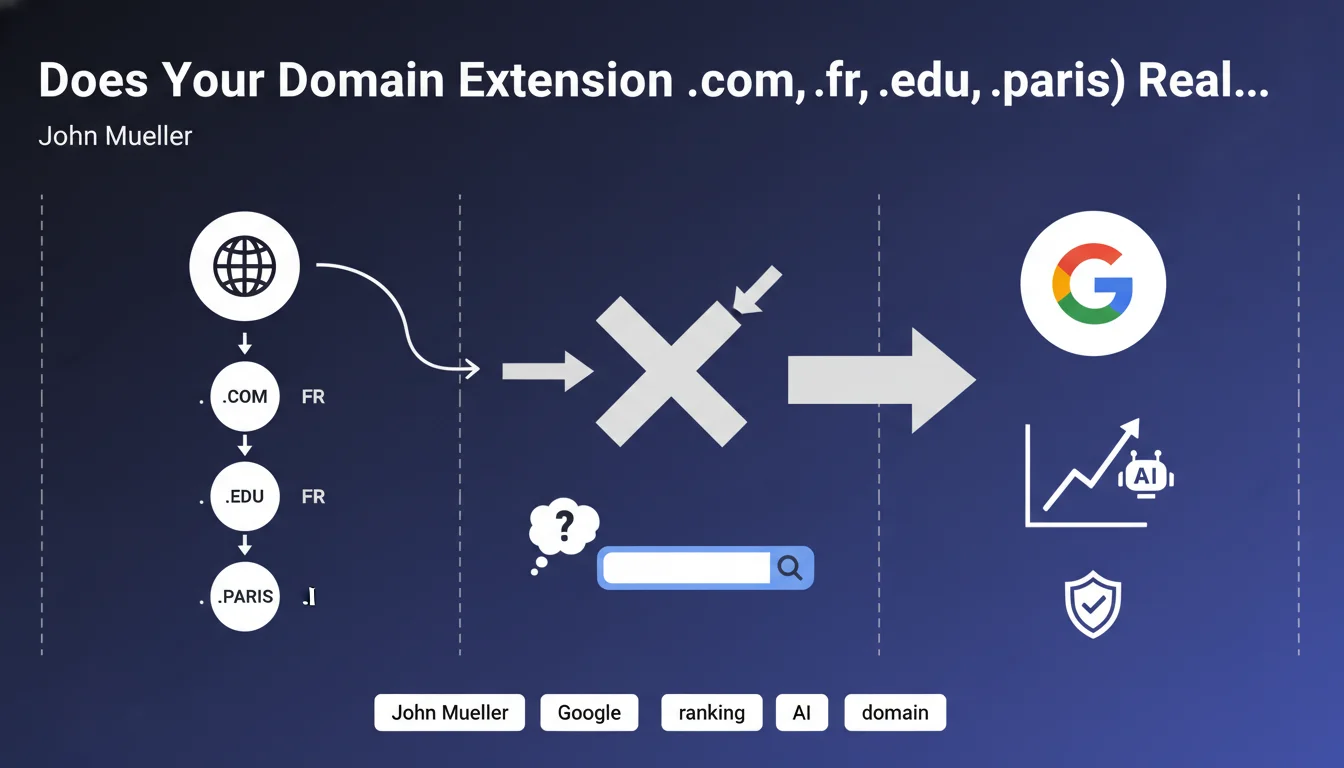
John Mueller and Gary Illyes have reaffirmed multiple times that Google neither penalizes nor favors any domain extension in its ranking algorithm. Whether you choose a .com, .fr, .edu, .music, .paris or any other extension, your SEO potential remains identical.
This statement aims to reassure SEO professionals who wonder about the impact of new generic top-level domains (gTLDs) launched in recent years. Google treats all extensions equally when it comes to the site's quality scoring.
Why does this confusion persist in the SEO community?
Historically, certain extensions like .edu or .gov were perceived as more trustworthy because they were reserved for specific institutions. This reputation created the myth of an intrinsic SEO advantage for these domains.
The massive arrival of hundreds of new extensions (.lawyer, .restaurant, .tech...) has revived these questions. Many practitioners wondered whether Google granted additional semantic relevance to descriptive extensions.
What elements does Google actually take into account?
Google evaluates your site based on objective quality criteria: content, authority, user experience, backlinks, technical structure. The domain extension is not part of this algorithmic equation.
- No SEO bonus for premium or descriptive extensions
- No penalty for new extensions (gTLD)
- The choice of extension is a matter of branding and geographic targeting
- National extensions (.fr, .de) can signal a preferred geolocation but without impact on overall ranking
- The brand-extension consistency remains a marketing question, not an SEO one
SEO Expert opinion
Is this statement consistent with field observations?
After 15 years of practice, I confirm that empirical data validates Google's position. Sites with exotic extensions (.xyz, .online) can perfectly rank on the first page if their SEO strategy is solid.
However, I observe that certain extensions like .edu or .gov continue to correlate with good positions. It's not the extension that causes this, but the fact that these domains generally belong to high-authority institutions with naturally powerful link profiles.
What important nuances should be added to this rule?
Although Google doesn't favor any extension, user behavior can create indirect differences. Internet users still have a psychological preference for .com domains, perceived as more legitimate and professional.
This perception can impact your click-through rate in the SERPs and your conversion rate. A lower CTR sends negative signals to Google about the relevance of your result, thus creating an indirect disadvantage.
In which cases can the extension still influence your SEO?
If you choose a little-known extension or one associated with spam in its history (certain free .tk, .ga domains), you could inherit a negative reputation. It's not the extension itself that's problematic, but its past usage by malicious actors.
Additionally, some extensions have registration restrictions that guarantee quality. A .bank requires strict verification, which creates a form of quality filtering – but again, this is not a direct ranking factor.
Practical impact and recommendations
Should you change your extension to improve your SEO?
No, absolutely not. Migrating your site to a new extension would be a major strategic mistake. You would temporarily lose your link equity, your domain history and create technical risks.
If your site is performing poorly, the problem lies elsewhere: content quality, architecture, backlink profile, Core Web Vitals. Focus your efforts on these levers that have a real and measurable impact.
How do you choose the right extension for a new project?
For a new site, prioritize first the consistency with your brand and your target market. A .fr is perfectly suitable for a French audience, a .com for international reach.
New descriptive extensions (.restaurant, .photo) can strengthen your branding and facilitate memorization, but don't expect any SEO boost. Check that the chosen extension doesn't have a spam history using tools like Wayback Machine.
- Choose your extension based on your marketing and geographic objectives, not for SEO
- Prioritize recognized and memorable extensions to optimize CTR
- Check the domain history before purchase (previous owners, penalties)
- Properly configure geographic targeting in Search Console according to your strategy
- NEVER migrate solely to change extensions – the risks far outweigh the non-existent benefits
- Invest your budget in on-page optimization, quality content and backlinks
- Monitor your organic click-through rate: an unfamiliar extension can indirectly reduce it
- Ensure your extension doesn't create confusion with competitors on similar TLDs
What strategy should you adopt to maximize your organic visibility?
Focus on proven SEO fundamentals: impeccable technical architecture, expert content meeting search intent, optimal user experience, and qualitative link-building strategy. These pillars determine 100% of your success in organic search.
💬 Comments (0)
Be the first to comment.