
Official statement
Other statements from this video 30 ▾
- 1:02 Pre-rendering, SSR, or dynamic rendering: which strategy should you choose for Googlebot to properly index your JavaScript?
- 2:02 Is pre-rendering really suitable for all types of websites?
- 5:40 Is SSR with hydration really the best of both worlds for SEO?
- 5:40 Does SSR with Hydration Really Solve All JS Crawl Issues?
- 6:42 Are SSR and pre-rendering really SEO techniques or just developer tools?
- 6:42 Is it a myth that JavaScript rendering really helps with SEO?
- 7:12 Is it true that HTML is actually faster to parse than JavaScript for SEO?
- 7:12 Is native HTML really faster than JavaScript for SEO?
- 10:53 Does Google really apply the same ranking rules to all websites?
- 10:53 Why does Google refuse to answer your SEO questions in private?
- 10:53 Does Google really treat all websites equally, regardless of their size or ad budget?
- 10:53 Why does Google refuse to answer your SEO questions privately?
- 13:29 Can private messages to Google really influence the detection of SEO bugs?
- 13:29 Can DMs to Google really trigger fixes?
- 19:57 Does spending more on Google Ads really improve your organic SEO?
- 20:17 Does spending more on Google Ads really boost your SEO?
- 20:17 Who really decides on exceptions to Google's Honest Results policy?
- 20:17 Can Google really intervene manually on your site for exceptional reasons?
- 21:51 Should you still report spam to Google if reports are never handled individually?
- 22:23 Is it true that reporting spam to Google is almost pointless?
- 22:54 Does Search Console really provide an SEO advantage to its users?
- 23:14 Does Search Console really lack privileged support from Google?
- 24:29 Does escalating a request with Google really impact your SEO?
- 24:29 Should you escalate your SEO issues to Google's management?
- 26:47 Are Office Hours truly the best channel to ask your SEO questions to Google?
- 27:05 Should you really rely on Google’s public channels to solve your SEO issues?
- 28:01 Is it true that Google refuses to give direct SEO answers?
- 29:15 How does Google handle systemic search bugs internally?
- 31:21 Does the Google feedback form in the SERPs really work?
- 31:21 Does the Google feedback form really help correct search results?
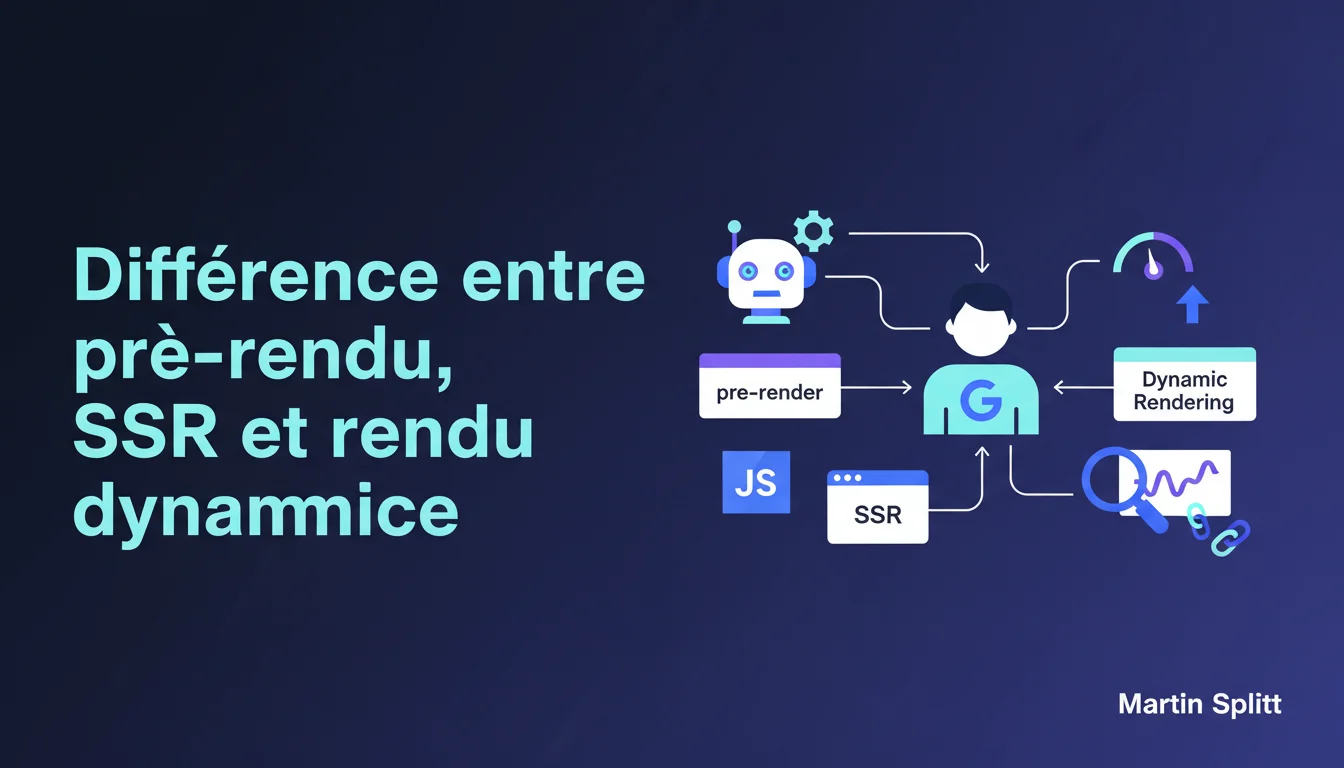
Google clearly distinguishes three methods of JavaScript rendering: pre-rendering generates static HTML ahead of time, SSR executes JS on the server for each request, and dynamic rendering reserves SSR solely for bots. Confusing these techniques can lead to costly and unsuitable architectural choices. Specifically, pre-rendering remains optimal for content that changes infrequently, while dynamic rendering raises maintenance and UX consistency questions that Google does not detail here.
What you need to understand
Why does Google bother clarifying these distinctions?
Because these three terms are constantly mixed up in SEO discussions and technical briefs. Agencies advise "SSR" when they mean pre-rendering, developers refer to "dynamic rendering" to mean classic SSR, and decision-makers no longer know which solution to choose.
Google sets the record straight: Pre-rendering generates complete HTML pages at build time or at regular intervals—ideal for a blog where articles change rarely. SSR executes JavaScript for each user request, with the server being constantly queried. Dynamic rendering detects Googlebot (via user agent) and serves it SSR, while human visitors receive classic client-side rendering.
What technical nuance makes all the difference?
Pre-rendering requires no real-time server execution—the pages are already there, stored somewhere (CDN, cache). It's ultra-fast, scalable, but unsuitable for ultra-dynamic content (real-time prices, stock levels, user personalization).
SSR, on the other hand, implies that each request triggers server-side JavaScript execution. Increased latency, non-negligible server load, but always fresh content. Dynamic rendering introduces a fork: two versions of the site, one for bots, one for humans. Google allows it, but it remains controlled cloaking—with all the risks of desynchronization that it entails.
What are the use cases where each method truly prevails?
Pre-rendering is suitable for editorial sites, corporate blogs, portfolios, product documentation—anything that changes little and can be regenerated every X minutes without drama. A headless CMS with Gatsby or Next.js in static export mode, typically.
SSR becomes essential for marketplaces, sites with personalized paywalls, B2B dashboards where each user has a different interface. But beware: if your traffic explodes, your server infrastructure does too. Dynamic rendering is a crutch when you have a legacy SPA that you can't refactor and that Googlebot struggles to crawl correctly.
- Pre-rendering: static or quasi-static content, scheduled regeneration (blogs, showcase sites, docs).
- SSR: highly personalized or real-time content, each request unique (complex e-commerce, SaaS, platforms).
- Dynamic rendering: transitional solution for existing SPA sites with critical indexing issues, user-agent sniffing.
- Never confuse pre-rendering and SSR in a technical brief—the architecture and hosting costs are radically different.
- Dynamic rendering involves maintaining two versions of the site in parallel—risk of content divergence between bot/user, to be monitored via Search Console.
SEO Expert opinion
Is this distinction really respected in practice?
Let's be honest: the majority of projects still wildly confuse these terms. I've seen audits recommend "SSR" for WordPress blogs that would just need a proper CDN cache. Agencies sell "dynamic rendering" while they are implementing simple pre-rendering via plugin.
The reality is that Google simplifies here for educational purposes, but the boundaries are porous. Next.js, for example, mixes SSR, pre-rendering (SSG), and client rendering in the same framework—and many developers don't even know which method applies to which page of their site. From Google's side, it's still unclear: does Googlebot detect these nuances? Does it really receive SSR when we send it pre-rendering with ISR (Incremental Static Regeneration)? [To verify]
Is dynamic rendering really risk-free as Google suggests?
Google allows dynamic rendering, certainly, but it is still technically cloaking—serving different content based on user-agent. If the bot version diverges too much from the user version (missing content, different links, incompatible layout), you're risking a manual penalty.
The real problem with dynamic rendering is the maintenance complexity. You deploy a new feature on the client side, forget to update the server version for bots—and bam, Google can no longer see your new products. I've seen e-commerce sites lose 30% of their organic traffic because their dynamic rendering solution (Prerender.io, Rendertron...) was no longer synchronized with the front end. Google does not mention this here, but it's an architectural choice that must be assumed long-term, not just a quick fix.
What method does Google actually prefer to crawl?
Google never says this explicitly, but signals converge towards pre-rendering or clean SSR. Dynamic rendering is tolerated, not recommended—Google only mentions it in its guides "if you have no other choice." The crawl budget is less taxed with already ready HTML, and so is the rendering budget.
But beware: Google has also admitted that its JavaScript rendering engine is now performant. So if your SPA is well designed (managed lazy loading, critical CSS inline, optimized hydration), pure client rendering can also work. What Google does not say here is that rendering speed takes precedence over the method—a slow SSR is worse than a fast CSR with good initial state. [To verify] with comparative Core Web Vitals tests on your own site.
Practical impact and recommendations
How do I choose the right method for my project?
Ask yourself three questions. How often does your content change? If it's monthly or weekly, pre-rendering is more than enough. If it's real-time (stock market, sports betting, live stocks), SSR or client-side with a well-designed API is necessary.
What is your traffic volume and server budget? SSR is expensive in resources—each request hits Node.js or another runtime. Pre-rendering, once generated, serves static content from a CDN for just a few cents. If you're scaling up, the cost delta can be 10x. Do you have the skills to maintain two versions of the site? Dynamic rendering requires a team capable of synchronizing the front and bot version—otherwise, you're heading for disaster.
What mistakes should you absolutely avoid with these methods?
First classic mistake: implementing dynamic rendering without dedicated monitoring. If you don't regularly check (via Search Console, server logs, bot user-agent tests) that Googlebot is getting the right content, you're navigating blind. Desynchronization = loss of rankings.
Second mistake: confusing pre-rendering and server cache. Pre-rendering generates complete HTML files during the build, while cache temporarily stores the result of SSR execution. They are not the same in terms of architecture or performance. Third mistake: opting for SSR "just because it's modern" when your WordPress blog with Varnish cache would do the job better and cheaper. SSR is not a badge of honor; it's a tool with specific constraints.
What should you concretely check on your current site?
Start by identifying which method you're actually using—not the one your provider sold you, the one that's running in production. Inspect the source code received by Googlebot (using the Search Console's "URL Inspection" tool, or curl with the bot user-agent). If the HTML is empty and everything loads in JS, you're in pure client-side—potential problem.
If you see complete HTML but the page takes 2 seconds to display, your SSR may be too slow—check server metrics (notably TTFB). If you are using dynamic rendering, compare the bot version and the user version with an HTML diff tool—any substantial content disparity must be justified and documented, otherwise, Google may consider it manipulation.
- Audit the rendering method currently in production (not the one announced, the one measured).
- Compare the source HTML received by Googlebot vs. standard user (curl, Search Console, diff tools).
- Measure TTFB and Time to Interactive—an unoptimized SSR can kill Core Web Vitals.
- If dynamic rendering: set up automated monitoring for bot/user discrepancies (Slack alerts, server logs).
- Evaluate both current and projected infrastructure cost (SSR scalability vs. pre-rendering on CDN).
- Document precisely which page uses which method if you're mixing approaches (Next.js hybrid case, for example).
❓ Frequently Asked Questions
Le pré-rendu convient-il à un site e-commerce avec milliers de produits ?
Le rendu dynamique peut-il être considéré comme du cloaking par Google ?
Quelle méthode consomme le moins de crawl budget ?
Peut-on mixer pré-rendu et SSR sur un même site ?
Comment vérifier que Googlebot reçoit bien le bon HTML ?
🎥 From the same video 30
Other SEO insights extracted from this same Google Search Central video · duration 37 min · published on 09/12/2020
🎥 Watch the full video on YouTube →
💬 Comments (0)
Be the first to comment.