
Official statement
Other statements from this video 4 ▾
- □ Is Google Really Changing Its Rules or Just Repackaging Them With Search Essentials?
- □ Should you really start your SEO audit with your browser and Search Console?
- □ Are Google Search Console's bubble charts really revolutionizing your SEO analysis?
- □ Why have image dimensions in HTML become essential for fixing CLS problems?
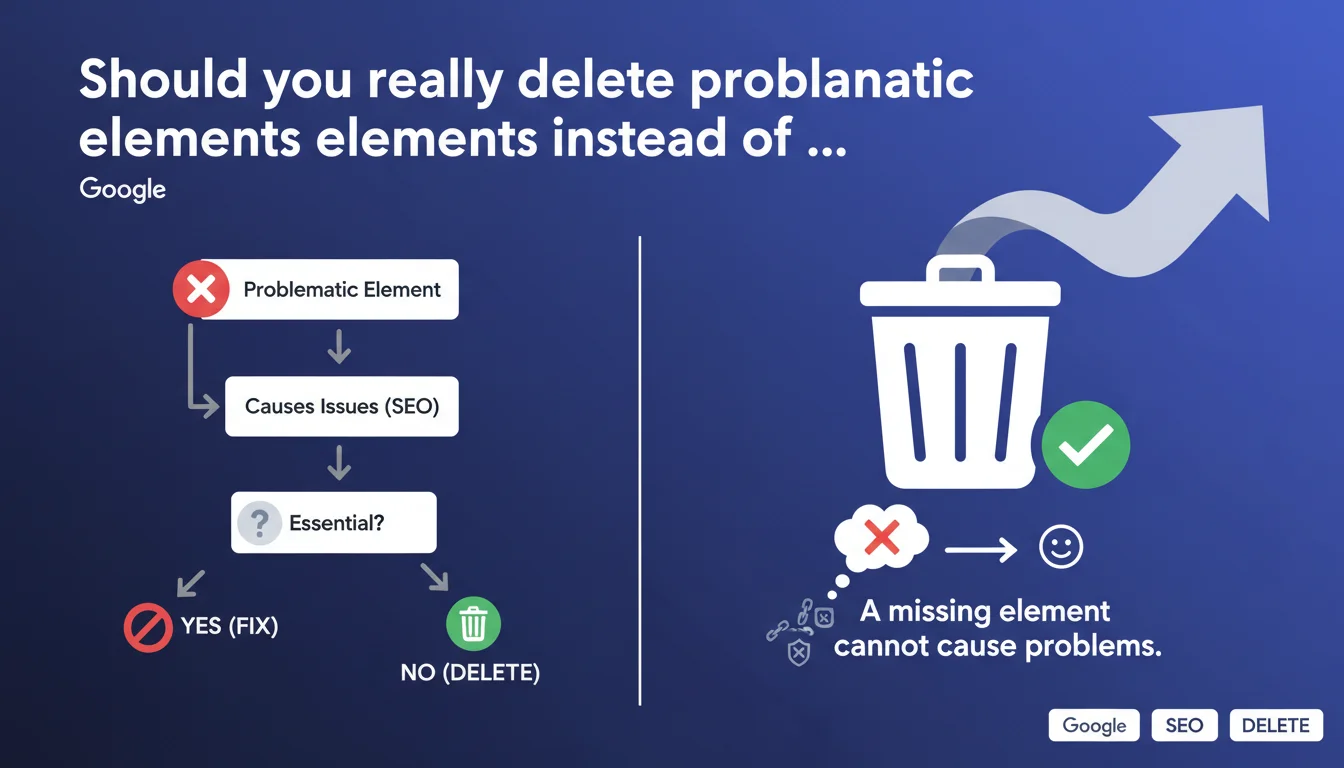
Google recommends a radical approach: if an element causes problems and isn't essential, delete it instead of trying to fix it. The logic is flawless — what doesn't exist can't cause problems. A pragmatic position that challenges the natural instinct to fix everything.
What you need to understand
Why is Google pushing for deletion rather than correction?
Google's position reflects a simple economic reality: crawl time and processing capacity is a limited resource. Every element present on a site consumes crawl budget, even if it's "fixed".
In concrete terms? A site with 10,000 pages where 3,000 are of little value but technically correct will still underperform compared to a site with 7,000 truly relevant pages. The site's average quality increases mechanically when you eliminate dead weight.
Does this approach apply to all types of content?
No, and this is where Google's discourse remains intentionally vague. The recommendation is primarily aimed at orphaned content, unnecessary navigation pages, automatically generated filters, or product variants without added value.
For historical editorial content with residual traffic, the decision is more nuanced. Google doesn't distinguish these cases — but an SEO practitioner should.
- Eliminate: pages with zero traffic for 12+ months, internal duplicate content, unnecessary URL parameters
- Keep and improve: content with backlink history, pages with seasonal traffic, content supporting internal linking strategy
- Merge: thematic variants too similar that are cannibalizing each other
- Deletion must always be accompanied by relevant 301 redirects to equivalent or superior content
What's the difference between "unnecessary" and "underperforming"?
Google plays on the ambiguity. Unnecessary content never had a reason to exist — excessive pagination, auto-generated tags, internal search pages indexed by mistake.
Underperforming content had legitimate intent but fails to achieve its objectives. In this second case, pure deletion isn't always the right answer — unless rewriting would require more effort than creating new optimized content.
SEO Expert opinion
Is this statement consistent with real-world observations?
Yes, and the results are measurable. SEO audits regularly show sites that gain visibility after deleting 20-30% of their lowest-performing pages. The phenomenon is especially visible on e-commerce sites with thousands of product references.
But be careful — Google doesn't specify the decision criteria. What is "necessary"? For a media site, a 2015 archive without traffic may remain useful for editorial depth. For a corporate site, an outdated service page is dead weight.
What risks does this approach carry?
The main danger: deleting too quickly without analyzing weak signals. A page may have zero organic traffic but serve a strategic function — entry point for paid campaigns, conversion page for a specific journey, content cited as external reference.
[To verify] Google provides no indication of an acceptable threshold. At what point does the volume of "unnecessary" pages truly become negative? 10%? 30%? 50%? This lack of clear metrics requires empirical testing.
In what cases does this rule not apply?
News sites and user-generated content platforms (forums, Q&A) work differently. Their volume itself creates value — Google knows this and adjusts its criteria accordingly.
For these sites, the strategy isn't "delete" but selectively deindex via robots.txt, noindex tags, or Search Console parameters. Content remains accessible to users but doesn't consume crawl budget.
Practical impact and recommendations
What should you concretely do to identify content to delete?
Start with a multi-criteria content audit. Cross-reference Search Console (impressions, clicks, CTR, average position) with Analytics (sessions, time on page, bounce rate) and your crawl tool (depth, internal links received).
Priority candidates for deletion: pages with fewer than 10 impressions/year, zero internal links, zero external backlinks, and zero recorded conversions. But always validate manually — an algorithm doesn't capture business context.
- Export all indexed URLs from Search Console and compare with your current sitemap
- Identify pages with zero clicks over 12 rolling months and fewer than 50 impressions
- Check for absence of external backlinks via Ahrefs, Majestic, or Semrush
- Verify that these pages don't serve as relays in your strategic internal linking
- Prepare a 301 redirect plan to the closest thematically relevant content
- Delete in waves of 10-15% maximum and measure impact over 4-6 weeks before continuing
What mistakes should you avoid during a cleanup campaign?
First mistake: deleting without redirecting. A deleted page that returns a 404 permanently loses any potential SEO juice and degrades user experience. Every deletion must include a 301 redirect to the best alternative.
Second mistake: deciding solely on current traffic. A page may generate no traffic today but possess a solid incoming link profile that benefits the rest of the site through internal linking. Analyze internal PageRank before making a decision.
How do you measure the impact of deletions on overall performance?
Track four key metrics: evolution of overall organic traffic, number of pages receiving at least 1 click/month, average position of retained pages, and crawl speed (via Search Console's Crawl Statistics section).
If you notice accelerated crawling and improved average positions within 6-8 weeks, you're on the right track. If overall traffic drops more than 5%, suspend and analyze what was removed.
❓ Frequently Asked Questions
Faut-il supprimer toutes les pages avec zéro trafic organique ?
Que faire des anciennes pages qui ont encore des backlinks mais plus de trafic ?
Combien de temps faut-il attendre pour mesurer l'impact d'une suppression massive ?
Vaut-il mieux supprimer ou passer en noindex les contenus faibles ?
Comment gérer les redirections après suppression de centaines de pages ?
🎥 From the same video 4
Other SEO insights extracted from this same Google Search Central video · published on 16/02/2023
🎥 Watch the full video on YouTube →
💬 Comments (0)
Be the first to comment.