
Official statement
What you need to understand
What's the Difference Between Passage Indexing and Passage Analysis?
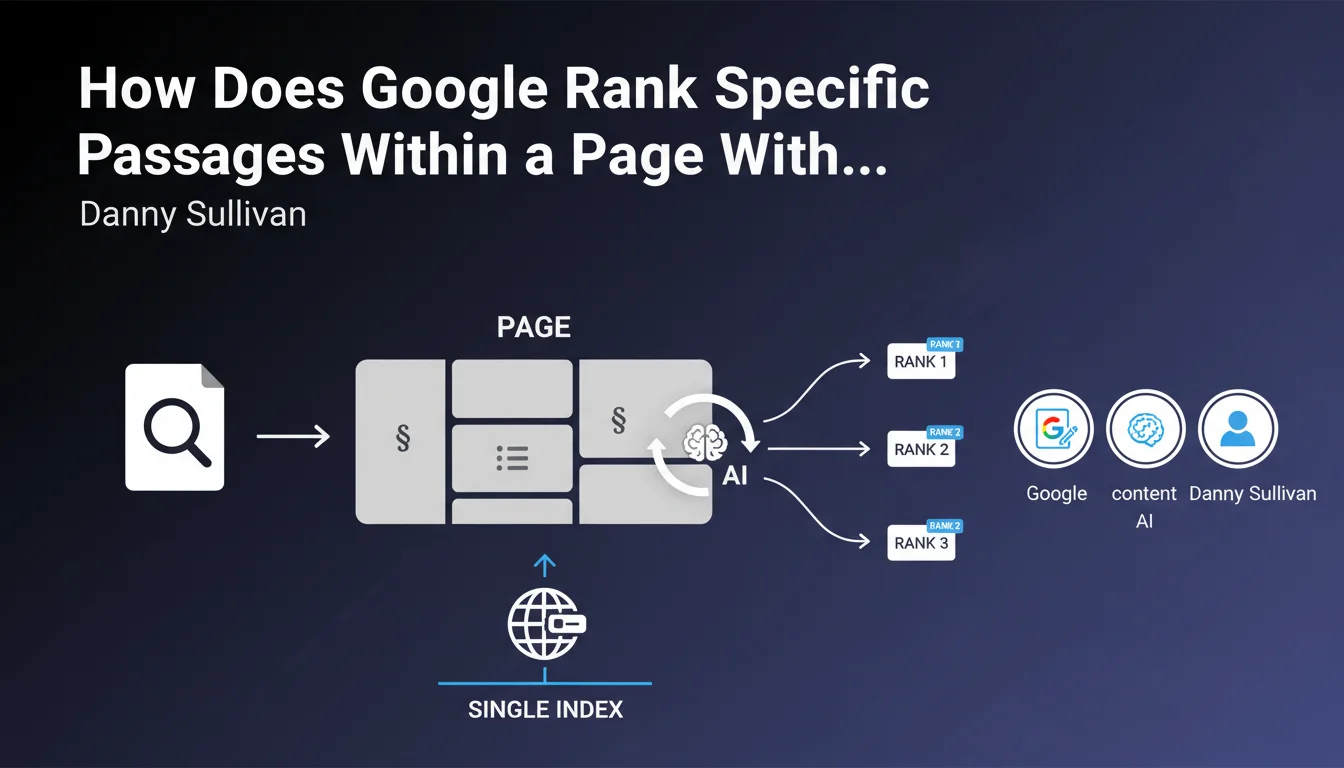
Google has clarified a major point: there are not two distinct indexes, one for overall content and another for specific passages. Indexing remains singular and global.
What has changed is Google's differentiated analysis capability. The search engine can now identify and evaluate separately paragraphs or sections within a page, even if their theme differs from the main topic of the content.
Why Does This Passage Analysis Capability Matter?
This evolution allows Google to answer very specific queries by exploiting relevant sections buried in long articles. Overall content about gardening can thus rank for a specific query about pruning roses thanks to a single dedicated paragraph.
This values comprehensive and exhaustive content that addresses multiple facets of a topic, even secondary ones. No longer necessary to systematically create a dedicated page for each sub-topic.
How Are Passages and Featured Snippets Related?
Danny Sullivan specified that the technical systems are different. Passage analysis serves ranking in standard organic results, while featured snippets use their own selection algorithm.
Both can nevertheless exploit the same content. A passage identified as relevant may appear in an organic position, and another excerpt from the same page may be selected for a featured snippet.
- Indexing remains singular, only the analysis is differentiated by passage
- Passages allow ranking for specific queries with long-form content
- Passages and featured snippets use distinct algorithms
- The same content can be valued both for its passages and as a featured snippet
SEO Expert opinion
Is This Statement Consistent with Practices Observed in the Field?
Absolutely. Since the progressive rollout of this feature, we indeed observe pages ranking for secondary queries thanks to specific sections. Pillar content pieces of 3000+ words generate traffic on dozens of different long-tail queries.
This also validates why certain long-form content performs better than a multitude of targeted short pages. Google now has the necessary granularity to understand and value internal thematic richness.
What Nuances Should Be Applied to This Approach?
Passage analysis does not replace overall thematic relevance. A page about gardening will never rank well for a plumbing query, even with a dedicated paragraph. The semantic coherence of the overall content remains fundamental.
Additionally, this capability works better on long-tail informational queries. For commercial or highly competitive queries, Google still favors dedicated pages with clear intent.
In Which Cases Does This Feature Not Apply Effectively?
On very short pages (less than 500 words), passage analysis has little impact since overall content and passages merge. The benefit really appears from 1500-2000 words onward.
Pages with chaotic or poorly tagged structure also make it difficult to identify relevant passages. Without appropriate Hn tags, lists, or clearly delimited paragraphs, Google struggles to segment content effectively.
Practical impact and recommendations
What Should You Do Concretely to Optimize Your Content?
Favor long and exhaustive content that treats a main subject and its logical ramifications. Aim for 2000+ words for topics that allow it, covering related questions users ask themselves.
Structure rigorously with hierarchical Hn tags (H2, H3) that clearly delimit each section. Each subheading should introduce a coherent and autonomous passage, capable of answering a specific question alone.
Write self-sufficient paragraphs: each section should be understandable independently of the rest, with context and complete answer. Google must be able to extract a passage and present it alone in the results.
What Mistakes Should You Avoid When Writing Long-Form Content?
Don't create an incoherent thematic patchwork. Passages should remain natural extensions of the main subject, not artificial grafts to capture off-topic traffic. Overall semantic coherence takes priority.
Avoid walls of text without structure. Content of 3000 words without clear subheadings, lists, or distinct paragraphs will be poorly segmented by Google and penalize user experience.
How Can You Verify That This Optimization Works on Your Site?
Analyze in Search Console the queries generating impressions and clicks for your long-form content. Identify unexpected long-tail queries: they reveal which passages Google values.
Use tools like SEMrush or Ahrefs to identify secondary keywords your long pages rank for without explicitly targeting them. This data indicates the effectiveness of passage analysis on your content.
- Create content of 2000+ words covering a topic and its natural ramifications
- Structure with clear Hn tags delimiting each thematic section
- Write self-sufficient passages answering specific questions
- Maintain overall semantic coherence, avoid off-topic grafts
- Aerate text with lists, short paragraphs, and appropriate formatting
- Analyze Search Console to identify captured long-tail queries
- Maintain dedicated pages for competitive commercial queries
💬 Comments (0)
Be the first to comment.