
Official statement
What you need to understand
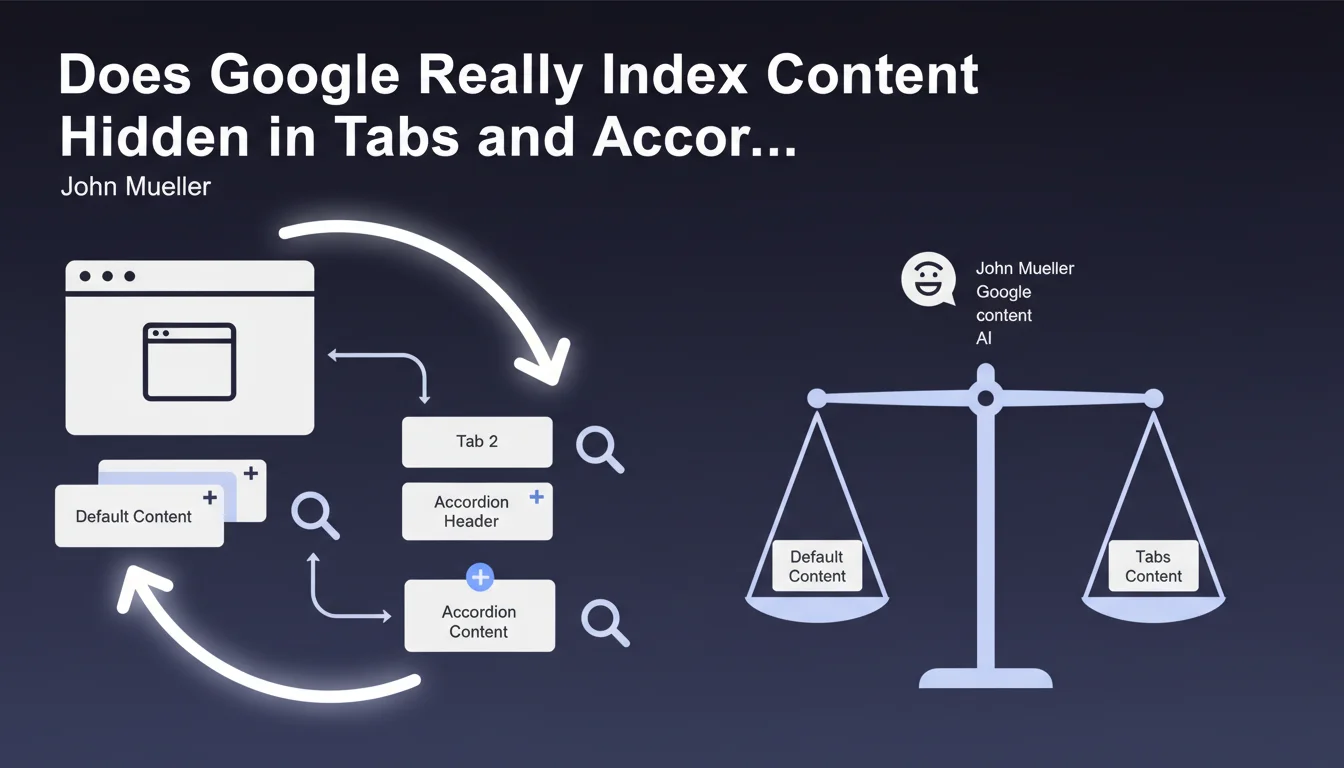
This official statement from Google provides important clarification on how hidden-by-default content is treated. Contrary to some misconceptions, content placed in tabs or accordions is not penalized or considered less important by the search engine.
Google states that this type of content receives the same SEO weight as content directly visible on screen. It doesn't matter whether users need to click to access it: if the content is present in the page's HTML code, it will be indexed and valued normally.
This approach aligns with the logic of mobile-first indexing. On mobile devices, using accordions and tabs is a common UX practice to save screen space without sacrificing content richness.
- Content in tabs and accordions is fully considered by Google
- There is no difference in weighting compared to default-visible content
- This rule applies as long as the content is present in the DOM when the page loads
- This position supports best UX practices without SEO compromise
SEO Expert opinion
Google's position is consistent with field observations from recent years. Tests conducted on sites heavily using accordions indeed show that this content appears in featured snippets and feeds Google's answers.
However, an important nuance: this rule applies to content natively present in the HTML. If your content is dynamically loaded via JavaScript after user interaction (advanced lazy loading), Google might have more difficulty crawling it. Testing with the URL Inspection tool in Search Console remains essential.
Practical impact and recommendations
- Optimize mobile UX by confidently using accordions to structure long-form content (FAQs, detailed product descriptions)
- Verify HTML rendering: use the URL Inspection tool to confirm that Google does indeed see your tab content
- Avoid excessive lazy loading: favor content present in the initial DOM rather than loaded after interaction
- Structure with Schema.org: for accordion FAQs, implement FAQPage markup to maximize visibility
- Keep priority content visible: don't hide your USPs, main calls-to-action, or strategic keywords in accordions
- Test accessibility: ensure your accordions comply with ARIA standards for optimal navigation
Tabs and accordions therefore represent a risk-free opportunity to enrich your pages while preserving user experience. This official confirmation allows you to create more comprehensive content without fearing dilution of your SEO signal.
The technical implementation of these interactive elements, their optimization for crawling, and their integration with an overall content strategy nevertheless require specialized expertise. For high-stakes sites, guidance from a specialized SEO agency helps secure these optimizations and guarantee their long-term effectiveness, avoiding common technical pitfalls.
💬 Comments (0)
Be the first to comment.