
Official statement
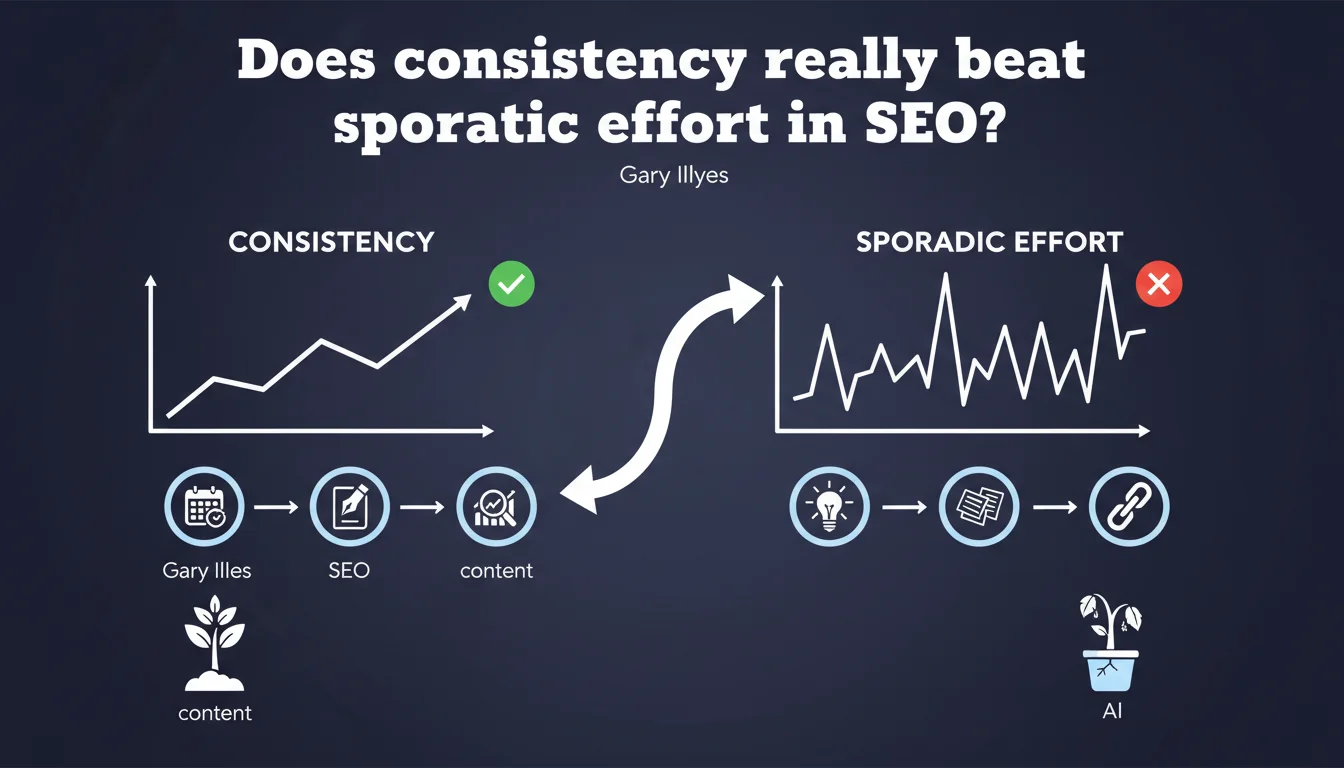
Gary Illyes asserts that consistency trumps massive one-off efforts in SEO. It's better to publish regularly and stay on top of SEO news consistently than to produce a ton of content all at once and then disappear. A reminder that challenges publish-in-bursts strategies.
What you need to understand
Gary Illyes's statement emphasizes a principle often overlooked: regularity in content production and SEO monitoring. Rather than publishing 20 articles in one week and then nothing for two months, Google would reward a stable cadence.
The message targets two audiences: those managing content creation, and those following SEO news to adjust their strategies.
Why does Google insist on consistency?
Google's algorithms analyze publication patterns. A site that publishes regularly sends signals of freshness and sustained editorial activity. Conversely, irregular spikes can be interpreted as spam or opportunistic content.
Consistency also makes it easier for crawlers. If Googlebot knows a site publishes every Tuesday, it optimizes its crawl budget accordingly — rather than discovering 50 new URLs all at once without temporal coherence.
What does "regular routine" mean in SEO?
Gary Illyes doesn't provide precise numbers — typical of Google. A "regular routine" could mean one article per week for a small site, or several per day for a media outlet. The key: maintain a predictable pace.
On the SEO monitoring side, this means following official announcements, field tests, and algorithm updates continuously rather than waking up in panic mode after a core update.
Does this recommendation apply to all types of sites?
Let's be honest: an e-commerce site with 10,000 stable product pages doesn't face the same "editorial consistency" challenge as a blog or media outlet. The statement primarily targets sites with strong content components.
For a corporate or SaaS site with few new pages, consistency plays out more through updates to existing content and progressive addition of resources (guides, case studies) than through a strict editorial calendar.
- Publication regularity sends positive signals to Google's algorithms
- Irregular spikes can be interpreted as spam or opportunistic content
- Crawl budget is better managed when Googlebot can anticipate new content
- Continuous SEO monitoring beats frantic catch-up sessions post-update
- Applicability varies depending on site type (media vs e-commerce vs corporate)
SEO Expert opinion
Is this statement aligned with field observations?
Yes, largely so. Sites that maintain a stable publication rhythm tend to perform better than those alternating between periods of intense activity and editorial drought. We also observe that Google values freshness, but not just any freshness.
That said — and here's where it gets tricky — quality remains the dominant parameter. A site publishing a mediocre article religiously every week won't see miracles. Consistency amplifies good content, it doesn't save bad content.
What nuances does this recommendation hide?
Gary Illyes doesn't specify what constitutes a "regular routine." Weekly? Bi-weekly? Daily? [To verify]: no official data quantifies the optimal frequency threshold.
Additionally, this logic applies better to news or editorial sites than to transactional sites. An e-commerce business launching 200 products in November (peak season) and 10 in January isn't penalized for "lack of consistency" — that's market seasonality.
In what cases does this rule not apply?
For sites with naturally low editorial velocity: corporate sites, portfolios, brochure sites. If your business doesn't naturally generate new publications, forcing an editorial calendar can lead to artificial content.
Another case: authority sites that publish infrequently but exceptionally. A 10,000-word guide every two months can outperform 20 articles of 500 words published each week — especially if the topic is evergreen and competition is light.
Practical impact and recommendations
What should you do concretely to apply this advice?
Establish a realistic editorial calendar that your team can maintain long-term. Better to have 1 article per week for 12 months than 3 per week for 2 months then abandonment.
On the SEO monitoring side, set up a follow-up routine: RSS subscriptions to official Google sources, alerts on specialized forums, regular participation in SEO communities. The goal: anticipate changes rather than react to them.
What mistakes should you avoid in this approach?
Never sacrifice quality for cadence. Mediocre content published "to keep pace" hurts more than it helps. If you can't maintain quality, slow down the frequency.
Also avoid duplicating content or superficially recycling old articles just to "publish something." Google detects these patterns and they degrade your authority.
How can you verify your site respects this principle?
Analyze your publication history over the last 6 months. Are there gaps of several weeks? Sudden spikes followed by silence? Use Google Search Console to check if your new URL crawl follows a coherent pattern.
Also measure impact: do contents published on a regular cadence perform better than those published in bursts? Compare indexation rates, average rankings, organic traffic by publication cohort.
- Create a realistic and sustainable editorial calendar for 6+ months
- Define a publication frequency suited to your resources (weekly, bi-weekly, etc.)
- Prioritize consistent quality over irregular volume
- Establish a structured SEO monitoring routine (RSS feeds, alerts, communities)
- Analyze crawl patterns in Google Search Console
- Measure content performance by publication cohort
- Adjust frequency if quality begins to decline
- Avoid prolonged editorial silence without strategic reason
💬 Comments (0)
Be the first to comment.