
Official statement
Other statements from this video 3 ▾
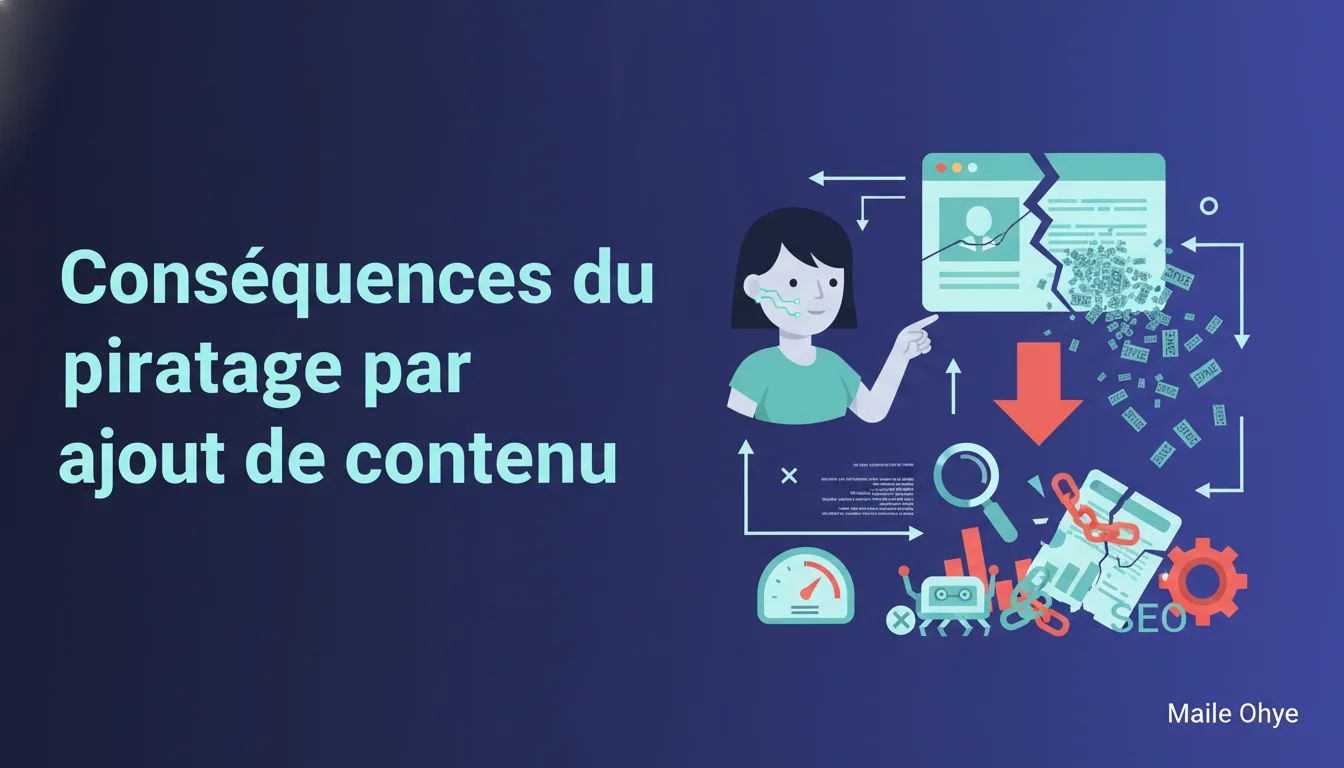
Google confirms that the injection of spammy content by hackers (primarily in pharmaceuticals) exploits a legitimate site's reputation to gain credibility. This accumulated reputation then becomes a vector for pollution that directly affects the ranking of the hacked site. The challenge for an SEO professional is to detect these intrusions before Google penalizes the entire domain, as the contamination can spread well beyond the infected pages.
What you need to understand
Why do hackers specifically target a site's reputation?
A domain that has accumulated authority and trust signals represents an attractive target for hackers. They exploit this credibility as a shortcut: instead of building their own domain from scratch, they attach their spammy content to a site already recognized by Google.
The pharmaceutical sector dominates these attacks because organic competition is fierce and the margins allow for investment in sophisticated intrusion techniques. Hackers know that Google places weight on a domain's historical signals, and they ride this momentum before the algorithm detects the anomaly.
What types of contamination actually occur?
Injection can take several forms: indexed ghost pages that are invisible to the average user, conditional redirects based on user-agent, or subtle modification of existing pages with hidden text. These techniques aim to go under the radar of webmasters while remaining visible to Googlebot.
The danger lies in the speed of propagation. An exploited vulnerability can generate thousands of spammy pages within hours, massively polluting the index before corrective action can be taken. Google usually detects the anomaly, but the time lag between infection and manual action can be enough to permanently damage the domain's reputation.
How does this pollution affect overall quality signals?
Google measures the thematic consistency of a site. When hundreds of pharmaceutical pages appear on a gardening domain, the algorithms detect a structural inconsistency that degrades overall trust. It is not just a matter of isolated spammy content; it is a signal of compromise that contaminates everything.
Behavioral signals also play a role: if users land on these hacked pages and leave immediately (massive pogo-sticking), it creates a negative pattern that can extend beyond the infected pages. Google interprets this degradation as a systemic issue for the domain.
- Reputation builds slowly but degrades quickly: a hacked site can lose in a few weeks what it took years to build.
- Injected spammy pages temporarily inherit the domain's authority, explaining why they can rank quickly before detection.
- Google does not always differentiate immediately between legitimate content and injection: the detection time can vary from a few days to several weeks depending on the sophistication of the attack.
- Manual penalties for hacking can affect the entire domain, not just the infected pages, if Google considers that the webmaster has not taken adequate corrective measures.
- Post-hacking rehabilitation requires an explicit reconsideration request in Search Console after complete cleaning, with documented proof of corrective actions.
SEO Expert opinion
Does this statement truly reflect the mechanics observed on the ground?
Yes, but with an important nuance: Google simplifies the mechanism. In reality, the exploited reputation is not a single score but a bundle of signals (domain age, link profile, thematic consistency, quality history). Hackers primarily target sites with a strong backlink profile because that is the signal most difficult to artificially reconstruct.
Field observations show that hacked sites rarely lose all their visibility at once. The degradation is gradual and often sector-specific: first on peripheral queries, then on thematic core if the infection is not addressed. Google seems to apply a form of algorithmic quarantine before definitive manual sanction.
What flaws in Google's reasoning should be highlighted?
Google does not specify what threshold of contamination triggers a global penalty versus a local devaluation of infected pages. This opacity is problematic for sites with thousands of pages: at what point does the hacking of a number of pages push the entire domain into the red? [To be verified] based on documented cases, but Google never communicates a precise ratio.
Another point: the claim that hackers target "the good reputation" suggests that only quality sites are targeted. False. Hackers cast a wide net and exploit any accessible vulnerability, regardless of actual reputation. An average site with an outdated CMS can be infected just as easily as an industry leader. The difference lies in the impact: on a weak site, injection can go unnoticed longer because monitoring is less rigorous.
In what scenarios does this rule not apply as expected?
Sites with a segregated architecture (very sealed subdomains or subdirectories) can limit contagion. If the infection remains confined to a dedicated subdomain, Google may penalize only that part without affecting the main domain. However, this requires quick detection and strict technical isolation.
User-generated content platforms (forums, marketplaces) undergo different treatment: Google knows that moderation is not instantaneous and applies algorithmic tolerance if the spam/legitimate ratio remains manageable. However, a massive influx of pharmaceutical content injected via compromised accounts can still trigger manual action.
Practical impact and recommendations
What should be put in place to detect an infection before Google does?
An automated monitoring of indexing is essential: use site: queries combined with common pharmaceutical keywords (viagra, cialis, pharmacy) to identify abnormal pages. Set up Search Console alerts for spikes in indexing: a sudden increase in indexed pages without editorial explanation is an immediate red flag.
Regularly scan the system files and templates to detect unauthorized changes. Injections often hide in footers, headers, or configuration files (.htaccess, wp-config.php). An automatic diff between your clean version and the production version allows you to spot alterations. Also, check users and permissions: a ghost admin account is a classic sign of compromise.
What critical mistakes should be avoided during cleanup?
Never just remove the visible pages without addressing the original vulnerability. Hackers leave backdoors: if you clean without sealing, reinfection will occur in a few days. Worse, Google detects this pattern and may interpret the recidivism as negligence or complicity, tightening the penalty.
Avoid mass disallowing via robots.txt or noindex without first cleaning. Google must be able to re-crawl the cleaned pages to confirm the cleanup. Blocking access before cleaning freezes the situation and delays rehabilitation. Instead, use the temporary URL removal feature in Search Console for the most toxic pages during the complete cleanup.
How to document the cleaning to accelerate rehabilitation?
Google requests concrete evidence in reconsideration requests. Prepare a file detailing: the nature of the exploited vulnerability, the corrective measures (patches applied, passwords changed, plugins updated), and a sample of pages before/after cleanup. The more rigorous your documentation, the faster the request is processed.
Monitor post-cleanup metrics: if organic traffic does not rebound within 4-6 weeks following the reconsideration approval, it indicates that negative signals persist (toxic backlinks to hacked pages or residual contamination not detected). A thorough audit is necessary, as Google may have maintained a form of enhanced monitoring on the domain.
- Set up Search Console alerts for indexing anomalies (sudden spikes, rising 404 errors)
- Implement a weekly scan of system files with an alert for any unauthorized modifications
- Enable two-factor authentication on all admin accounts of the CMS and hosting
- Document each technical intervention in a timestamped log for reconsideration requests
- Audit the backlink profile post-hacking to identify toxic links created by hackers
- Plan a complete re-scan 2 weeks after cleaning to verify the absence of reinfection
❓ Frequently Asked Questions
Combien de temps faut-il pour qu'un site piraté perde sa visibilité organique ?
Une pénalité manuelle pour piratage peut-elle être levée rapidement ?
Les backlinks créés vers les pages piratées doivent-ils être désavoués ?
Un site piraté puis nettoyé garde-t-il une trace négative permanente dans Google ?
Comment différencier une baisse de trafic due au piratage d'une mise à jour algorithmique ?
🎥 From the same video 3
Other SEO insights extracted from this same Google Search Central video · duration 6 min · published on 30/10/2013
🎥 Watch the full video on YouTube →
💬 Comments (0)
Be the first to comment.