
Official statement
Other statements from this video 9 ▾
- 2:20 Pourquoi Google refuse-t-il d'indexer vos pages malgré un contenu que vous jugez pertinent ?
- 5:48 Pourquoi les données site: et Search Console ne correspondent-elles jamais ?
- 8:04 Faut-il vraiment abandonner AMP pour votre stratégie SEO ?
- 11:12 Pourquoi les outils Core Web Vitals donnent-ils des résultats contradictoires ?
- 17:40 Comment Google traite-t-il vraiment les pages de phishing dans ses résultats de recherche ?
- 31:32 Faut-il vraiment exclure les URLs mobiles des sitemaps XML ?
- 33:06 Pourquoi Google détecte-t-il des différentiels de couverture entre mobile et desktop dans Search Console ?
- 41:04 Faut-il vraiment utiliser la balise picture pour servir vos images WebP ?
- 54:20 Google pénalise-t-il vraiment les sites avec plusieurs URLs en première page ?
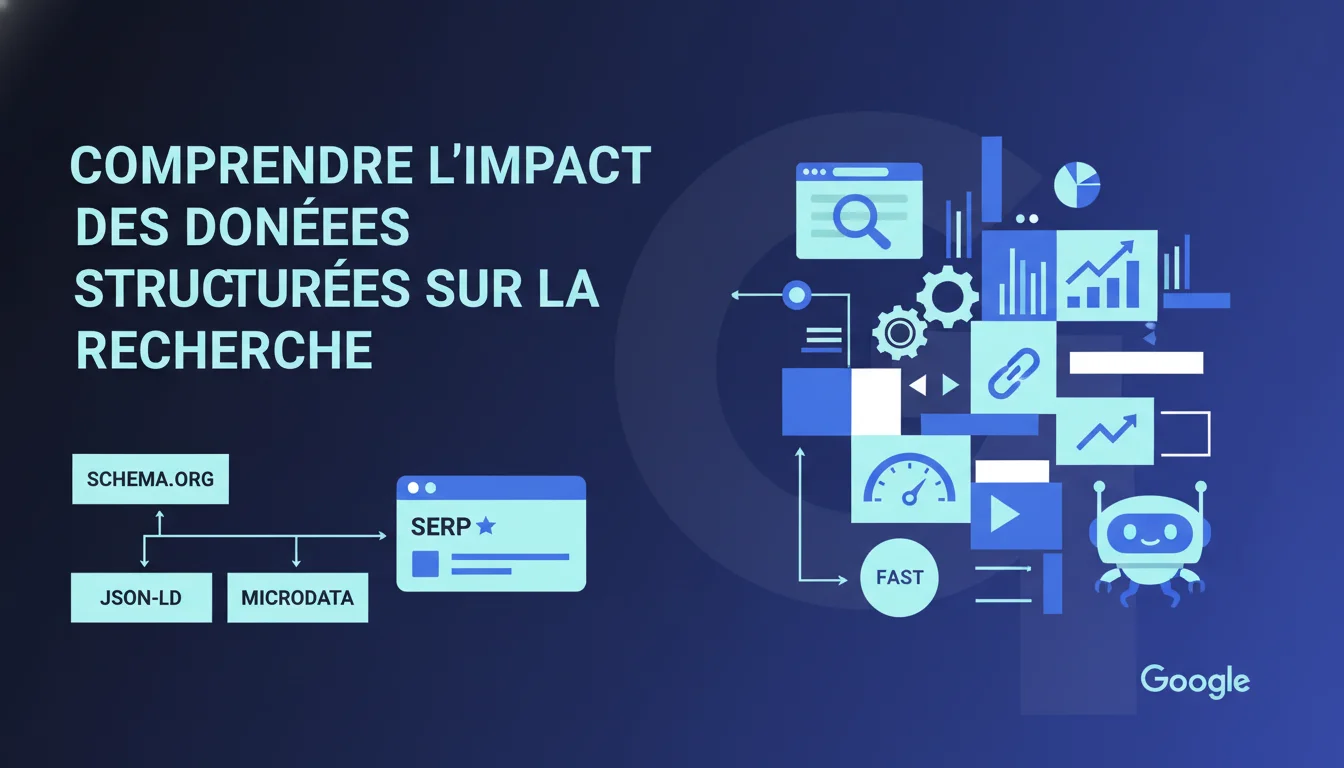
Google states that structured data helps in understanding the content of a page but does not guarantee a better organic ranking, even for rich snippets like Top Stories. In essence, schema.org markup is a facilitator of understanding, not a direct ranking signal. For SEOs, this means that implementing JSON-LD without improving content quality will not boost your positions.
What you need to understand
What does Google really say about the link between schema.org and ranking?
Google's position is clear but often misinterpreted: structured data serves to interpret the semantic context of a page, not to improve its authority or algorithmic relevance. When you mark up an article with schema.org/Article, you facilitate the extraction of information such as the author, publication date, or the main image.
What Google does not explicitly state is that this markup indirectly influences visibility through enriched SERP features. A well-structured article can land a Top Stories carousel, a featured snippet, or rich results. These placements generate traffic but do not change the raw organic ranking of the URL among the classic 10 blue links.
Why does Google emphasize the lack of guaranteed positioning?
Because thousands of sites have implemented schema.org hoping for an instant boost and were left disappointed. Google wants to prevent webmasters from seeing structured data as a tool for algorithm manipulation. The underlying message: structure your content for users and machines, not to game the system.
The example of Top Stories is telling. Even with perfect Article markup and impeccable Core Web Vitals, you will only appear in this carousel if your site meets the editorial criteria of Google News and the content is deemed sufficiently fresh and relevant for the query. Schema.org is a necessary but never sufficient condition.
How do understanding and ranking differ?
Understanding refers to Google’s ability to extract entities and semantic relationships: title, author, date, price, rating, availability. Ranking, on the other hand, depends on hundreds of signals including textual content, backlinks, user experience, freshness, and domain authority.
A product properly marked up with schema.org/Product will allow Google to display the price and availability in enriched results. However, if your product page is low on content, your site is slow, and you have no backlinks, you will remain invisible on page 3. Structured markup never compensates for a failing SEO strategy.
- Structured data facilitates semantic indexing but does not create an authority signal.
- Access to rich results depends on schema.org, but their appearance is still conditioned on content relevance.
- Top Stories, recipes, FAQs, products, events: each enriched format has its own eligibility criteria beyond the technical markup.
- A poorly optimized site with perfect JSON-LD will never surpass a well-optimized competitor without structured markup.
- Google may ignore your structured data if it detects inconsistencies between markup and visible content.
SEO Expert opinion
Is this statement consistent with field observations?
Yes, and it is confirmed by years of testing. I have audited dozens of sites that implemented complete schema.org without seeing significant changes in their raw organic traffic. In contrast, those that have secured rich snippets (FAQs, recipes, videos) saw their CTR skyrocket on relevant queries, which indirectly enhances user signals and may influence ranking in the medium term.
The case of Top Stories is illustrative: Google requires valid Article or NewsArticle markup, but only sites indexed in Google News and meeting editorial criteria appear in this carousel. I have seen technically structured blogs that were never eligible while media outlets with approximate markup consistently appeared there due to their editorial authority.
What are the gray areas of this claim?
Google says nothing about the indirect impact of rich results on CTR and thus on ranking. A site that obtains product stars or FAQs directly in the SERPs attracts more clicks, sending positive signals to the algorithm. Does this improve positioning? Not directly. Does it enhance visibility and generate more traffic? Absolutely.
Another vague point: Does Google use structured data to refine its understanding of entities in its Knowledge Graph? Probably. If your Organization or Person markup is consistent and recurring, it may contribute to building or strengthening an entity in Google's knowledge base, which has indirect effects on E-E-A-T and thus potentially on ranking. [To be verified] But Google never explicitly confirms this.
In which cases does this rule not completely apply?
There are formats where the absence of structured data completely excludes you from certain SERP positions. Recipes without schema.org/Recipe never appear in the dedicated carousel. Events without schema.org/Event do not surface in enriched event results. Job postings without JobPosting are invisible in Google for Jobs.
In these specific cases, structured markup becomes a mandatory prerequisite for accessing specific visibility areas. Saying it does not guarantee better positioning is technically true for classic organic ranking, but misleading when considering all SERP surfaces. Without schema.org, you are simply out of the game for these opportunities.
Practical impact and recommendations
What should you do with this information?
Implement relevant structured data for your content, without expecting a ranking miracle. Focus on the types of schema.org that unlock SERP features: Article for media, Product for e-commerce, Recipe for recipes, Event for events, LocalBusiness for local businesses, FAQPage for FAQ pages.
Consistently test your tags with Google's Rich Results Test and monitor errors in Search Console under 'Enhancements.' Poorly implemented markup is worse than no markup at all: it can prevent rich results from displaying and create confusion for crawlers.
What mistakes should you absolutely avoid?
Never mark up invisible content or content that does not represent the page. Google detects inconsistencies between schema.org and visible DOM and can penalize you by excluding you from rich results. If you mark up a 5/5 rating while the visible content shows 3/5, you violate the guidelines.
Also avoid multiplying schema.org types without consistency. A product page does not need Article markup. A blog article does not need Product markup. Google prioritizes semantic clarity: one page = one main content type. Nesting is possible (like Article with VideoObject) but must remain logical.
How can you check if your implementation is effective?
Monitor the 'Enhancements' reports in Search Console: they indicate how many pages are eligible for rich results and how many have errors. A high error rate signals an implementation problem. Also, track CTR evolution in performance reports: a jump in CTR on certain queries may indicate the appearance of rich snippets.
Compare your SERP visibility with tools like Semrush or Ahrefs by enabling tracking of featured snippets and rich results. If you implement schema.org FAQPage but never obtain enriched FAQs in the SERPs, it's either that your markup is invalid or that Google considers your content insufficiently relevant.
- Implement relevant schema.org types for each strategic page model (Article, Product, Recipe, Event, LocalBusiness).
- Validate the markup with the Rich Results Test and correct all reported critical errors.
- Monitor Search Console reports for eligibility issues regarding rich results.
- Never mark up invisible content or content that does not represent the visible DOM.
- Track CTR evolution on queries where you target rich snippets.
- Test actual display in the SERPs with queries representative of your audience.
❓ Frequently Asked Questions
Les données structurées sont-elles un facteur de ranking direct ?
Faut-il absolument implémenter du schema.org pour ranker ?
Pourquoi mon balisage schema.org n'apparaît-il pas dans les SERP ?
Le balisage schema.org améliore-t-il le taux de clic ?
Quels types de schema.org sont prioritaires en SEO ?
🎥 From the same video 9
Other SEO insights extracted from this same Google Search Central video · duration 59 min · published on 03/09/2020
🎥 Watch the full video on YouTube →
💬 Comments (0)
Be the first to comment.