
Official statement
What you need to understand
What is Google's official stance on automatic translation?
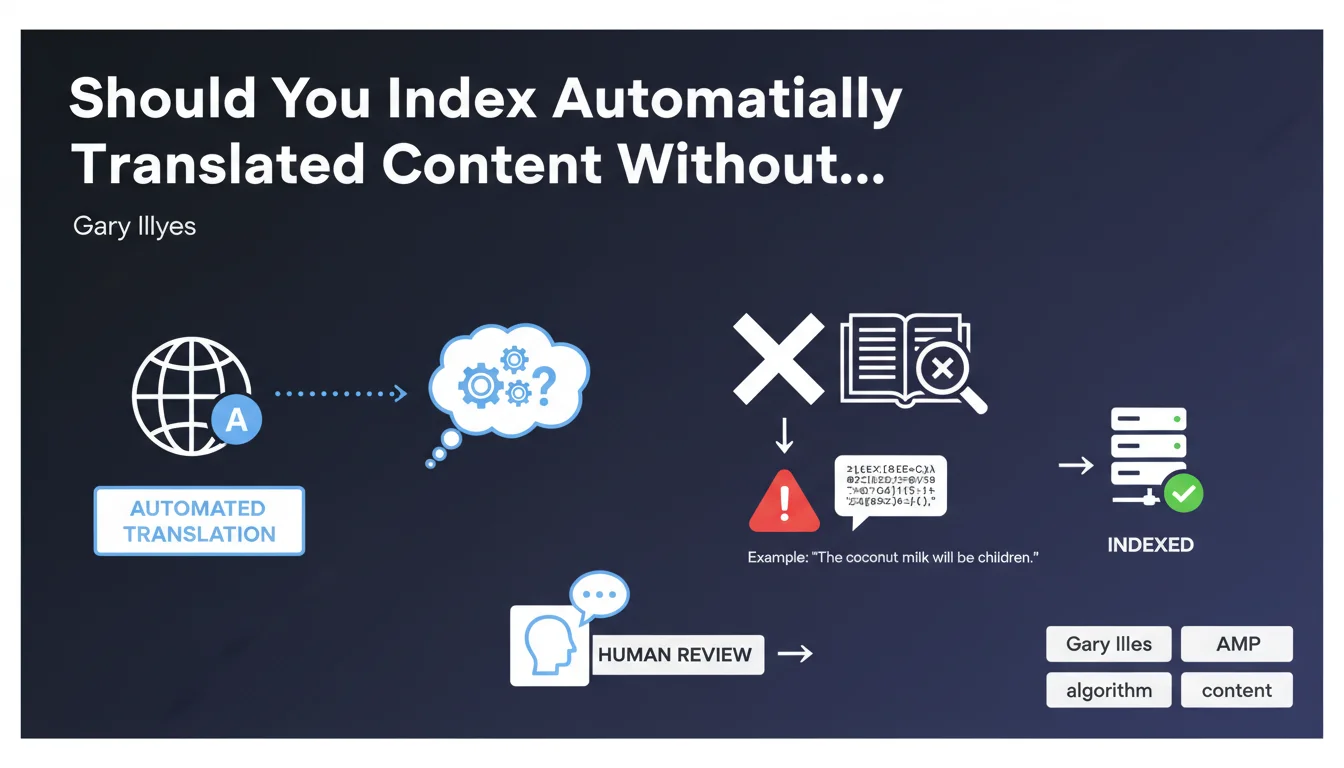
Google clearly recommends not indexing automatically translated content without prior human review. This directive targets translations generated by algorithms like GPT-3 or other automatic translation tools.
The example provided perfectly illustrates the problem: a sentence that became completely incomprehensible after translation, demonstrating that automatic tools can produce content with no value for the user. Google considers this type of content as low quality.
Why does this recommendation matter for SEO?
This position is part of Google's fight against large-scale content spam. Without this directive, sites could massively generate poor-quality linguistic versions in hundreds of languages.
Google always prioritizes user experience and content quality. Poorly translated text harms this experience and can lead to algorithmic or manual penalties for low-value content.
What are the essential takeaways from this directive?
- Automatic translation alone is not sufficient for indexable content
- Human review is necessary before any indexation
- Automatically translated content must be set to noindex at minimum
- Ideally, you should also block crawling of these pages via robots.txt
- This rule aims to maintain the overall quality of Google's index
SEO Expert opinion
Is this directive consistent with practices observed in the field?
Absolutely. Sites that have massively deployed unreviewed automatic translations have often experienced ranking problems. Google's algorithms, particularly quality updates, do indeed penalize this type of content.
We observe that successful multilingual sites systematically invest in human review of their translations. Linguistic quality is an indirect but measurable ranking factor through user engagement signals.
What nuances should be added to this recommendation?
The quality of automatic translation tools has significantly improved since this statement. Tools like DeepL or GPT-4 produce results far superior to the catastrophic examples cited. Nevertheless, the recommendation remains valid.
There's a difference between translating simple informational content and technical, marketing, or legal content. The more complex the content or the more it requires cultural precision, the more essential human review becomes to avoid misunderstandings.
In which cases can this rule be relaxed?
For content with low SEO value (user pages, internally generated user content, interfaces), automatic translation may be acceptable if it remains noindexed. The objective is then purely functional.
Sites with thousands of product references can use automatic translation for standardized technical attributes, provided that the main marketing descriptions are humanly reviewed. This is a pragmatic hybrid approach.
Practical impact and recommendations
What should you actually do with automatically translated content?
If you use automatic translation tools, the first action is to identify all affected pages on your site. Conduct a complete audit of your language versions to determine which ones were generated without review.
For pages automatically translated without review, immediately apply a meta robots noindex tag. Ideally, also block their crawling in the robots.txt file to avoid wasting your crawl budget.
The best solution remains investing in professional human review of your translations, at least for strategic pages generating traffic or conversions. Prioritize landing pages, main product sheets, and editorial content.
What critical mistakes must you absolutely avoid?
- Never publish machine-only translated content as index, follow
- Avoid automatically translating title tags and meta descriptions without verification
- Don't simultaneously deploy dozens of unreviewed language versions
- Don't consider automatic translation as a viable international SEO solution
- Avoid poor-quality translation tools producing incomprehensible content
How can you check and optimize your existing translated content?
Conduct an audit of your multilingual pages by checking bounce rates, session duration, and conversions by language. Low metrics often indicate translation quality problems.
Test the actual comprehensibility of your translations by having them read by native speakers of each target language. Identify priority pages based on their traffic potential and correct them first.
Implement a quality process for all new translations: initial automatic translation, then systematic human review before publication. This hybrid approach optimizes costs and quality.
💬 Comments (0)
Be the first to comment.