
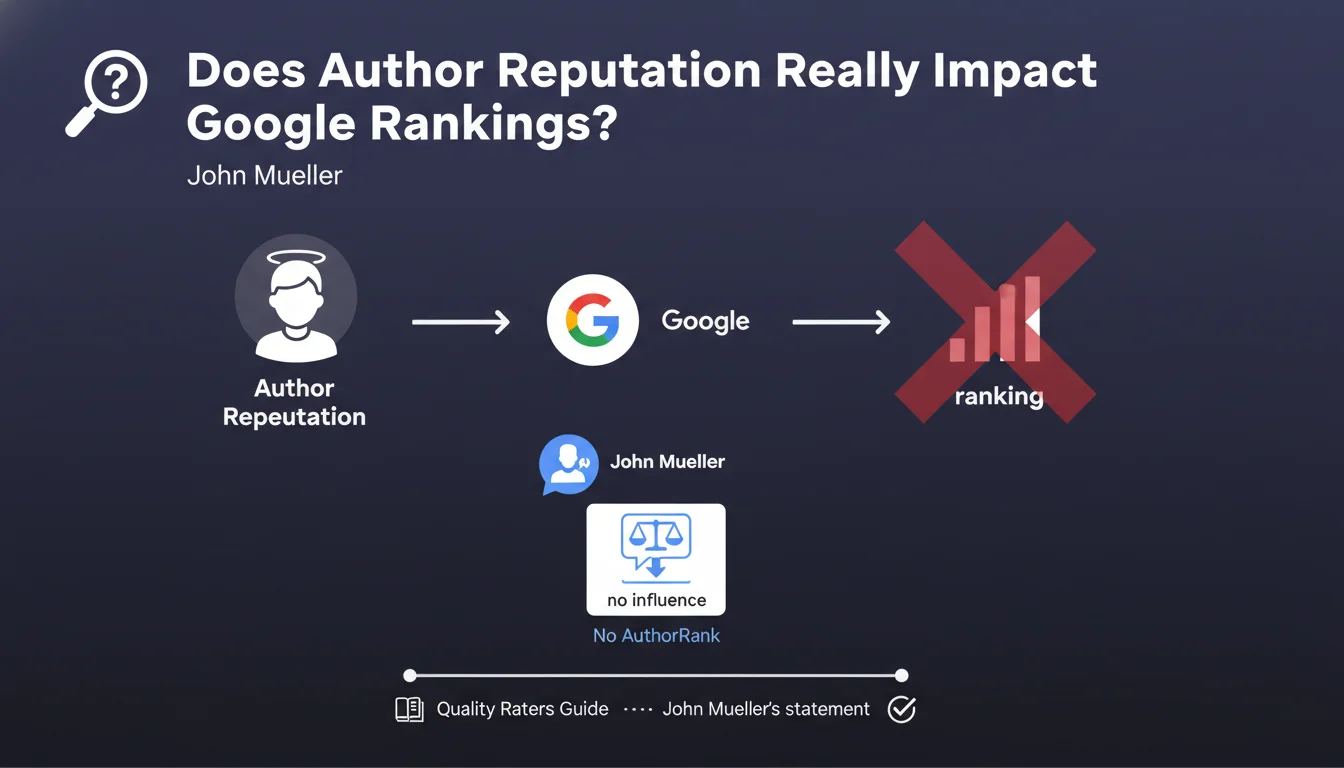
Official statement
What you need to understand
What's the difference between AuthorShip and AuthorRank?
AuthorShip refers to the identification of the author of a piece of content, while AuthorRank would refer to a scoring system that would value content based on their author's reputation.
According to John Mueller, Google uses author markers to identify who wrote what, but does not assign a reputation score that would directly influence page rankings.
Why is there confusion with the Quality Raters guide?
The Quality Raters guide does indeed mention author expertise and reputation as evaluation criteria. However, this document serves to train human evaluators, not to describe the actual algorithm.
Quality Raters assess the quality of search results after the fact. Their feedback serves to improve the overall algorithm, but doesn't necessarily reflect each individual signal used by the search engine.
What should we take away from this official statement?
- No direct author score: Google states it doesn't calculate an AuthorRank that would automatically boost your content
- Identification remains important: Signing your content and clearly identifying authors remains a best practice
- Distinction between algorithm vs manual evaluation: What Quality Raters look for is not necessarily an algorithmic signal
- Focus on content: The intrinsic quality of content takes precedence over the author's notoriety
SEO Expert opinion
Is this statement really consistent with observed practices?
Mueller's statement deserves to be seriously nuanced. In YMYL (Your Money Your Life) sectors, we observe that content signed by recognized experts consistently performs better.
Google has multiple indirect means of measuring an author's authority: mentions on third-party sites, social profiles, academic citations, links to author pages. It would be surprising if these signals weren't exploited in one way or another.
What nuances need to be brought to Google's analysis?
The semantics are important here. Mueller says there is no AuthorRank "currently," which leaves the door open. He also specifies that it is not a direct "relevance criterion."
This doesn't exclude that an author's authority could influence other signals such as click-through rate, reading time, or social shares. The impact exists, but in an indirect and diffuse manner.
In which contexts does author reputation matter most?
For YMYL (health, finance, legal) content, clear identification of the author and their qualifications is essential. Google analyzes these pages with superior quality requirements.
In technical or scientific niches, authors with recognized publications or academic backlinks benefit from credibility that translates into better user signals, therefore indirectly into better rankings.
Practical impact and recommendations
What should you do concretely on your site?
Continue to clearly identify your authors. Create detailed author pages with biographies, expertise, and links to their publications or professional profiles.
Implement Schema.org Author markup to explicitly signal to Google who wrote each piece of content. Even without direct AuthorRank, this practice improves understanding of your content.
For YMYL sectors, highlight your writers' qualifications and certifications. Indicate their degrees, experience, and any relevant professional recognition.
What mistakes should you absolutely avoid?
- Don't bet everything on an author's notoriety at the expense of the content quality itself
- Don't invent fake qualifications or expertise for your authors: verification is possible
- Don't neglect author identification on the pretext that there's no direct AuthorRank
- Don't use generic signatures like "Editorial Team" for YMYL content requiring identifiable expertise
- Don't duplicate author biographies without real personalization
How can you optimize your content strategy accordingly?
Focus on content quality and depth rather than simply having a well-known personality sign it. A mediocre article signed by an expert won't outperform excellent content from a less-known author.
Develop the overall topical authority of your site. Regularly publish reference content in your niche, obtain quality backlinks, and build a reputation for collective expertise.
Create consistent author profiles on your site and professional networks. Authors should have a verifiable digital presence that reinforces their credibility beyond your site alone.
💬 Comments (0)
Be the first to comment.