
Official statement
What you need to understand
What is Google's official position on audio versions?
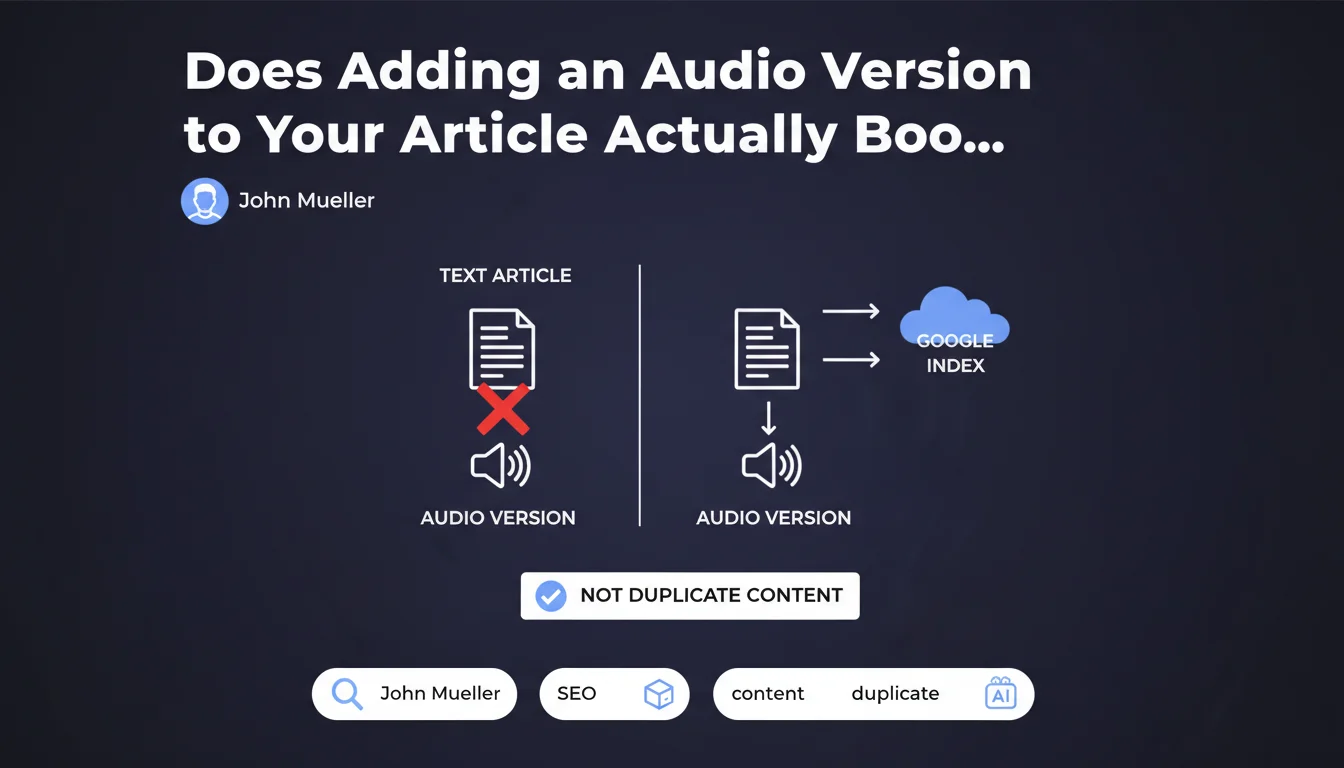
Google has clearly stated that offering an audio version of textual content does not provide any SEO bonus to the original article. This statement puts an end to certain speculations about a potential competitive advantage related to multi-format accessibility.
More importantly, Google confirms that the audio version is not considered duplicate content. This distinction is crucial because it allows enriching the user experience without fearing algorithmic penalties.
Why is this SEO neutrality important to understand?
This position reflects Google's philosophy: the algorithm primarily evaluates indexable textual content. Audio files, although detected, are not analyzed in the same way as text.
This means that your SEO strategy must focus on the quality of written content, even if you offer audio alternatives to improve user engagement.
What are the key takeaways from this statement?
- No direct SEO advantage: adding an audio version does not boost rankings
- No duplication risk: you can offer both formats without concern
- Focus on user experience: audio remains relevant for accessibility and engagement
- Text remains king: indexing and ranking depend on written content
- Editorial freedom: enrich your formats without SEO calculations
SEO Expert opinion
Is this statement consistent with field observations?
Absolutely. In my 15 years of experience, I have observed that SEO signals come primarily from indexable textual content. Complementary media (audio, video) indirectly influence through behavioral metrics.
Sites that have added audio versions have indeed seen an improvement in time on page and a reduction in bounce rate, but no direct modification in ranking for targeted keywords.
What important nuances should be brought to this analysis?
There is a fundamental difference between direct SEO impact and indirect benefits. If audio does not improve the algorithmic relevance score, it can increase user engagement signals.
Furthermore, podcasts and native audio content follow a different logic. They can appear in specific rich results and generate traffic via Google Podcasts. The statement specifically concerns audio versions of existing articles.
In what contexts does this rule deserve to be put into perspective?
For news sites and media outlets, offering an audio version can become a differentiating factor that improves loyalty metrics. These positive behavioral signals can indirectly strengthen Google's perception of quality.
As part of a voice search strategy, having well-structured audio content can position you favorably for voice assistants, even though this remains a channel distinct from traditional SEO.
Practical impact and recommendations
What should you concretely do with this information?
Do not create an audio version solely for SEO. This approach would be a waste of resources without direct return on investment in terms of rankings.
On the other hand, if your audience and editorial strategy justify this format (accessibility, mobile consultation, experience enrichment), deploy it without fear of negative impact. The neutrality confirmed by Google gives you this freedom.
Ensure that your textual content remains optimized and complete. It is what carries your SEO strategy, with audio being only a functional complement.
What common mistakes should you absolutely avoid?
The main mistake would be to replace text content with audio thinking you're innovating. Google cannot effectively index audio content, and you would lose all visibility on your strategic keywords.
Also avoid implementing heavy audio files that slow down your page loading time. Degraded Core Web Vitals will penalize your SEO far more than audio could improve it.
Do not neglect structured tags and metadata if you offer audio. Schema.org offers specific markers (AudioObject) that facilitate content understanding by search engines.
How can you technically optimize an audio version without risk?
- Always maintain a complete and indexable text version of your content
- Use a lightweight audio player that does not penalize loading performance
- Implement Schema.org AudioObject markup to clearly identify the content
- Optimize audio files (compression, adaptive format) to limit bandwidth impact
- Add a textual transcription if the audio content differs from the main text
- Measure user engagement (listening time, completion) via custom events
- Avoid automatic loading that unnecessarily consumes resources
- Verify the mobile compatibility and accessibility (WCAG) of the audio player
💬 Comments (0)
Be the first to comment.