
Official statement
What you need to understand
Why Does Google Defend Old Content?
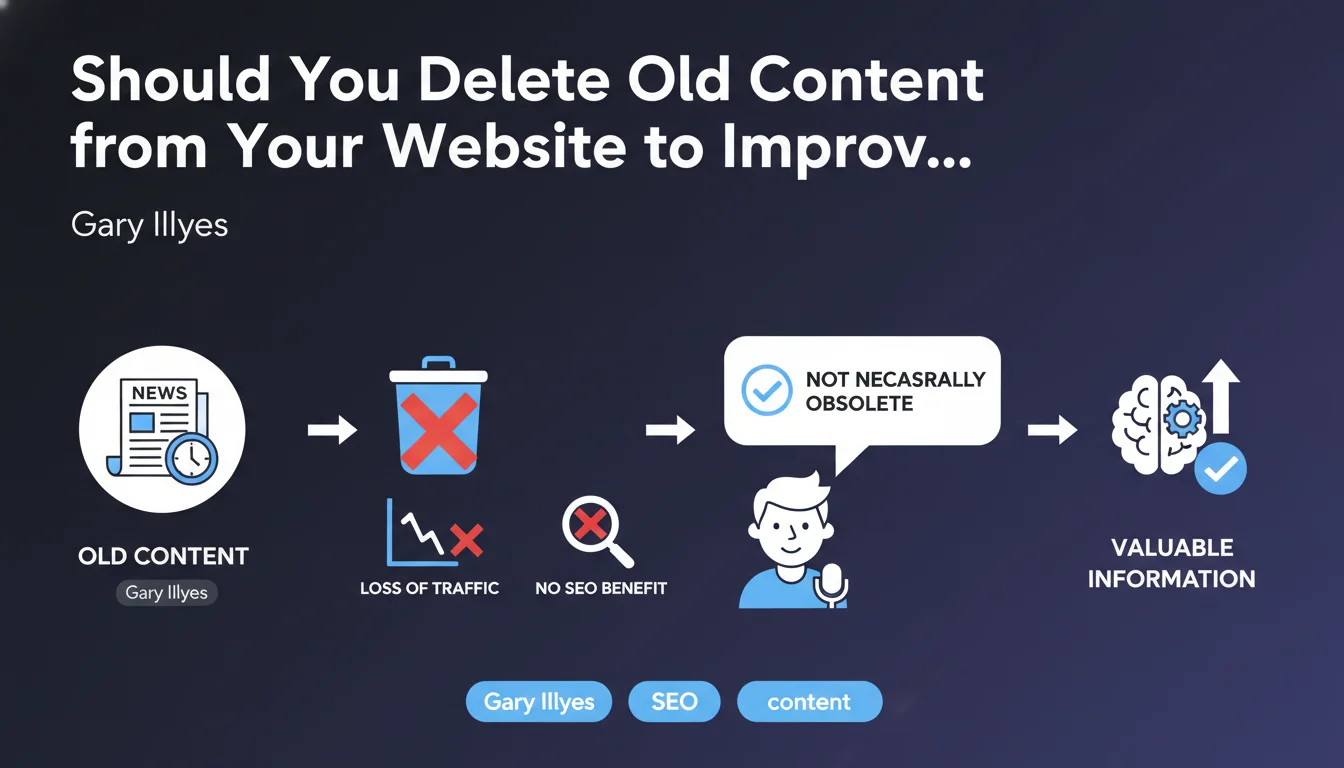
Google clearly states that content age does not automatically mean obsolescence. Mass deletion of archives can lead to significant traffic loss without providing any tangible SEO benefit.
This position is explained by the fact that many historical contents continue to generate qualified traffic via long-tail searches. Internet users regularly search for dated information, historical references, or chronological developments.
What's the Difference Between Old and Obsolete?
Old content is simply content that was published a long time ago. Obsolete content is content whose information has become false, misleading, or irrelevant.
A 2015 article about a historical event remains relevant. On the other hand, a 2015 technical guide about a technology that no longer exists is obsolete. This nuance is essential for making the right decisions.
What's the Real Problem Identified by Google?
The major problem is not age but the absence of content dating. A user must be able to easily identify when the information was published to assess its relevance.
Without a visible date, old content can be misleading or lose credibility. Google values temporal transparency that allows users to contextualize information.
- Age is not inherently a negative criterion for Google
- Deleting archives can generate traffic loss without SEO gains
- Visible dating is crucial for perceived relevance
- Systematically distinguish between old content and obsolete content
- Historical content has long-tail SEO value
SEO Expert opinion
Is This Recommendation Consistent with Observed Practices?
Absolutely. Traffic analyses regularly show that old content generates stable, qualified traffic over the long term. Sites that have massively deleted their archives often experience a progressive erosion of their visibility.
I observe that authority sites systematically keep their archives. Wikipedia, major media outlets, and institutional sites maintain their historical content with clear dating, which strengthens their overall credibility.
What Important Nuances Should Be Considered?
Not all old content is equal. Informational content (news, case studies, testimonials) ages well. Transactional content (prices, product availability, technical tutorials) requires regular updates.
Archive depth also depends on the sector. A general news site can keep 10 years of archives. A fashion e-commerce site will need to be more selective about obsolete products.
When Should You Still Delete or Deindex Content?
Deletion remains justified for misleading content: obsolete pricing, outdated regulatory information, dangerous technical advice. This content can harm your reputation and user experience.
Cannibalizing content should also be addressed: if two articles on the same topic are competing, merge them rather than keeping everything. Consolidation improves topical authority.
Practical impact and recommendations
How Can You Intelligently Audit Your Old Content?
Start with a traffic analysis over a minimum of 12 months. Identify old content that still generates organic visits. These pages are your SEO assets to absolutely preserve.
Use Google Analytics combined with Search Console to cross-reference age, traffic, and rankings. Create segments by publication year to visualize each period's contribution.
Then examine the informational quality: is the information still accurate? Partially true? Completely obsolete? This qualitative analysis guides your decisions.
What Strategy Should You Adopt to Optimize Your Archives?
For high-performing old content: add clearly visible publication dates, improve schema.org markup with temporal properties, and possibly add a contextual note.
For mixed content (partially obsolete): proceed with an intelligent update. Keep sections that are still relevant, update what needs updating, add a dated editorial note.
For truly obsolete content: favor 301 redirects to updated content rather than pure deletion. You preserve link equity and guide users to relevant information.
What Critical Mistakes Should You Absolutely Avoid?
Never delete in batches based solely on date. A blind industrial approach destroys SEO value. Each piece of old content deserves individual evaluation.
Don't forget visible dating: old content without a date loses credibility. Article schema with datePublished and dateModified is essential for both Google and users.
- Audit organic traffic from your old content over a minimum of 12 months
- Segment by publication year in Analytics
- Identify archives still generating qualified traffic
- Add visible publication dates to all content
- Implement schema.org markup with temporal properties
- Create an update strategy rather than a deletion strategy
- Use 301 redirects for truly obsolete content
- Add contextual notes to important historical content
- Merge cannibalizing content instead of deleting
- Document your decisions to ensure consistency over time
💬 Comments (0)
Be the first to comment.