
Official statement
Other statements from this video 2 ▾
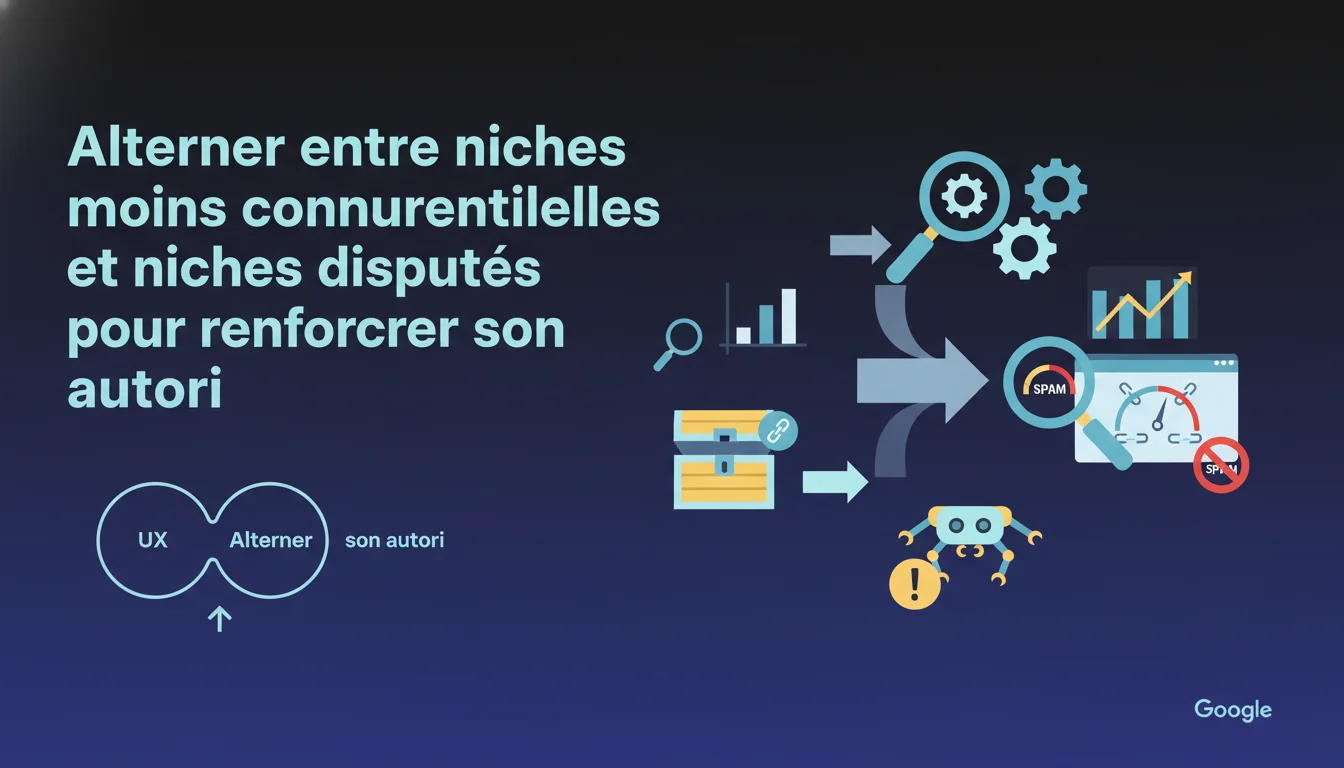
Google suggests beginning with less competitive niches to gradually build authority before tackling highly contested commercial sectors. This gradual approach would better prepare a site to compete in spammy environments. The real question is whether this strategy holds up against on-the-ground realities and if it applies to all projects.
What you need to understand
What exactly does Google say about this step-by-step progression?
Google states that it would be more strategic to begin in less competitive niches to build a strong reputation before tackling saturated commercial sectors. The underlying idea: a site that accumulates authority signals in calm environments would have a better chance of facing the rampant spam in contested niches.
This statement aligns with the concept of domain authority as Google views it. A site that demonstrates its expertise in a specific area would accumulate transferable trust signals. When this site subsequently broadens its scope into more competitive sectors, it would start with already established trust capital.
Why does Google emphasize spammy sectors?
Contested commercial niches — finance, health, insurance, gambling — are full of black hat techniques and content farms. In these environments, a new site without history or authority gets drowned out by the noise. Google suggests that gradual authority building provides better resistance to anti-spam algorithms that scrutinize these sectors.
The search engine would favor sites that have proven themselves elsewhere before qualifying for lucrative positions. A site that has already demonstrated its ability to produce reliable content in a related field would benefit from a presumption of legitimacy. At least, that’s what Google implies.
What exactly defines a less competitive niche?
A less competitive niche typically features a moderate search volume, fewer established players, and low KD on the main keywords. These spaces allow faster ranking and traffic accumulation without massive investment in backlinks. User signals — time on site, bounce rate, CTR — are easier to build in these niches.
These niches also offer a learning ground to understand what works: content architecture, internal linking, on-page optimization. Algorithmic feedback is clearer here than in ultra-competitive environments where hundreds of variables clash. You can test approaches and see what yields measurable results.
- A site ranking in a calm niche accumulates real engagement signals (time spent, interactions, organic shares)
- A history of regular publishing and quality indexed content builds transferable algorithmic reputation
- Backlinks naturally obtained in these niches carry more weight than in a spam-saturated sector with artificial links
- The topical authority built in one domain can extend to more competitive adjacent topics
- A site with a clean history withstands algorithm updates targeting spam in contested niches more effectively
SEO Expert opinion
Does this progressive approach really work in practice?
Yes and no. I've seen sites start in quiet micro-niches — let’s say specialized hiking gear — and then expand into more commercial sectors like mainstream outdoor equipment. It works when the progression is thematically coherent and the site maintains its quality standards. The trust capital does indeed transfer.
The problem? This strategy requires time and an initial investment that does not pay off immediately. A client who wants to rank for "car insurance" in six months lacks the patience to spend two years building authority on "electric bike insurance." Business reality doesn’t always align with Google’s recommendations. [To be checked] on short timelines.
What nuances does Google overlook in this statement?
Google doesn’t specify that this approach assumes a strict thematic coherence. You can't build authority in gardening and then pivot to crypto. Expertise signals only transfer within a logical semantic cluster. A health site can transition from niche nutrition to mainstream supplements, not finance.
Another unmentioned point: the quality of initial backlinks matters as much as their volume. Better to have ten solid editorial links from authoritative niche sites than a hundred low-quality links purchased on Fiverr. Google doesn't clearly distinguish between "building authority" and "accumulating artificial signals." A site can appear legitimate without actually being so.
In what cases does this rule not apply?
Established major brands do not need this approach. If you are Amazon launching a new vertical, your overall authority suffices. Sites with a massive marketing budget can force entry into contested niches through premium backlink acquisition and large-scale content production.
Pure transactional sites — price comparison sites, marketplaces — operate differently. Their authority builds on technical signals (speed, UX) and impeccable structured data rather than an organic thematic progression. Google’s approach assumes an editorial model that doesn't fit all business models.
Practical impact and recommendations
How do you choose your starting niche?
Identify specific sub-segments of your target market with a KD below 30 and a monthly search volume between 500 and 5000. These spaces provide enough traffic to build signals without requiring an arsenal of backlinks. Use Ahrefs or Semrush to map out long-tail keywords where the top three results have a DR below 40.
Initially, favor niches with a strong informational intent. Educational content ranks more easily than purely transactional content and accumulates natural backlinks. Once your authority is established on these queries, gradually pivot towards commercial intention content in more lucrative adjacent sectors.
What is a realistic duration for this building phase?
Expect a minimum of 12 to 18 months to build transferable authority in a calm niche. This requires regular publishing — at least two substantial articles per week — and a clean link building strategy. The first authority signals appear around the sixth month, but actual algorithmic maturity takes longer.
Don’t expect visible results before the fourth quarter. Google monitors your behavior over the long term: publication frequency, content update rate, diversity of backlink sources. A site maintaining a steady pace over twelve months sends serious signals that a three-month rush cannot produce.
What pitfalls should be avoided during this transition?
Don't dilute your topical authority by expanding too quickly into unrelated subjects. Stay within a coherent semantic perimeter for at least the first year. A gardening site suddenly publishing on finance loses its algorithmic credibility immediately. Each new vertical should be a logical extension of your established expertise.
Avoid the trap of low-quality content to artificially inflate your volume. Google values depth over quantity. Ten ultra-documented 3000-word articles are better than fifty superficial 500-word posts. The quality of user signals — reading time, scroll depth — is just as important as the number of indexed pages.
- Audit related niches with a KD below 30 and a monthly volume between 500 and 5000 searches
- Build an editorial calendar over 18 months with a clear thematic progression towards target niches
- Implement tracking of engagement metrics (time on page, bounce rate, pages per session) from the start
- Establish a white hat link building strategy in the starting niche before expanding
- Create solid topic clusters in the initial niche before opening new verticals
- Monitor the authority transfer between sections through internal link equity and organic rankings
❓ Frequently Asked Questions
Combien de temps faut-il pour construire une autorité transférable dans une niche calme ?
Peut-on sauter cette étape si on a déjà un budget backlinks conséquent ?
Comment savoir quand pivoter vers des niches plus commerciales ?
Cette stratégie fonctionne-t-elle pour les sites e-commerce ?
Quelle distance thématique peut-on parcourir sans perdre son autorité ?
🎥 From the same video 2
Other SEO insights extracted from this same Google Search Central video · duration 3 min · published on 07/07/2010
🎥 Watch the full video on YouTube →
💬 Comments (0)
Be the first to comment.