
Official statement
What you need to understand
Why does Google require specific attributes on affiliate links?
Google aims to distinguish natural editorial links from commercial or advertising links. Affiliate links generate revenue for the site owner, so they don't constitute unbiased recommendations.
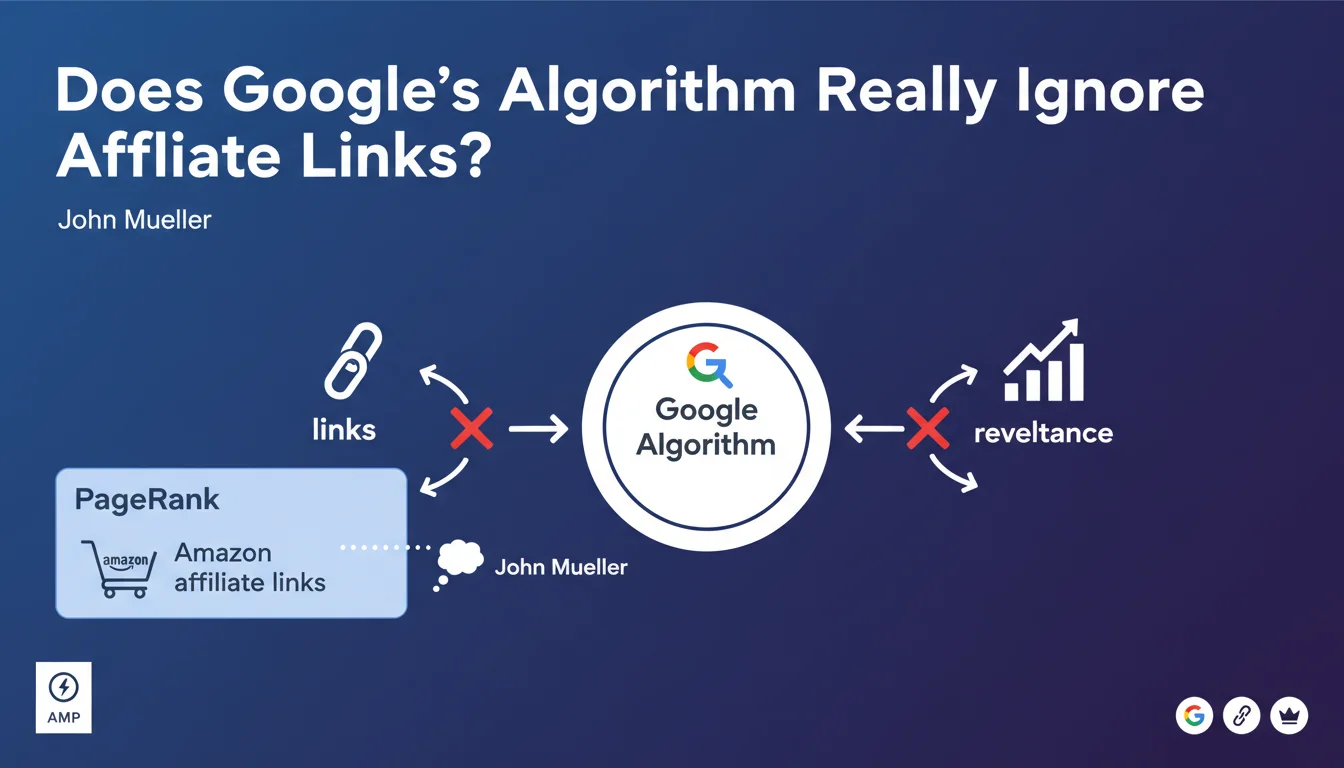
By requiring the rel="sponsored" markup, Google ensures these links don't pass PageRank and don't distort the ranking algorithm. It's a matter of transparency and search results integrity.
What's the difference between rel="nofollow" and rel="sponsored" for affiliate links?
Both attributes prevent PageRank transfer, but rel="sponsored" provides additional semantic precision. It explicitly tells Google that this is a commercial or paid link.
Since 2019, Google treats these attributes as hints rather than strict directives. The search engine can choose whether to consider them or not, but using the correct attribute remains a recommended best practice.
- rel="sponsored" is the recommended attribute for all affiliate links
- rel="nofollow" remains acceptable but less semantically precise
- Both attributes prevent PageRank transfer
- Since 2019, these attributes are treated as hints rather than absolute directives
- Non-compliance can be considered an attempt to manipulate rankings
What are the risks of not properly tagging your affiliate links?
A site that doesn't mark its affiliate links with rel="sponsored" may be considered as participating in a link scheme designed to manipulate PageRank. This violates Google's guidelines.
Consequences can range from a simple warning in Search Console to a penalizing manual action, or even significant loss of organic visibility. Transparency is essential to maintain Google's trust.
SEO Expert opinion
Is this recommendation consistent with practices observed in the field?
Absolutely. Since the introduction of rel="sponsored" and rel="ugc" attributes in September 2019, Google has clarified its position on link qualification. Major affiliate sites quickly adopted these attributes.
In my audits, I observe that sites correctly using rel="sponsored" have no issues with Google, while some sites neglecting this practice have received manual actions for artificial links. There's complete consistency between the statements and algorithmic reality.
What nuances should be considered with this recommendation?
The main nuance concerns the status as a hint rather than a directive. Since 2019, Google can choose whether to follow these attributes depending on context. This doesn't mean they should be neglected—quite the opposite.
Another subtlety: some affiliate links can be simultaneously editorial and commercial. In this case, rel="sponsored" remains appropriate because the commercial dimension takes precedence. It's also possible to combine attributes: rel="nofollow sponsored" for double security, even though this remains redundant.
In which specific cases does this rule require adaptation?
For price comparison sites or deal sites, where the entire business model relies on affiliation, systematically applying rel="sponsored" is crucial. These sites are particularly monitored by Google.
However, for an editorial blog where affiliation is minor and contextual, the stakes are lower but rigor remains important. Some SEOs think they can "forget" a few links, but this is a strategic mistake that can prove costly during a manual review.
Practical impact and recommendations
What should you do concretely to bring your affiliate links into compliance?
Start by auditing all your existing affiliate links. Use a crawler like Screaming Frog or search your source code to identify links pointing to your affiliate programs (Amazon Associates, Awin, CJ Affiliate, etc.).
Then, systematically modify these links to add the rel="sponsored" attribute. If you use a CMS like WordPress, affiliate management plugins can automate this task. Ensure your editorial process integrates this practice for all new content.
- Identify all affiliate links on your site (complete crawl)
- Add the rel="sponsored" attribute to each affiliate link
- Verify that cloaking tools or affiliate redirection preserve the attribute
- Update templates and snippets to automatically include this attribute
- Train writers and contributors on this requirement
- Document the procedure in your SEO editorial guidelines
What technical mistakes must you absolutely avoid?
The most common mistake is using JavaScript to insert affiliate links thinking Google won't see them. This is false: Google executes JavaScript and will detect these untagged links.
Another trap: using a 301/302 redirect system to hide the affiliate nature of the link. Google can follow these redirects and identify the final destination. Transparency must be complete, right from the source link.
Finally, don't think that adding rel="sponsored" only to new links will suffice. Google analyzes history and can retroactively penalize a site that belatedly corrects its practices without cleaning up existing content.
How can you verify that your site properly follows these recommendations?
Use Search Console to monitor potential warning messages regarding artificial links. Regularly perform a crawl with tools like Screaming Frog, filtering external links containing your affiliate domains.
Also verify the rendered source code (after JavaScript) to ensure attributes are present in the final DOM. A simple test is to manually inspect a few strategic pages in Chrome DevTools.
💬 Comments (0)
Be the first to comment.