
Official statement
What you need to understand
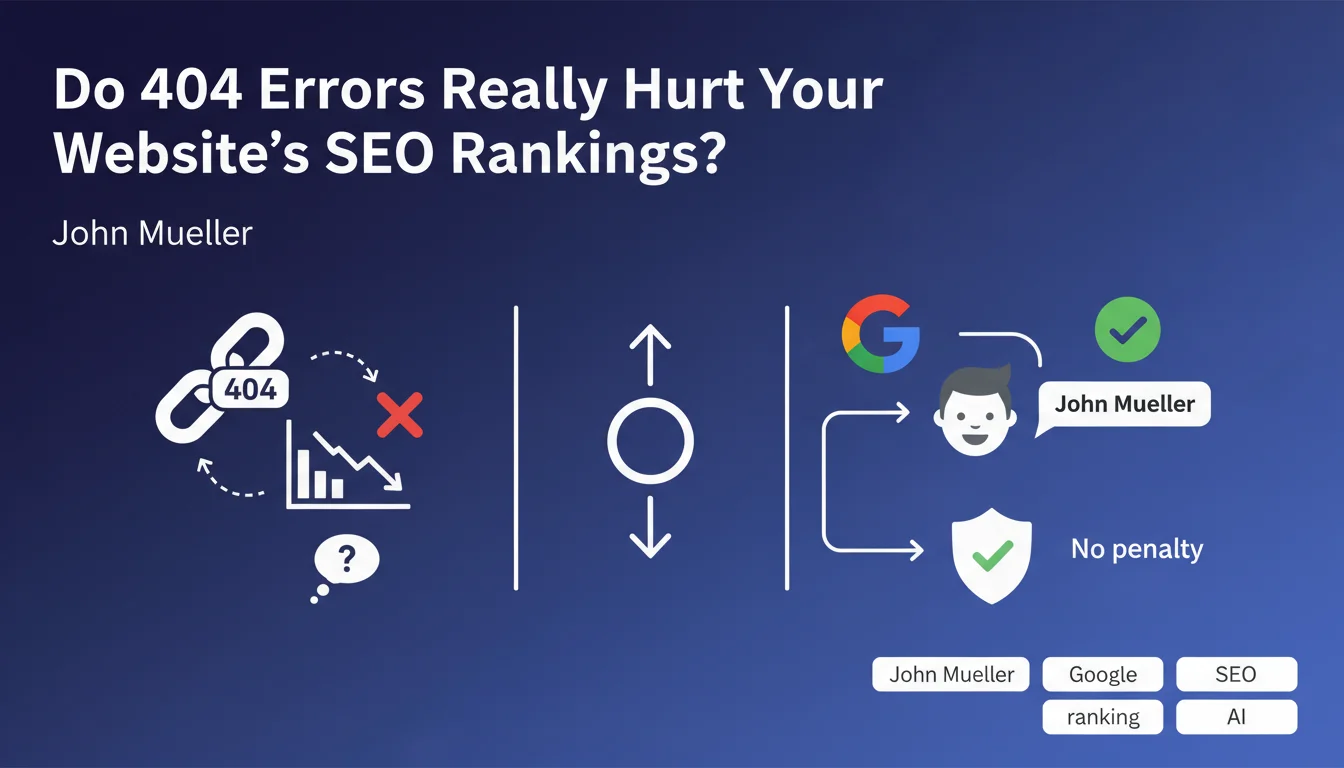
This official statement clears up a persistent misconception in the SEO world: 404 errors are not considered a low-quality signal by Google's algorithm. Contrary to what some practitioners fear, having pages returning a 404 code on your site does not trigger any algorithmic penalty.
Google understands that 404 errors are part of a website's normal lifecycle. Products sell out, articles become obsolete, content gets reorganized. It's natural for a site to generate 404 pages over time.
However, this tolerance doesn't mean these errors should be completely neglected. There's an important difference between a few legitimate 404s and a massively broken site that creates a poor user experience.
- No direct algorithmic penalty related to 404 codes
- 404s are considered normal in a site's lifecycle
- Google doesn't view this as a negative quality criterion
- The real impact lies at the user experience level rather than the algorithm
- Distinction must be made between a few 404s and a structurally broken site
SEO Expert opinion
This position from Google is consistent with field observations over several years. Many high-performing SEO sites have 404 errors without any visible negative impact on their rankings. Google's algorithm is mature enough to distinguish a well-managed site from an abandoned one.
However, an important nuance regarding user experience must be added. While 404s don't directly penalize, an excessive number of errors can degrade behavioral signals: high bounce rate, decreased time on site, visitor frustration. These engagement metrics can indirectly affect your visibility.
Furthermore, crawl budget wasted on thousands of 404s can be problematic for very large sites. Google has to spend time crawling non-existent pages instead of discovering your new content.
Practical impact and recommendations
General recommendation: Adopt a pragmatic and proportionate approach to 404 errors. Don't panic over a few errors, but maintain reasonable technical hygiene.
- Don't waste time obsessively tracking down every isolated 404 error on your site
- Monitor your strategic pages: set up alerts for URLs generating traffic or possessing quality backlinks
- Implement 301 redirects for important deleted pages to relevant and equivalent content
- Create a customized 404 page with clear navigation, internal search, and content suggestions to limit abandonment
- Audit regularly (quarterly) massive 404s via Search Console to identify potential structural issues
- Avoid systematic 301 redirects to the homepage: prefer leaving a real 404 if no relevant alternative exists
- Clean up broken internal links pointing to 404s, as this degrades the navigation experience
- For large e-commerce sites: monitor the active pages/404 ratio to detect massive technical indexing problems
- Document your strategy for managing obsolete content: deletion, redirection, or maintenance with updates
The optimal management of 404 errors is part of a comprehensive technical SEO strategy that requires an overall vision of your digital ecosystem. Between backlink auditing, crawl budget analysis, redirect mapping, and performance monitoring, these optimizations require sharp technical expertise and professional tools. For sites with a large volume of pages or complex history, support from a specialized SEO agency enables establishing a coherent strategy and avoiding costly mistakes, while freeing your teams to focus on creating value.
💬 Comments (0)
Be the first to comment.