
Official statement
What you need to understand
What Is the Fundamental Difference Between HTTP Redirect Codes?
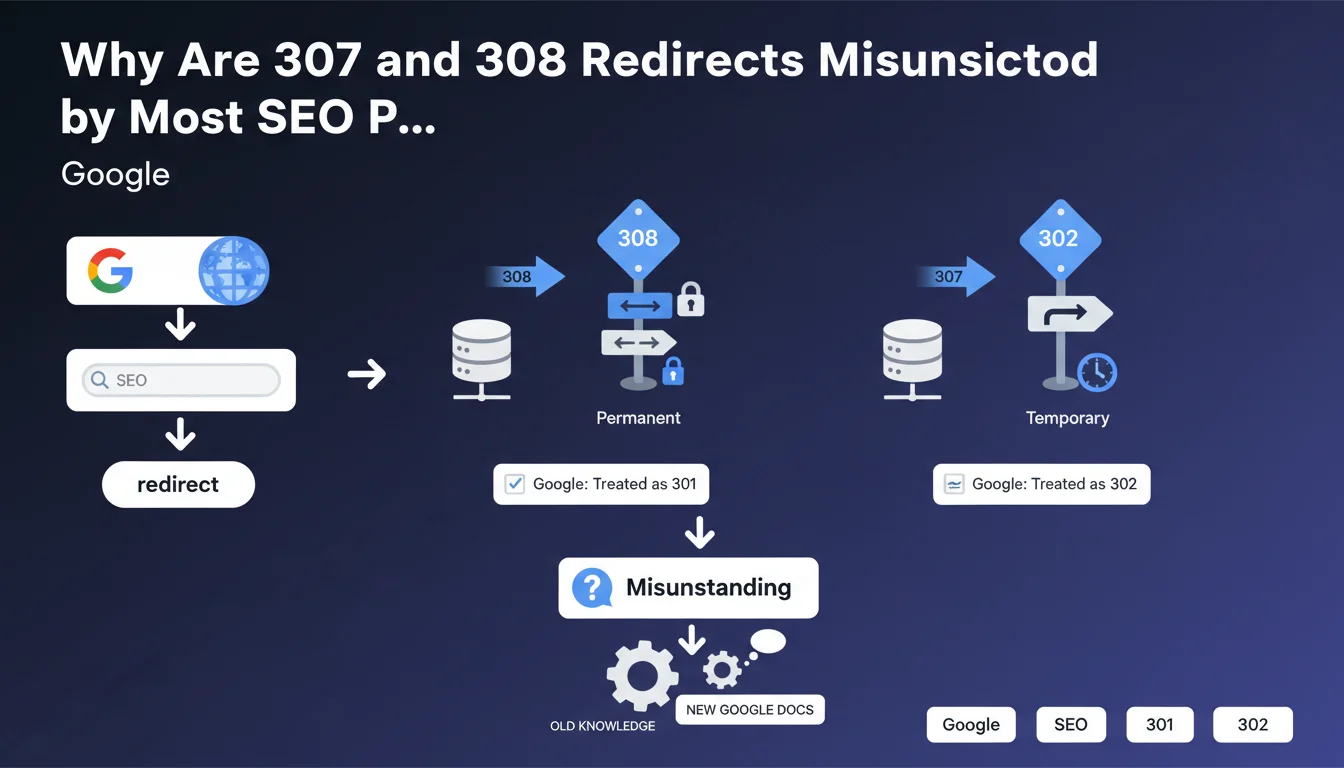
HTTP redirect codes are divided into two main categories: permanent redirects and temporary redirects. The 301 and 308 codes indicate to the search engine that the resource move is permanent, while the 302 and 307 codes signal a temporary move.
The nuance between these codes lies primarily in their handling of HTTP methods. The 301 and 302 can modify the request method (POST to GET), whereas 307 and 308 guarantee the preservation of the original method. This technical distinction has long created confusion about their treatment by Google.
How Does Google Actually Handle These Different Types of Redirects?
Google has officially stated that 308 redirects are treated exactly like 301s, meaning as permanent redirects. PageRank is transferred and the destination URL replaces the source URL in the index. Similarly, 307 redirects are interpreted as 302s, which are temporary redirects.
This clarification means that Google focuses on the redirect intent (permanent or temporary) rather than on the technical subtleties of HTTP method preservation. For an SEO practitioner, this significantly simplifies decision-making when implementing redirects.
Why Does This Information Matter for Site Migrations?
Many migrations, particularly from HTTP to HTTPS, have been carried out with 307 redirects, which constitutes a major strategic error. Since a 307 redirect is considered temporary, Google may keep the old HTTP URL in its index and not fully transfer the ranking signal.
The correct use of redirect codes ensures an effective SEO migration with optimal authority transfer. For any permanent migration, 301 or 308 codes should be prioritized to ensure rapid signal consolidation on the new URL.
- 308 redirects are treated as 301s by Google (permanent)
- 307 redirects are treated as 302s (temporary)
- Using 307 for HTTPS migrations is a bad practice
- Google prioritizes the redirect intent over technical HTTP aspects
- Choosing the right code directly impacts PageRank transfer
SEO Expert opinion
Does This Statement Align with Real-World Observations from SEO Practitioners?
This official clarification confirms the empirical observations of the SEO community over several years. Tests conducted on migrations indeed show that 308s behave like 301s in terms of authority transfer and consolidation speed in the index.
However, the use of 307 for HTTPS migrations remains surprisingly widespread, likely due to default server configurations or outdated technical recommendations. This practice explains some cases of HTTPS migrations that struggle to fully consolidate in search results.
What Nuances Should Be Applied to This General Rule?
Although Google treats 307s as 302s, there are specific contexts where their use may be justified. For example, during scheduled maintenance or temporary A/B tests, a 307 redirect sends a clear signal that the change is ephemeral.
It is also important to note that some cache systems and CDNs react differently to 307/308 codes compared to 301/302, particularly regarding redirect caching. This infrastructure dimension deserves to be taken into account in complex technical environments.
When Do 307 and 308 Redirects Offer a Real Advantage?
307 redirects find their usefulness in intentional temporary scenarios: scheduled maintenance, user testing, temporary geographic switching. They allow you to clearly signal to Google that the source URL remains the reference to be indexed.
308s, although rare in practice, offer an advantage in environments where strict preservation of HTTP methods is critical, particularly for REST APIs or complex web applications. For classic SEO, their equivalence with 301s makes them interchangeable, although 301s remain the de facto standard.
Practical impact and recommendations
What Should You Check Immediately on Your Site?
The first action is to audit all your redirects, particularly those related to HTTPS migration. Use tools like Screaming Frog, browser extensions, or curl commands to identify the HTTP status codes actually returned by your server.
Pay particular attention to redirects configured at the web server level (Apache, Nginx), CDN, or application firewall. These technical layers can sometimes override CMS configurations and implement unexpected codes.
How Do You Fix Identified Redirect Errors?
If you detect 307 redirects on your HTTPS URLs, replace them immediately with 301 or 308. On Apache, modify your .htaccess file to explicitly use the [R=301] directive. On Nginx, use the 301 return code in your configuration blocks.
After correction, monitor Search Console to observe signal consolidation. The process can take a few weeks depending on the crawl frequency of your pages. Also document your redirect code choices in your technical documentation to maintain consistency.
What Best Practices Should You Adopt for Your Future Implementations?
Establish a clear nomenclature within your team: 301 or 308 for any permanent change (migrations, URL restructuring, content consolidation), 302 or 307 only for documented temporary situations with a planned duration.
Integrate redirect code verification into your deployment checklist. Before each production release involving redirects, validate the HTTP codes returned on a representative sample of URLs in the staging environment.
- Audit all current redirects with a professional crawl tool
- Specifically identify HTTP to HTTPS redirects and verify their code
- Replace all 307 redirects used for permanent migrations with 301/308
- Test modifications in pre-production environment before deployment
- Document the redirect policy in your internal technical SEO guide
- Set up a Search Console alert to detect redirect errors
- Plan a quarterly check of redirect codes on strategic URLs
- Train technical teams on the SEO implications of different HTTP codes
💬 Comments (0)
Be the first to comment.