
Official statement
What you need to understand
What exactly does Google say about 301 redirects and multilingualism?
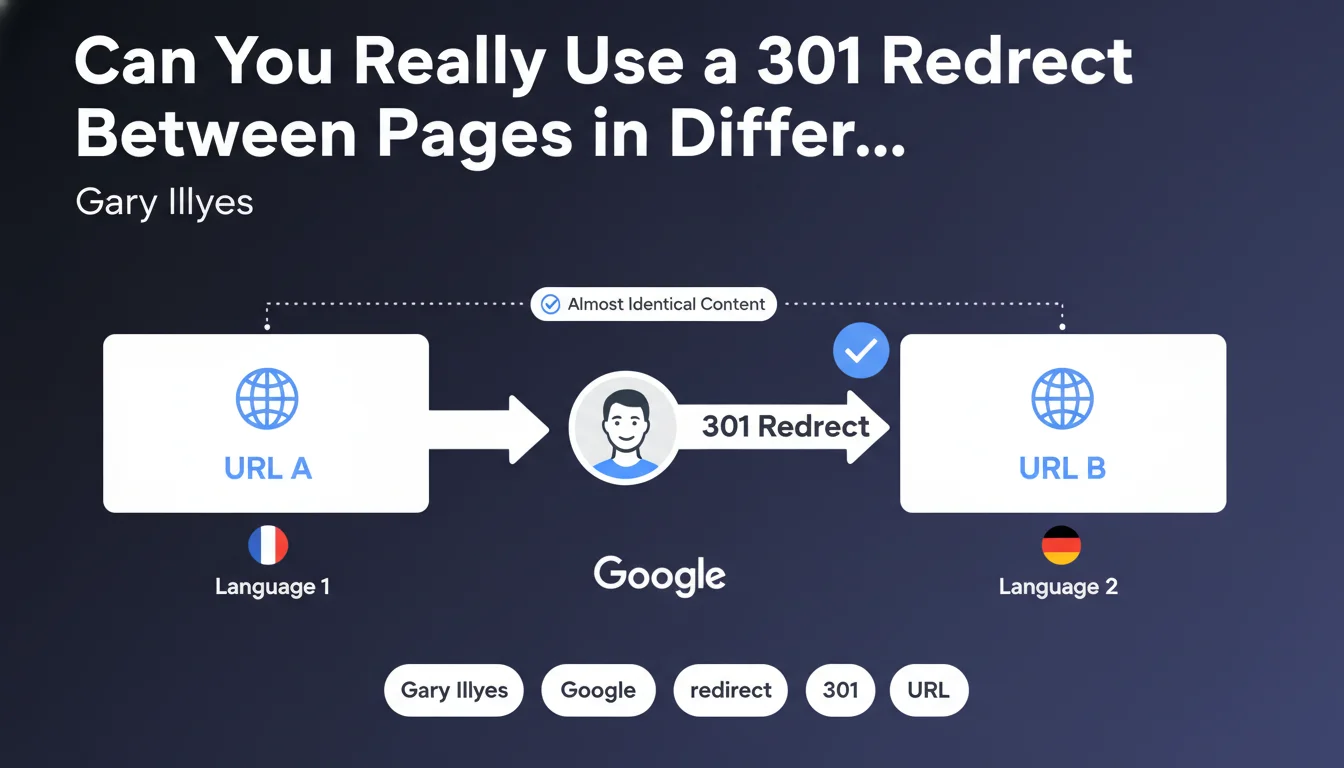
Google, through Gary Illyes, confirms that a permanent 301 redirect can be used even when two URLs present identical content but in different languages. This statement clarifies a gray area for many SEO professionals.
Traditionally, the 301 redirect was recommended only for strictly identical content. Here, Google acknowledges that semantically equivalent content in another language also justifies this type of redirect.
In what context does this practice make sense?
This approach primarily applies when a site decides to consolidate multiple language versions into a single primary language. For example, a site abandoning its French version in favor of English.
It also concerns situations where duplicate content accidentally exists in different languages, creating SEO dilution and cannibalization issues.
What are the essential conditions for this implementation?
Google emphasizes a crucial point: although the 301 redirect is possible, it must be coupled with the hreflang tag for clean and coherent implementation.
- The 301 redirect indicates that the content has permanently changed location
- The content must be semantically identical, only the language differs
- Using hreflang allows signaling remaining language alternatives
- This practice suits strategic consolidations of language versions
- It doesn't replace a properly structured multilingual architecture for active sites
SEO Expert opinion
Is this statement consistent with practices observed in the field?
This Google position indeed corresponds to field observations from recent years. Many international sites that have consolidated their language versions with 301s have not suffered penalties, provided the transition was well managed.
However, this approach remains a last resort solution. Ideally, a multilingual site should maintain distinct language versions with a classic hreflang architecture rather than systematically redirecting.
What nuances and limitations must absolutely be considered?
The major nuance here concerns user experience. Redirecting a French user to an English page can generate frustration and increase the bounce rate, even if Google technically accepts this practice.
Moreover, this recommendation doesn't mean you should systematically merge language versions. It mainly applies to cases where maintaining multiple versions is no longer viable economically or strategically.
In which scenarios is this approach not recommended?
This method is clearly inappropriate for sites wishing to maintain an active multilingual presence. If you're actively targeting multiple language markets, keeping distinct URLs with hreflang remains best practice.
It's also discouraged for sites with significant traffic coming from different language regions. Losing positions in local SERPs can have a major business impact that outweighs the gains from technical simplification.
Practical impact and recommendations
How do you properly implement this multilingual redirect?
Before any implementation, conduct a thorough traffic analysis by language and region. Precisely identify the volumes and business value of each language version.
If the consolidation decision is made, implement the 301 redirects gradually. Start with low-traffic pages to test the impact before generalizing.
- Audit your organic traffic by language and country over the last 12 months
- Identify language versions with low ROI or strategic abandonment
- Precisely map each source URL to its semantic equivalent in the target language
- Implement 301 redirects at the server level (Apache, Nginx) rather than in JavaScript
- Maintain or adjust your hreflang tags for preserved language versions
- Monitor Search Console for 404 errors and traffic drops by country
- Prepare a rollback plan in case of significant traffic loss
What critical mistakes must absolutely be avoided?
The most common error is implementing redirect chains. A French URL should never redirect to an English URL that itself redirects elsewhere. Each redirect must point directly to the final destination.
Don't abruptly remove your existing hreflang tags without thinking. If you're maintaining other language versions, adjust the hreflang configuration to reflect the new architecture.
Also avoid blindly redirecting all pages from one language to the homepage of the other language. Each page should redirect to its closest thematic equivalent.
How do you verify that the implementation is correct and optimal?
Use Google Search Console to monitor crawl errors and performance changes by country. A sudden drop in a specific market should immediately raise alerts.
Test your redirects with tools like Screaming Frog or similar to verify they return a 301 code and not 302. Also validate that redirects work from different geographic locations.
- Check HTTP status codes (301 permanent, not 302 temporary)
- Test redirect response time from different countries
- Verify the absence of multiple redirect chains
- Validate the consistency of remaining hreflang tags in the source code
- Monitor the evolution of organic traffic by language segment over 90 days
- Analyze the bounce rate and user behavior post-redirect
Managing multilingual redirects requires sharp technical expertise and a deep understanding of international SEO stakes. An implementation error can lead to traffic losses that are difficult to recover.
These complex optimizations, particularly in a multilingual context, often benefit from being supported by experienced SEO specialists. An agency with expertise in international SEO can help you develop a tailored strategy, avoid technical pitfalls, and maximize the preservation of your organic visibility during such transitions.
💬 Comments (0)
Be the first to comment.