
Official statement
Other statements from this video 2 ▾
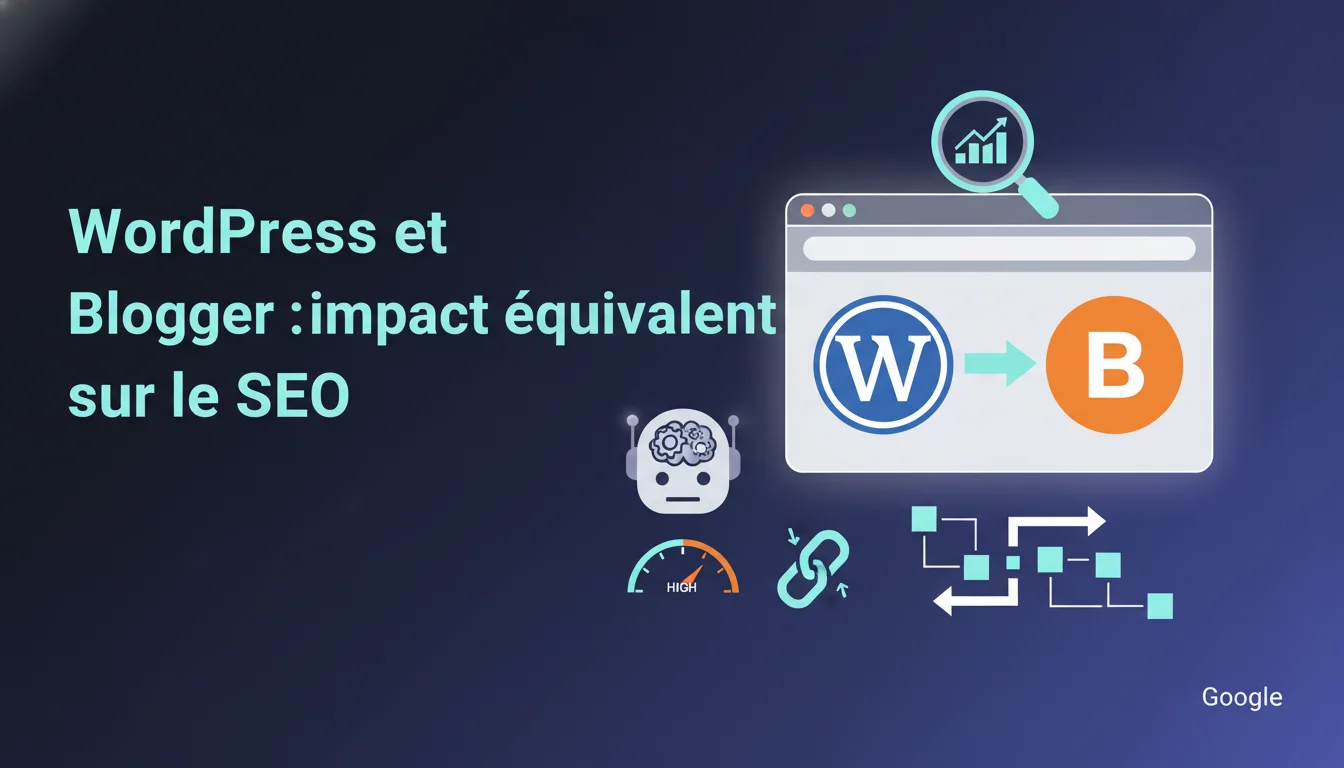
Google claims that WordPress and Blogger offer equivalent SEO potential, as long as there is excellent content and high-quality links. This statement emphasizes the fundamentals of SEO rather than the technical specifics of the platforms. For practitioners, this means that optimizing traditional ranking factors is more important than the initial technological choice.
What you need to understand
What is Google's official position on these two platforms?
Google establishes a strict equivalence between WordPress and Blogger in terms of SEO potential. This displayed neutrality aims to shift the debate from technical aspects to fundamental quality criteria.
The statement specifies that both platforms can achieve good results, implying that neither benefits from algorithmic preferential treatment. The message is clear: backend technology matters less than the concrete execution of your strategy.
On what criteria does Google base this equivalence?
Google identifies two pillars: quality links and excellent content. These factors are presented as crucial, regardless of the chosen platform.
This intentional simplification removes many technical parameters. There is no mention of loading speed, URL architecture, control of technical files (robots.txt, sitemap), or the flexibility of structured data markup. Google focuses on what generates user value rather than technical specifications.
How should we interpret this stated neutrality?
Google's discourse aims to dismantle the technological obsession that paralyzes some decision-makers. By asserting that the platform is not a discriminating factor, Google redirects to the essentials: producing relevant content and earning natural links.
This position reflects the maturity of modern algorithms, capable of effectively handling varied architectures. It also indicates that quality signals (engagement, authority, relevance) transcend basic technical choices.
- According to Google, both platforms have equivalent SEO potential
- Quality links and excellent content are the only criteria explicitly mentioned
- Google recognizes no structural advantage for either platform
- The statement intentionally avoids advanced technical considerations
- The emphasis is primarily on SEO fundamentals rather than technical optimization
SEO Expert opinion
Does this statement reflect field observations?
The practitioner reality strongly nuances this theoretical equivalence. WordPress massively dominates competitive search results, not due to algorithmic favoritism but because of its superior technical flexibility.
Blogger imposes critical structural limitations: rigid URL architecture, limited markup control, reduced internal linking capabilities, and the absence of many optimization plugins. These constraints become blocking as soon as you step outside low-competition niches.
Google is correct: Blogger can rank properly. But it omits that WordPress greatly facilitates the execution of SEO best practices. The effort curve to achieve the same result is not comparable.
What are the blind spots in this official communication?
Google does not mention the Core Web Vitals, which are a confirmed ranking factor. WordPress offers granular control (CDN, lazy loading, image optimization) that Blogger does not natively allow. [To be verified] whether this omission is innocent or strategic.
The absence of reference to crawl budget and exploration efficiency is telling. On a well-architected WordPress site, you control what Googlebot crawls in fine detail. Blogger imposes a predefined structure that can dilute your budget on less strategic pages.
The statement completely ignores the scalability dimension. Managing 50 articles on Blogger: feasible. Managing 5000 pages with complex taxonomies, multilingual management, and fine optimization: Blogger becomes a major operational handicap.
In what cases is this equivalence actually valid?
For a personal blog or a limited showcase site (fewer than 100 pages), with a simple content strategy and low competition, Blogger may indeed suffice. The technical limitations become negligible.
As soon as you target competitive queries, need a sophisticated architecture, or anticipate significant growth, WordPress becomes essential. Sites ranking in positions 1-3 for commercial terms heavily use WordPress or equivalent CMS with flexibility.
Practical impact and recommendations
What should you do if you are currently using Blogger?
Assess your real level of competition. If you are targeting low-competition niches with a limited volume of content, Blogger remains viable. Focus on producing expert content and building natural backlinks.
For broader ambitions, plan a migration to WordPress. This operation requires careful management of 301 redirects, a reconstruction of optimized URL architecture, and an algorithm stabilization period of 3 to 6 months.
How can you maximize your results on any platform?
On WordPress, leverage advanced technical capabilities: complete Schema.org markup, loading time optimization, fine control of internal linking, and thematic silo architecture for large sites.
On Blogger, compensate for the limitations with absolute editorial excellence. Your content must be significantly superior to the competition to counterbalance the technical handicaps. Invest heavily in acquiring authoritative backlinks.
What mistakes should you avoid when choosing a platform?
Do not choose Blogger just because it is free and simple. The real cost is measured in missed opportunities: unavailable SEO features, performance ceiling, difficulty in later migration when your project grows.
Conversely, do not overestimate WordPress as a magical solution. A poorly optimized WordPress installation (heavy theme, poorly chosen plugins, insufficient hosting) performs worse than a well-executed Blogger. The tool does not replace strategy.
- Audit your level of competition to assess if Blogger meets your ambitions
- Prioritize content quality and natural link acquisition on both platforms
- On WordPress, correctly configure the Core Web Vitals and technical markup
- Plan a migration strategy if you exceed Blogger's capabilities
- Regularly measure your actual performance (rankings, organic traffic, conversions) rather than just technical specifications
- Invest in high-performance hosting if you choose WordPress to not negate its advantages
❓ Frequently Asked Questions
Google favorise-t-il Blogger puisque c'est sa propre plateforme ?
Peut-on migrer de Blogger vers WordPress sans perdre son référencement ?
Les liens obtenus sur Blogger ont-ils la même valeur que sur WordPress ?
Blogger permet-il de gérer correctement le balisage Schema.org ?
Un site Blogger peut-il atteindre la position 1 sur une requête très compétitive ?
🎥 From the same video 2
Other SEO insights extracted from this same Google Search Central video · duration 2 min · published on 05/03/2013
🎥 Watch the full video on YouTube →
💬 Comments (0)
Be the first to comment.