
Official statement
Other statements from this video 8 ▾
- 1:52 Does the exclusion of pages in the Search Console really affect your site's PageRank?
- 5:31 Does proper HTML really boost your SEO ranking?
- 9:17 Do canonicals really suffice to manage duplicates without causing SEO penalties?
- 25:47 Does the noindex tag really prevent the indexing of your strategic pages?
- 31:36 Do social signals really influence Google rankings?
- 39:58 Do buying links and exchanging backlinks really lead to penalties?
- 55:24 Could excluded AMP pages really indicate a bad implementation?
- 67:02 Is Quality Content Really Enough to Rank Well on Google?
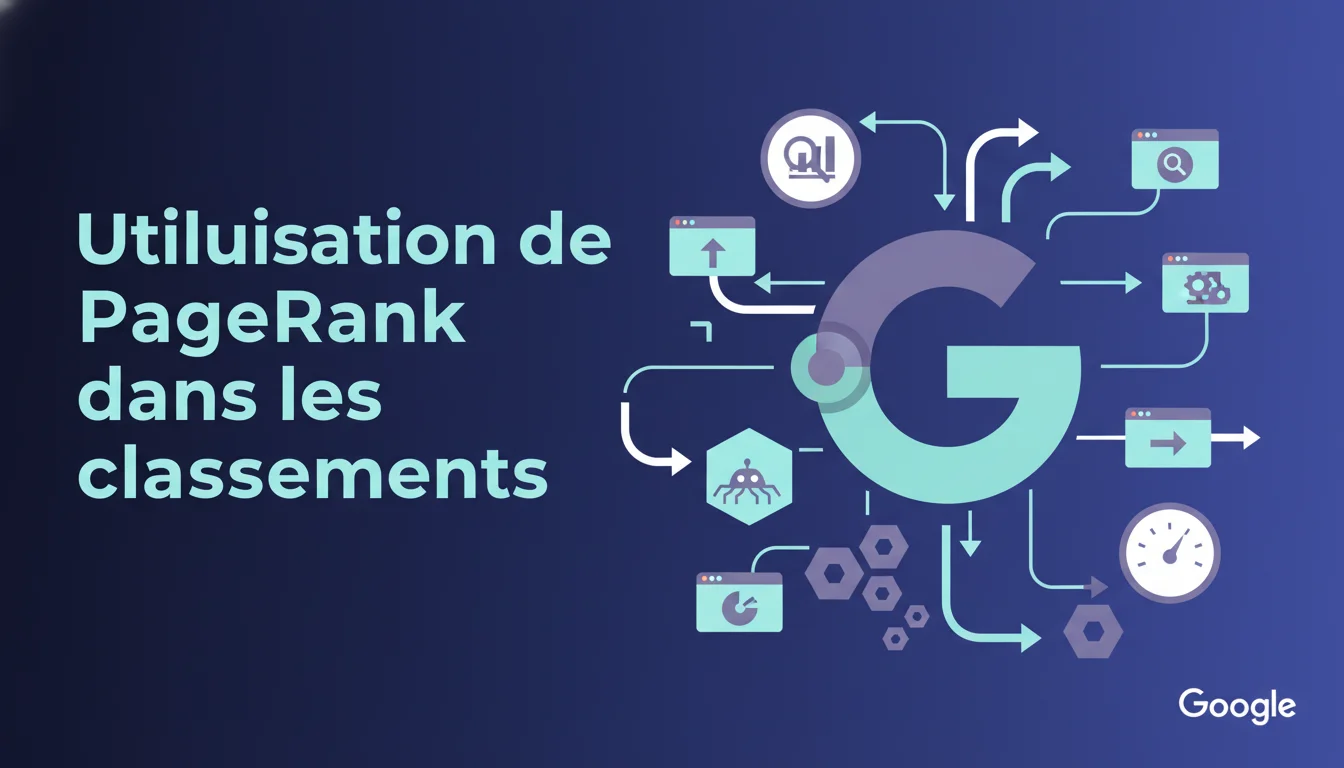
Google confirms that PageRank remains an active ranking signal, measuring a page's credibility through the quantity and quality of backlinks. Essentially, this statement validates that link building remains a crucial strategic lever for ranking. The catch? Google does not specify the exact weight of this signal or how it interacts with the hundreds of other factors in the algorithm.
What you need to understand
Why does Google maintain PageRank even though the public tool disappeared in 2016?
The public PageRank (the famous green bar in the toolbar) was removed years ago, leading to persistent confusion. Many believed that Google had abandoned this signal. Wrong. The internal PageRank algorithm continues to operate behind the scenes, evolving and refining over the years.
This statement clarifies an ambiguity: even though you no longer see a PageRank score, Google still uses it to assess the web's link structure. The lack of transparency does not mean the absence of use — it's a classic with Google.
How does PageRank actually measure a page's credibility?
The basic principle remains that formulated by Larry Page and Sergey Brin: a link from page A to page B is a vote of confidence. The more credibility page A has (through its own backlinks), the more its vote counts. It is a system of recursive popularity transmission.
The quality of backlinks outweighs quantity. A link from an authoritative site (high credibility) is worth infinitely more than dozens of links from content farms or low-grade directories. PageRank distributes this credibility in a non-linear fashion — and that's where many SEOs struggle, hoping to compensate quality with volume.
What is the difference between PageRank and third-party domain authority?
Metrics like Moz's Domain Authority (DA) or Ahrefs' Domain Rating (DR) attempt to replicate a score close to PageRank, but they are approximations based on limited indexes. The real Google PageRank relies on the entire graph of links crawled by Googlebot, with proprietary weightings and adjustments inaccessible to third-party tools.
These third-party metrics remain useful for comparative benchmarks, but they do not reflect either the exact weight or the subtleties of internal PageRank. Google sees signals that Moz or Ahrefs do not see: click-through rates, user behaviors, spam signals, manual penalties. In short, PageRank is just one piece of the puzzle — certainly important, but never alone.
- Internal PageRank continues to exist despite the disappearance of the public toolbar in 2016
- A quality link (from an authoritative site) is worth more than dozens of mediocre links
- Third-party metrics (DA, DR) are useful approximations but do not replace real PageRank
- PageRank evolves over time: Google adjusts the algorithm, incorporates anti-spam signals, and weighs differently according to verticals
- The structure of internal linking influences the distribution of PageRank on your own pages
SEO Expert opinion
Does this statement align with practices observed in the field?
Yes, largely. Empirical tests conducted by the SEO community over the years confirm that a solid backlink profile remains correlated with better rankings. Sites that rank in the top 3 for competitive queries almost systematically have a more robust link profile (in terms of quality) than those on page 2.
Now, let's be honest: correlation does not imply causation. PageRank alone is never enough. Sites with a mediocre link profile can rank if the content is ultra-relevant, if the search intent is perfectly addressed, if the Core Web Vitals are top-notch. But all things being equal, PageRank tips the balance.
What nuances should be applied to Google's statement?
Google says "PageRank is used" but does not specify its relative weight, or how it evolves with different verticals. For YMYL (Your Money Your Life) queries (health, finance), PageRank probably matters less than perceived E-E-A-T or the freshness of content. For highly competitive commercial queries, it becomes central again.
[To be verified] Google does not specify how it handles internal links in the calculation of PageRank. Officially, internal linking distributes PageRank within a site — but what is the impact ratio between an external link and an internal link? No one knows precisely. Tests suggest that a quality external link is worth 5 to 10 times more than an internal link, but that's field knowledge, not official science.
Another fuzzy point: thematic PageRank. Google has patented variations that weigh links according to thematic proximity between source and destination. A link from a tech blog to another tech blog would carry more weight than a link from a cooking blog. But Google has never publicly confirmed the use of this variant in production.
In what cases does this signal become secondary or even unnecessary?
For ultra-specific niche queries with little competition, PageRank has little weight. If you are the only one who has written a detailed guide on an obscure topic, you will rank even with zero external backlinks — the relevance and uniqueness of the content are enough.
Similarly, for local queries, geographical signals (Google Business Profile, local citations, NAP consistency) largely take precedence over classic PageRank. A plumber in Lyon does not need backlinks from Le Monde to rank for "emergency plumber Lyon 6" — he needs Google reviews, citations in local directories, and a technically sound website.
Practical impact and recommendations
What concrete steps should be taken to optimize a site's PageRank?
First priority: audit your current backlink profile. Identify toxic links (link farms, detected PBNs, spam comments) and disavow them via Google Search Console. One bad link from a penalized network can undermine all your credibility.
Next, build a quality link-building strategy. Aim for links from high-authority thematic sites: media in your sector, influential blogs, institutional partners. A contextual link in an editorial article is worth 10 times a footer or sidebar link. Always prioritize editorial relevance.
What mistakes should absolutely be avoided in a PageRank strategy?
A classic mistake: buying cheap backlinks packages on Fiverr or obscure platforms. These links often come from PBNs (Private Blog Networks) identified by Google, and you risk a manual or algorithmic penalty (Penguin) that will annihilate your visibility.
Another trap: neglecting internal linking. You can have an excellent external backlink profile, but if your PageRank is not intelligently redistributed to your strategic pages (landing pages, product sheets), you waste juice. Create a semantic cocoon, link your content logically, and avoid orphan pages.
How can I check if my site is effectively leveraging distributed PageRank?
Use Screaming Frog or Oncrawl to simulate the distribution of internal PageRank via the calculation of InRank or internal PageRank. These tools show which pages are receiving the most juice through linking. If your high business value pages are undernourished, reconfigure your link structure.
Also monitor ranking metrics for competitive queries. If, despite good content and impeccable on-page optimization, you are stagnating on page 2, it's often a PageRank (backlink) deficit. Compare your link profile with that of competitors in the top 3 using Ahrefs or Majestic — and close the gap.
- Audit and clean the backlink profile (disavow toxic links)
- Build quality backlinks from authoritative and thematically relevant sites
- Optimize internal linking to redistribute PageRank to strategic pages
- Avoid link farms, PBNs, and bulk backlink purchases
- Analyze internal PageRank distribution with Screaming Frog or Oncrawl
- Compare your link profile to competitors on your target queries
❓ Frequently Asked Questions
Le PageRank est-il encore aussi important qu'avant pour le SEO ?
Peut-on améliorer son PageRank sans backlinks externes ?
Les liens nofollow transmettent-ils du PageRank ?
Comment savoir si mes backlinks sont de bonne qualité pour le PageRank ?
Le PageRank d'une page diminue-t-il si elle pointe vers beaucoup d'autres pages ?
🎥 From the same video 8
Other SEO insights extracted from this same Google Search Central video · duration 1h08 · published on 24/01/2019
🎥 Watch the full video on YouTube →
💬 Comments (0)
Be the first to comment.