
Official statement
Other statements from this video 9 ▾
- 1:01 Comment Google crawle, indexe et classe-t-il vraiment vos pages ?
- 1:34 Le PageRank pilote-t-il vraiment les priorités de crawl de Google ?
- 1:34 Le PageRank pilote-t-il vraiment la découverte des pages par Googlebot ?
- 2:36 L'index Google se rafraîchit-il vraiment tous les jours ?
- 3:17 Comment l'indexation incrémentielle rapide de Google change-t-elle la donne pour le référencement ?
- 4:13 Comment Google indexe-t-il vraiment vos mots-clés ?
- 4:13 Comment Google indexe-t-il réellement vos contenus ?
- 5:49 Comment Google utilise-t-il vraiment ses 200+ facteurs de classement ?
- 5:49 Les 200 facteurs de classement Google : mythe ou réalité exploitable ?
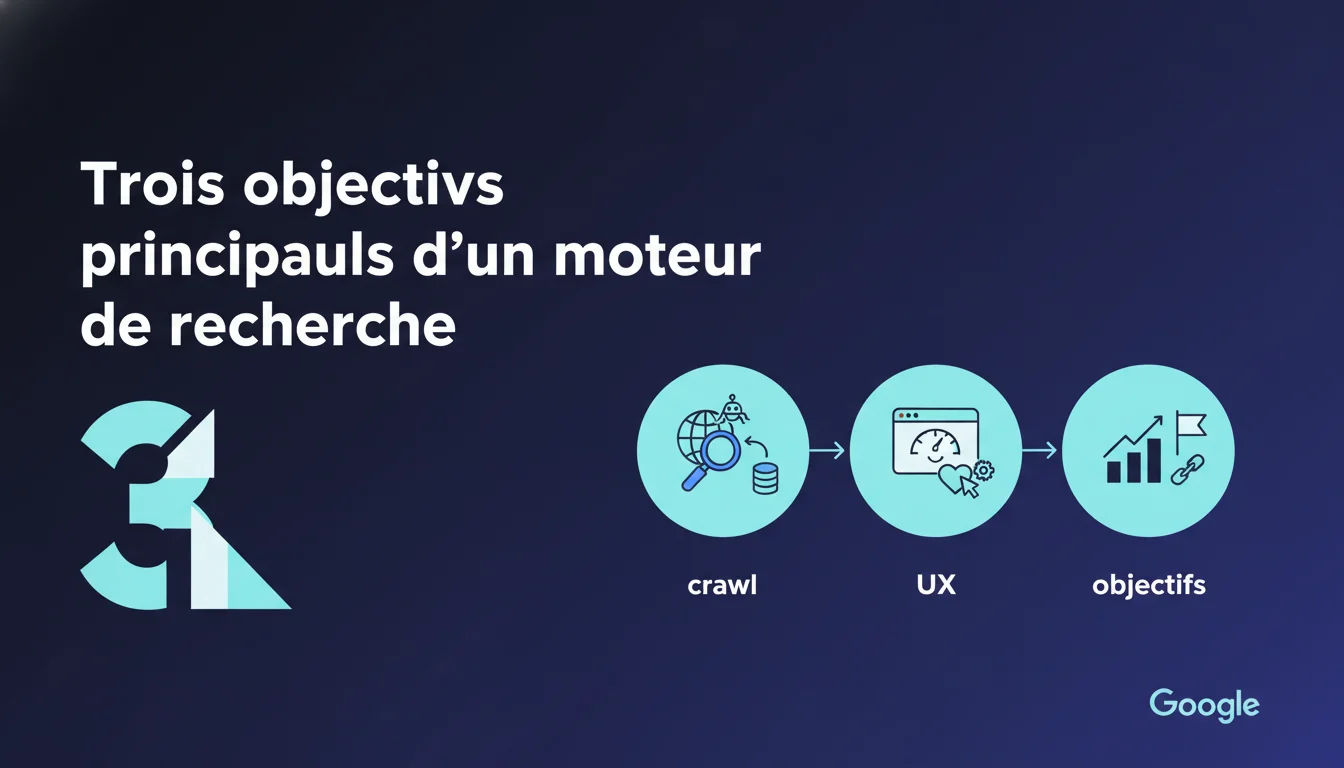
Google reminds us that its engine is built on three pillars: thoroughly crawling the web, indexing the discovered pages, and then ranking them by relevance. This statement may seem basic, but it illuminates the hierarchy of priorities: without crawling, there's no indexing; without indexing, there's no ranking. For SEO professionals, this means that addressing upstream issues (crawlability, crawl budget) takes precedence over content optimization or backlinks.
What you need to understand
Why does Google emphasize these three specific steps?
This wording is not incidental. Google describes its operation as a sequential funnel: first discovering content, then storing it, and finally evaluating it. Each step depends on the previous one.
If your page is never crawled, it cannot be indexed. If it is not indexed, it will never be ranked, even if your content is brilliant and your backlinks are strong. This hierarchy imposes a debugging logic: always start by checking crawlability before blaming the ranking algorithm for ignoring you.
What does “crawling thoroughly and exhaustively” really mean?
“Thoroughly” suggests that Google aims to cover the maximum number of available pages on the web. “Exhaustively” implies that it does not settle for surface levels but explores deeper layers within the structure.
In practice, this does not mean that all your pages will be crawled daily. Google allocates a crawl budget per site, influenced by domain authority, content freshness, and technical quality. A slow site, with server errors or duplicate content, will see its budget wasted on unnecessary pages.
How does Google determine which pages are “the most relevant”?
The statement remains intentionally vague regarding the ranking criteria. Google refers to “relevance” without detailing the hundreds of signals involved: backlinks, content, freshness, user experience, E-E-A-T, etc.
This abstraction protects its algorithm but creates a challenge for practitioners. It is impossible to know which lever carries how much weight. What is known is that relevance is contextual (query, intention, location) and evolving (signals change over time with updates). A/B testing and field observation remain the only reliable compass points.
- Crawlability: If Google cannot access your pages (robots.txt, noindex tag, server errors), they do not exist to the engine.
- Crawl budget: Optimize it by eliminating unnecessary pages, fixing redirect chains, and improving server speed.
- Selective indexing: Google does not index everything it crawls. Duplicate content, low quality, or lack of added value block indexing.
- Ranking: The most opaque phase. There is no guarantee that your optimizations will be rewarded immediately or sustainably.
- Continuous monitoring: Monitor Search Console for drops in crawling, indexing errors, or unexplained position declines.
SEO Expert opinion
Does this statement truly reflect behaviors observed in practice?
Yes, but with important nuances. Google does crawl the web at scale, but the actual crawl budget allocated to a given site is often much lower than what publishers expect. Low-authority or slow sites may see large portions of their structure ignored for weeks.
Indexing is not automatic either. Many owners discover that their pages, although crawled, are never indexed. Google talks about “quality” but the criteria remain opaque. Sometimes, perfectly legitimate pages are excluded without a clear explanation. [To be verified]: Google claims to index “the most relevant”, but no public documents detail the minimum quality threshold.
What contradictions arise between this statement and actual practices?
The main discrepancy concerns the promise of exhaustiveness. Google cannot crawl everything, let alone index everything. Sites with millions of pages (e-commerce, aggregators) find that only a fraction is regularly explored.
Another point: Google insists on “the most relevant first”, but many SEOs observe SERPs cluttered with mediocre content or outdated results. Theoretical relevance does not always guarantee an optimal user experience. Ranking remains a balance between hundreds of signals, some of which are contradictory (freshness vs authority, for example).
Should this statement be taken literally or as an ideal?
This is a strategic goal, not a factual description of every crawl. Google aspires to be exhaustive but makes compromises for technical (server resources, energy costs) and commercial (priority to sponsored content, featured snippets) reasons.
For SEO professionals, this means: do not rely on Google to compensate for your technical weaknesses. If your site is poorly structured, slow, or unreadable for bots, you will be at a disadvantage. The statement is not a service guarantee, it is a reminder that technical fundamentals dictate everything. Focus on what you can control: accessibility, speed, logical architecture.
Practical impact and recommendations
What should be prioritized to ensure Google can crawl your site?
Start by auditing your robots.txt file and your meta robots tags. A common mistake is inadvertently blocking important sections or leaving obsolete directives after a refresh. Test with the URL Inspection tool in Search Console.
Next, review your crawl budget in the crawl reports from Search Console. If Google primarily crawls unnecessary pages (filter facets, empty tag pages, old versions), you are wasting your budget. Streamline the structure, use canonicals wisely, and block unnecessary URLs via robots.txt or noindex.
How can you optimize the indexing of your strategic pages?
Indexing does not solely depend on crawling. Google evaluates the perceived quality: unique content, depth of treatment, engagement signals. Avoid automatically generated content without added value, excessively thin pages (fewer than 150 words), or internal duplicates.
Use strategic internal linking to send clear signals about your priority pages. An orphaned page, even if excellent, risks never being indexed. Force the indexing of important new content through the Indexing API (for structured events) or simply by integrating it into your XML sitemap and main navigation.
What mistakes should you avoid to not sabotage your ranking?
The first mistake: thinking that being indexed is enough. Thousands of indexed pages that are poorly ranked provide no benefit. Focus on thematic relevance: each page should fulfill a specific search intent with in-depth content and evidence of authority (consistent internal and external links).
The second mistake: ignoring Core Web Vitals and mobile experience. Google ranks based on relevance, yes, but with equal relevance, a fast and user-friendly site prevails. Invest in technical optimization: LCP under 2.5s, CLS under 0.1, FID under 100ms. These metrics are not just gadgets; they directly influence ranking in many competitive sectors.
- Audit your robots.txt file and remove accidental blockages on strategic sections.
- Analyze server logs or Search Console reports to identify crawled pages that are not indexed.
- Reduce click depth: no important page should be more than 3 clicks from the homepage.
- Clean up low-quality content: merge, redirect, or remove thin or duplicate pages.
- Optimize server speed (TTFB) and page weight to maximize crawl budget.
- Regularly monitor Core Web Vitals and rectify regressions as soon as they appear.
❓ Frequently Asked Questions
Google crawle-t-il toutes les pages de mon site ?
Pourquoi certaines pages crawlées ne sont-elles jamais indexées ?
Comment savoir si mon budget crawl est bien utilisé ?
Le classement dépend-il uniquement du contenu ?
Faut-il prioriser le crawl, l'indexation ou le ranking dans mes optimisations ?
🎥 From the same video 9
Other SEO insights extracted from this same Google Search Central video · duration 7 min · published on 23/04/2012
🎥 Watch the full video on YouTube →
💬 Comments (0)
Be the first to comment.