
Official statement
What you need to understand
Why Isn't Traffic a Quality Criterion for Google?
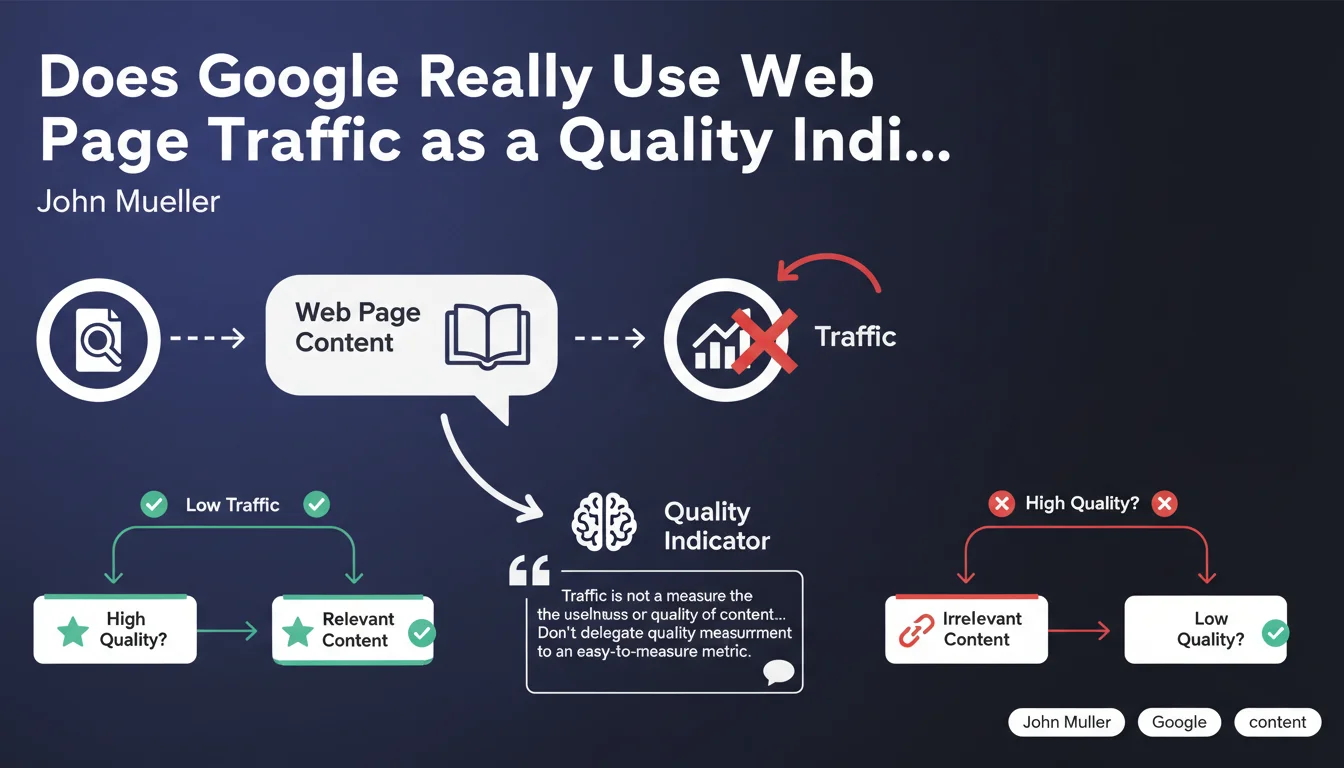
Google has its own metrics to evaluate content quality, based on semantic analysis, relevance, expertise, and user experience. Traffic volume is a consequence of multiple factors (topic popularity, seasonality, marketing strategy) that have no connection with the intrinsic value of the content.
A page can generate few visits while perfectly answering a very specific query (long tail). Conversely, viral content can attract massive audiences without necessarily being relevant or reliable.
How Does Google Actually Measure Page Quality?
Google's algorithms analyze direct signals such as the depth of topic coverage, content structure, information freshness, and E-E-A-T signals (Experience, Expertise, Authoritativeness, Trustworthiness). Behavioral indicators like time spent or bounce rate are also evaluated, but within their context.
Google cannot access the actual traffic data of most websites. It only has Analytics data (if installed), and even then, in an aggregated and anonymized manner in compliance with GDPR.
What's the Difference Between Traffic and User Engagement?
Raw traffic (number of visitors) is a quantitative metric that says nothing about user satisfaction. Engagement, on the other hand, measures how visitors interact with content: visit duration, scroll depth, clicks to other pages.
Google can observe certain engagement signals through clicks in search results (CTR), quick returns to SERPs (pogo-sticking), or subsequent clicks. These behaviors reflect perceived relevance, not traffic volume.
- Traffic is not a direct ranking signal for Google's algorithms
- Google evaluates quality through intrinsic criteria related to content and user experience
- A low-traffic page can be excellent if it precisely answers a search intent
- Engagement metrics are more relevant than raw visitor volume
- Google does not have access to Analytics data from the majority of sites to judge quality
SEO Expert opinion
Is This Statement Consistent with Field Observations?
Absolutely. After 15 years of SEO analysis, I regularly observe that pages with confidential traffic rank excellently on ultra-targeted queries. The myth of traffic as a ranking factor probably persists due to confusion between correlation and causality: well-positioned pages generate traffic, but it's not the traffic that makes them rank well.
A/B tests I've conducted show that artificial traffic increases (via advertising, for example) do not improve organic positions. On the other hand, optimizing content quality directly impacts ranking, which then leads to an increase in natural traffic.
What Nuances Should Be Added to This Statement?
While direct traffic is not a factor, behavioral signals from that traffic may be indirectly. Content that naturally generates recurring traffic, social shares, spontaneous backlinks, and brand mentions sends positive signals to Google.
Furthermore, a site with significant and regular traffic often benefits from better technical infrastructure, increased content freshness, and strengthened domain authority. It's not the Analytics numbers that matter, but the qualitative consequences of a vibrant and popular site.
In Which Contexts Is This Rule Particularly Important?
This clarification is crucial for B2B or niche sites that deal with highly specialized topics with limited search volumes. These sites can have excellent SEO with little absolute traffic, but a high conversion rate.
It's also essential to avoid sacrificing quality for popular topics that are distant from your expertise. Better to have 100 ultra-qualified visitors on expert content than 10,000 irrelevant visitors on generic content.
Practical impact and recommendations
What Should You Do Concretely to Optimize Quality as Perceived by Google?
Focus on the depth and comprehensiveness of your content rather than short-term traffic generation. Develop real expertise on your topics, with original data, in-depth analyses, and reasoned positions.
Optimize engagement signals by structuring your pages to facilitate reading (clear headings, short paragraphs, relevant visuals). Add strategic internal links to encourage navigation and increase time spent on the site.
Measure the actual performance of your content with relevant metrics: click-through rate from SERPs, average engagement time, scroll rate, conversions. These indicators better reflect quality than raw traffic volume.
What Mistakes Should You Absolutely Avoid?
Don't try to artificially inflate your traffic through dubious techniques (buying bot traffic, deceptive redirects, clickbait). These practices won't improve your SEO and may even harm your algorithmic reputation.
Avoid judging your content quality solely on traffic performance. A page that converts well with 50 monthly visitors is more valuable than a page with 5,000 visitors without engagement or conversion.
Don't neglect long-tail content on the grounds that it generates little traffic. These pages often form the foundation of your topical authority and attract the most qualified visitors.
How Can You Verify That Your Strategy Aligns with This Reality?
Audit your content by cross-referencing organic positions and traffic volume. Identify well-positioned pages with low traffic: they validate that Google recognizes their quality independently of their popularity.
Analyze engagement metrics in Google Search Console and Analytics. Compare user behavior on your low-traffic pages versus high-traffic ones: you'll often find that quality is not correlated with volume.
Reorient your editorial strategy toward expertise and relevance rather than search volumes. Target topics where you can provide unique value, even if the potential audience is limited.
- Prioritize depth of coverage rather than content quantity
- Measure user engagement (time spent, scroll, interactions) rather than raw traffic
- Develop recognized expertise on niche topics with high conversion potential
- Optimize behavioral signals visible to Google (SERP CTR, pogo-sticking)
- Structure content to promote readability and internal navigation
- Don't abandon long-tail content deemed underperforming in traffic
- Regularly audit the positions/engagement correlation to validate perceived quality
- Avoid any artificial technique for traffic inflation
💬 Comments (0)
Be the first to comment.